Call of the Wild: CGI dogs have their day in new Disney adventure
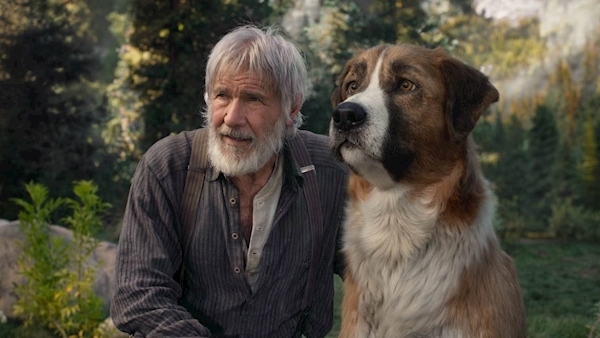
Movie magic unfolds before your eyes in , the tale of a big-hearted dog whose life is turned upside down.
Based on Jack London’s much loved novel, Buck is stolen and transplanted to the wilds of Canada during the 1890s Gold Rush.
Buck is a strong, brave and handsome dog who finds a friend in Harrison Ford’s character. But incredibly, the dog is not real.
He’s been brought to screen via cutting-edge technology in a blend of live-action and animated filmmaking from veteran director Chris Sanders. It’s the first time the animator behind and has worked in live action.
“The colossal animated elements made me feel like there was something that I was familiar with and that I could hold on to, and there was going to be a bunch of stuff I was going to have to learn and learn by doing,” says Sanders.
“But then I knew that at the end of the day, I would always be returning to animation, working with animators in a very tedious process that I’ve become very adapted to!”
Anything that humans touch in the film, except for Buck and the other dogs, is real. And an early encounter with top Canadian visual effects firm MPC persuaded him that they could bring Buck to life.
“They showed us some wolves that they had built for another film. I storyboarded a series of expressions and I asked them if they could take the wolf and have him do all of those expressions. The animators did a brilliant job of getting these expressions onto this wolf.
The response we got was really positive. The executives that we showed this footage to, they all laughed exactly where they were supposed to laugh. Seeing them accomplish that made me feel comfortable that we would be able to do anything we needed to do.”
While the tech wizards worked their magic, some major inspiration also came from characters of both the two-legged and four-legged variety.
“My wife, Jessica Steele Sanders, saved our butts because we began the process by casting real dogs,” explains the filmmaker. “MPC said the best way to do this was to find a real dog that represents each of the dogs, and scan them.
And they would work from those because we will get a more believable dog, and it will shortcut the creative process.
“We had every single dog cast and scanned except our lead Buck. He’s such a specific breed as described in the book and we couldn’t find one. Buck is a combination of a St Bernard and what they call a farm collie. It makes his face very handsome, because it takes that St Bernard face and it gives it more length.”
MOTION CAPTURE
After exhausting their search, the filmmakers were considering making Buck a Bernese mountain dog instead, though Sanders had concerns over whether their mostly black fur would stand out for nighttime scenes.
But he hadn’t reckoned on the determination of his wife, who found Buck’s breed mix in a rescue centre hundreds of miles away.
“They’d named him Buckley and she thought: ‘This is a sign.’ She drove out to Kansas, drove for two days while I stayed on set. She came back to set with him. And we said, everybody said: ‘That’s the dog’.”
The production also employed the services of acclaimed motion capture performer Terry Notary, a former Cirque du Soleil artist and stunt double. He has become renowned for portraying creatures and animals in movies like and .
“I thought it was an amazing idea. One of my first questions was the very same question that Harrison asked when we first sat down with him: how in the world do we deal with a missing character who’s the lead of the film?
“Terry Notary stood in for Buck, not just for movement, so the camera knew how to track his movement. But also we discovered is that Harrison and I and Terry could sit down and unlike having a real dog on set that would have a certain behaviour that he’d been trained to do on that particular day, have a conversation between Thornton and Buck in a sense and decide what we wanted the scene to be because Terry could doanything. We ended up with a very directable dog as lead of the film.”
An established animator who’s worked with both Disney and Dreamworks, Sanders is perhaps best known for writing and directing , a movie so successful that it spawned a number of sequels and several TV series. He also voiced the character of Stitch, and first came up with the idea while working on another project.
“In the waning days of as we were finishing it up, one of the things I was making an observation on was how often we talk about how we’re going to kill our villains.
It occurred to me what if instead of killing our villain, we redeemed him, and made our villain the hero? And really at the very base of is the idea that we redeem a villain and make him a hero.”
DREAM JOB
Although he grew up in a creative family and had inherited his father’s passion for drawing, Sanders says he never imagined he could pursue animation as a career.
“I loved Disney animation. And I never in my wildest dreams thought I would ever work there.
But that all changed when my grandmother was reading the newspaper one night, and she said: ‘Hey, there’s a school out in California that trains people to be artists at Disney Studios. It’s called Cal Arts.’
And that was the only place I ever applied to for college. I lucked out and got in and that began my career.
“My dad loved to draw, and he loved to paint. And I remember one time he told me: ‘There’s a limit to what you can build, but you can draw anything.’ And I thought that was a really inspiring thing.”
, for all its cutting-edge technology, has a lovely old-fashioned quality to it and is evocative of family-orientated adventure stories that were common in decades past but are increasingly rare. “You’re right — I don’t see those films that much anymore. It was fun to be able to bring one of those back,” he says.
“I think because of the source material, in this case, being a novel that is very well known and has been around forever, we wanted to give it a bit of a old fashioned look.
We wanted it to harken back to the films I saw when I was a kid.
and and some of those old Disney films. Those more epic family films that have a lot of heart, a lot of adventure and a lot of emotion are wonderful to see.”















