Knowing the signs of skin cancer
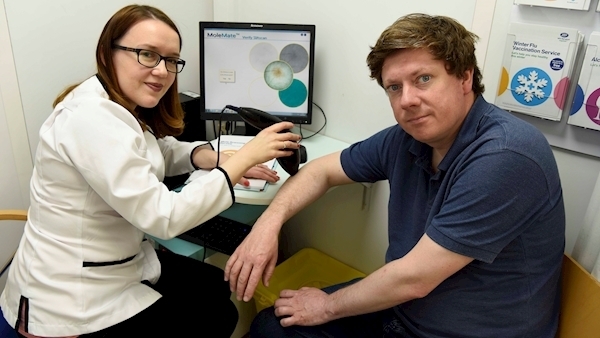
About 12,000 people are diagnosed with skin cancer in Ireland every year. visits Boots’ mole screening service where moles are scanned and the results sent away to British labs.
The other morning, as I readied my two boys for summer camp, I called over the eldest, seven-year-old Fionn. “Oh, no suncream,” he said to me. “I hate this.” I know how he feels. I hate it too. The smell of the stuff, its sticky, slippy gooiness and the way, when you’re on the beach, it mixes with sand and makes things terribly uncomfortable.
In fact, more often than not, when it comes to sunscreen I just don’t bother.
Having dropped the boys to camp on what is a hot but somewhat overcast day, I make my way into Stephen’s Green Shopping Centre where I have an appointment with Boots’ new Mole Scanning Service. Like most people, I have moles all over the place. I have never really worried about them but I have had some removed over the years as a precaution.
When the opportunity to get them tested arises, I jump at it. No harm I figure and in the grand scheme of things, it’s not too expensive. The service is available in 17 of the pharmacy’s 87 stores across Ireland and has been developed in partnership with ScreenCancer.
On the morning of my consultation I meet pharmacist Anna Jurak.
“Every situation is different,” she says. “So people come to us for all sorts of reasons.
We are not here to advise people on what to do, really we take pictures and we send them onto dermatologists who then send you the results. We never find out the results unless you decide to come back and tell us.
"We scan the moles we give you a number and they send you another number with which you can check your results.” Anna says Boots has a schema called ABCDE that it uses as a guide for people who might be worried about moles.
People are asked to look for changes in symmetry, changes around the borders of the mole, a change in colour, a change in diameter and any other signs of the mole evolving.
“If you’re worried,” says Jurak, “get them checked.”
Before we get to work there are a few routine questions to get through around tattoos, excessive hair and pacemakers. I’m asked about my sunburn history which, bar an awful belt in Connemara in my college days, isn’t too bad. There is a little raising of the eyebrow from Anna when I tell her about my 10-year stint living in Italy and we both agree that I could probably do a little better when it comes to protecting my skin.
As the software loads, a round turquoise frame with a folder appears on screen, followed by a picture of a male mannequin, replete with shaved testicles (I didn’t know that was a thing). I’m asked for the location of the first of my four moles. As it happens, a new invader popped up on my abdomen some four months ago which, when it first appeared, was a bit itchy.
Jurak pops a little red dot on the mannequin. I’m then told I will be rubbed with some alcohol. It’s all rather painless and non-invasive, though it does take a bit of skill on Juark’s part to get the scanner right over the middle of the mole. When the shot of the mole shows up on screen, it is quite an eye-opener. It’s positively alien and ugly. There are five picture versions of it which, Jurak explains, are the various levels of the mole that will be analysed by a lab of dermatologists in Britain.
The process is repeated three times on different parts on my body and it takes about half-an-hour. It’s all pleasant and Jurak’s bedside manner makes it easy to endure.
Four days later, I receive a text message with a code and a link. The results are good and all four moles are classified as “Normal”.
Other men are not so lucky. According to the Irish Cancer Society, about 12,000 people are diagnosed with skin cancer in Ireland every year. More men than women are diagnosed, with a ratio that works out at about six men for every four-and-half women.
Thankfully, the majority are non-melanoma skin cancer. However, there is one cancer death a week involving men who work outdoors.
“Those are really preventable,” says Roseleen Flaherty, cancer information nurse with the Cancer Health Line.
There is a health change habit that has to happen. If you think back a few years ago there were no hard hats and no hi-vis vests and that has all changed now.
"The same has to happen when it comes to sun protection and it is happening, particularly among bigger construction firms.”
Earlier this year the Irish Cancer Society teamed up with the Irish Congress of Trade Unions to promote the SunSmart Code among its 750,000 workers. “Not only are workers going to be enrolled in courses and supported through the code but the Health and Safety Authority (HSA) are now being given a guide so employer protection measures can be taken for the outdoor worker and employee to have sun protection.”
Among the measures are limiting a worker’s exposure to the sun and harmful UV rays between 11am and 3pm, limiting exposure when the UV index is higher than three, making sure breaks are taken out of the sun, making sure workers are covered up and providing workers with sunscreen with a UPV of 30 or above and sunglasses.
“It is also about education,” says Flaherty. “Letting men know that burning is not good, tanning isn’t good either. There has to be a change in mindset. It is slowly coming around. So prevention is the big thing and getting the message out there.”















