The coastal town fighting back against a seagull infestation
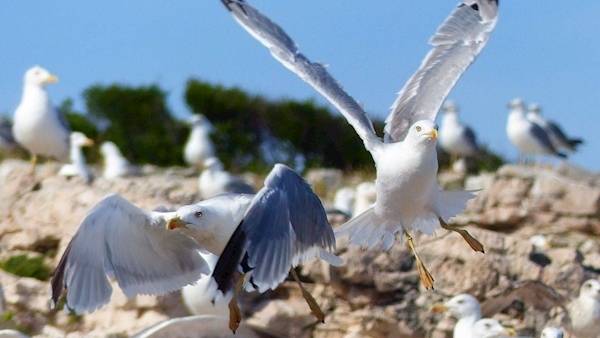
Balbriggan is suffering from a serious seagull problem but residents are fighting back, writes
ED GILDEA had murder on his mind when he climbed through a skylight window in his own home.
It was early in an April morning last year, somewhere around 3am, when he was driven to act with serious intent.
There were two seagulls on the roof of his home in the area known as Bath Road in the north Dublin town of Balbriggan. Their residence suggested they were incapacitated, unable to fly away.
Ed couldnât put up with it anymore. He earns his living driving trucks, which requires him to start at 4am most days. He needs his sleep. Yet for months, he could barely get a wink with the racket from the roof.
So at the end of his tether he wanted to kill them. He went out onto the roof, but survival instincts got the better of the pair of birds and they managed to leap beyond his reach.
âThatâs what I was reduced to,â he says.

âThey had made my life a misery. I have a legal obligation to be rested because I drive heavy goods vehicles, but it was broken sleep all the time. I tried sleeping downstairs, in other rooms, but it was no good. It was the same for the whole family. Nobody should have to put up with that.â
Ed Guiney is not alone in Balbriggan. The coastal town often feels under siege from seagulls. The fallout includes small children being kept indoors and school children not being allowed to eat outdoors. There has been physical damage to homes and businesses and physical risk to people who attempt to remove nests.
Ed Guiney is just one of dozens of people who claim they cannot sleep with the racket. Scientific studies give rise to concern that the birdâs dropping may present a serious health hazard, particularly to the old and the young.
Not everybody agrees that a crisis of sorts exists. The conservation body, Birdwatch Ireland, is of the opinion that a sledgehammer is being used to smash a nut.
But there is official acknowledgement of a serious issue. The Department of Culture, Heritage, and the Gaelteacht has given conditional permission to allow the removal of nests and eggs from homes and businesses, although many see this as a fob-off rather than a solution.
The local authority in the area has conducted a unique survey of birdsâ nests in the town in response to the widespread concerns. The survey used drones to attempt to quantify the extent of the nests, and while the work was not comprehensive it did produce some startling results.
So a serious issue does exist. What is unclear is whether it is serious enough to force the State to take a leading role in protecting the health of the townâs citizens. And some among those citizens feel like they are indeed at the end of their tether.

âIf I had a gun, Iâd shoot them all,â says Anne Cullen, a grandmother who has lived in the town all her life. âThey are unreal. I canât let my grandchildren out of my home during Springtime when theyâre at their worst. I donât even like letting the dog out because they go for him too.
âWhen you canât go out in your back garden it really is a big deal.â
Balbriggan clings to the north Dublin coast, about 30km from the capital. Like many settlements within shouting distance of the stateâs cities, it has grown as a commuter hub in recent decades with a population now heading towards 26,000.

Within the last eight years or so, the population of seagulls has also increased exponentially, according to residents. Different reasons are given for this. Birdwatch Ireland points towards an increasing migration of gulls to towns and cities, particularly in search of easy food.
Locally, many believe the gull problem stems from the closure of Balleally landfill in north Co Dublin in late 2012. Gulls thrive on the offerings presented by a landfill.
This is common throughout the world. And, in keeping with the closure of other dumps in other countries, the towns near Balleally, including Balbriggan, Howth and Skerries, have all reported a huge increase in the gull population since the closure.
The effects have been devastating for some. Don Costigan, a retiree who has lived most of his life in Balbriggan, considered the gulls to be part of the fabric in a coastal town.
âWeâve always had the seagulls. Going back years Iâd always feed them and thought that we were feeding the same gulls when they came back every year. But then, over a time, noticed that they were 15 or 16 where there had been three of four. And it went on like that.â
Costigan didnât just encounter the gulls out in the green spaces in the Hampton Cove estate, which looks out on the Irish sea. Pretty soon, they were making a racket on his roof.
âWe had solar panels on the roof for less than a year at the time. They were up there and they can see the water, or thought they could on the panels so they kept banging on it and broke the panels.â
A friend of Costiganâs, retired Revenue official Tom Cardiff, had also been experiencing the nuisance of the birds, but it went beyond that one afternoon a few years ago when he was visiting a neighbour.
âThis womanâs two-year-old grandchild was stuck in the house. The child was screaming that she wanted to go out and play, but her grandmother simply couldnât let her because the gulls would be down like a flash.â

The damage wasnât just to homes. Down the road from Balbriggan, MĂĄire NĂ OdhrĂĄin, the principal of Realt Na Mara primary school, outside Skerries, came into school during a holiday to check that all was well. She discovered that the ceiling of a three-room prefab had collapsed during the break.
âIt was really wet that summer,â she remembers. âAnd the roof had come in with all the rain but it had been hugely weakened by the gulls picking at it constantly.â
She wrote to the Department of Culture, Heritage and the Gaelteacht about what she saw as a growing problem, and received a standard polite response.
Since then, little has changed. Children are not allowed to eat lunch in the yard, whatever the weather.
âThey canât bring a morsel of food with them,â says Ms NĂ OdhrĂĄin. âWe had the problem of the gulls swooping down and taking the food from their hands. If the children were eating in the yard the seagulls would know within a week that the food was there and theyâd all be back at it.â
While individuals like Ms NĂ OdhrĂĄin wrote to the authorities about the problem, it didnât appear that anybody was listening. With that in mind, an ad hoc committee was formed by Tom Cardiff, Don Costigan, and fellow concerned citizens, including retired journalist Gene McKenna.

With their varied background, and, between them, several careers working in, or in near proximity to, the apparatus of State, they knew their way around.
The committee organised for a survey of nests in the town, recruiting another dozen concerned citizens to help. They also got stuck into researching the effects of the urbanisation of large bird numbers, lobbying, touching base with all the local constituency TDs, and European parliament members.
The more they researched, the more it became apparent that the system in this country for dealing with health and safety issues around gulls is not fit for purpose.
âWe are out of step with the rest of Europe in terms of licencing and operation in this area,â Tom Cardiff says.
Gulls â including herring gulls which are the most common form of what is known as seagulls â are a protected species, most recently under an EU Directive. If a gullâs nest is causing problems, the complainant must apply for a derogation to have the nest removed.
An inspector â such as a park ranger â will then attend the scene and make a determination, but the complainant is informed whether or not they can go ahead and remove the nest.

There are a handful of derogations statewide annually. Itâs a system that is certainly not designed for dealing with a large numbers of birds congregating in an urban area over an extended period.
The committee pushed for a derogation of the EU Directive based on a large body of local evidence. The constituency TDs weighed in by lobbying Culture and Heritage Minister Josepha Madigan.
The committee put together a comprehensive 100 page report brimming with research into how the issue is dealt with in other European countries â under the same directive â and the health and safety issues that have arisen.
In May 2017, a limited annually renewable derogation under the EU Directive was granted for the town of Balbriggan. This permitted the removal of nests and eggs from private homes and business on the basis of safety. It meant that official approval was not required for each individual removal of a nest.
Interestingly, the derogation was only for Balbriggan and not for the two neighbouring coastal towns. Whether this was due to the strength of the case presented by Balbriggan through the community committee is a moot point.
The Irish Examiner asked the department why other towns were not included, but the question was not addressed in a statement provided in response.
âI would definitely agree that it should be extended,â the primary school principle in Skerries Ms NĂ OdhrĂĄin says. âI just feel that anybody living along the coast here is going to have a problem. They are very big birds.â
In any event, the complaints from the townspeople eventually prompted Fingal County Council to conduct a survey of gull nests and eggs in the three coastal towns. (See panel). This was a first of its kind in this state.
Since the derogation was first granted, a review commissioned by the department has suggested that the derogation is not in compliance with the EU Directive. Birdwatch Ireland has made a complaint to the EU on the basis that it believes the derogation to be illegal.
Despite this, the derogation was renewed and the department is now setting up a âconsultative committeeâ to examine the whole area around bird infestation and the granting of permission to remove nests and eggs. Nobody, on either side, has mentioned the C-word â cull. The Balbriggan committee was invited to nominate representatives to the committee and have now agreed to put forward two names.
Yet, while issues arise about the derogation as it exits, the community committee believes that it falls well short of tackling the problem, and taking cogniscence of the real safety, and particularly public health, issues that are arising.

Ed Guiney thinks itâs bad enough that his sleep was plagued by the birds, but of even more concern to him is the safety of his family and friends. Many of his extended family live in the same estate and he has found himself being called on frequently to remove nests from roofs.
âIf I left tomorrow who is going to take a nest down,â he says. âIâm the youngest in my estate, the next is my uncle who is 68. You canât expect elderly people to be getting up on roofs to get rid of those things. Itâs too dangerous apart from anything else.â
The derogation leaves it up to homeowners to remove nests. There is no responsibility on the local authority to do so. However, if the derogation was extended to one of safety and public health that would change. The local authority would then be obliged to remove the nests if public health were at issue.
The health risk is presented through the transmission in bird droppings of anti microbial resistant (AMR) bacteria. The spread of AMR can lead to infections and manages to stop the effectiveness of antibiotics.
AMR is transmitted by wild birds but the extent of any threat posed is disputed. (See panel).
As far as the residents are concerned, the threat is real and needs to be addressed before disaster might strike.
âThis is a very serious public health issue and it has been ignored,â says Sinn FĂ©inâs health spokesperson and TD for Dublin Fingal Louise OâReilly.
âI and others have been trying to alert the political system to it. The government needs to use the powers that it has, to recognise that there is a public health issue here and to do some form of population control.â
The kind of derogation that the committee is seeking has been issued in other European countries and became the subject of a court action that went all the way to the Supreme Court in Holland before a full derogation was finally granted.
âThey have evidence of how serious the issue is,â Tom Cardiff says.
âAnd they have precedence from across the EU down through the years. Itâs beyond us why they canât or wonât act.
âWe believe the correct position is that there should be a general derogation for public health and safety matching that which exists in Northern Ireland, England and Scotland. And that in areas where it is established there are high density colonies these should be dealt with through a managed service by either the local authority or a contractor.â
It remains to be seen whether the departmentâs consultative committee comes to the same conclusion. According to the department, the committee has yet to sit and there is no deadline for its final report.
In the meantime, the flocks of seagulls are unlikely to abate. For conservationists, this is a phenomenon that may well be a nuisance but one that must take account of an endangered species.
For many in Balbriggan and the surrounding areas, it has gone well beyond a nuisance.
Potential health risks

Does a large infestation of gulls in an urban setting carry a serious health risk?
That is the question that is at the heart of concerns among residents of Balbriggan.
The community committee has conducted a wealth of research which is included in its report on the issue. If a threat exists it comes from the transmission of antimicrobial resistance (AMR) through bird droppings.
AMR is recognised by the World Health Organisation as a serious health concern, particularly in the developing world. AMR involves the transmission of bacteria which in turn builds up resistance to anti-biotics and consequently increases the risk of infection and the spread of disease.
The pertinent question in Balbriggan is whether there is a real risk of AMR being transmitted from the gulls to humans, with any threats amplified for the old and the young.
Barry John McMahon is an associate professor in wildlife conservation and zoonotic epidemiology in UCDâs School of Agriculture and Food Science.
He has been in contact with the group in Balbriggan and considers the issue there to be of interest to his work. In his research as a conservation biologist he has conducted work into the herring gull, which, he points out, is a red listed species in Ireland which has undergone a decline of more than 85%, although there are indications that this has been somewhat reversed in more recent years.
Herring gulls, which are the principle species in Balbriggan, can be carriers of AMR.
âRegarding these gulls and AMR in Balbriggan, from what I have heard, there is a potential public health risk,â he says.
âHowever, we do not currently possess the epidemiological data to state the directional movement of those bacteria expressing an AMR phenotype. Is transmission direction from wildlife to domestic animal to human or vice versa?
âFurthermore, we do not have good data describing the nature of the AMR phenotypes concerned. Current indications suggest that AMR-expressing bacteria are being transmitted between wildlife systems, food-producing animals and humans but, these studies are limited by the extent of their analyses.
âThese data should then be carefully risk-evaluated, to support any subsequent actions that might need to be taken. In Ireland, we fail to execute this and consequently none of our surveillance systems adopt such a wide-ranging effort,â he says.
Another opinion on the potential health risk in the north Dublin town was offered in 2016 when the matter was referred to the Health Protection Surveillance Centre by the HSE.
The reply was as follows: âThe current evidence while indicating that gulls and other pest birds do carry potential harmful pathogenic bacteria, there is little evidence (despite the fact that these birds have been documented as carrying and excreting these bacteria, in close proximity to humans, for many decades) that they transmit these viruses and bacteria in any meaningful amount to humans.
âHowever, just because these birds pose little in the way of a public health threat, this does not mean, as you would be keenly aware, that they do not pose a considerable and upsetting nuisance.â
This opinion found a similar expression in the minister for healthâs reply to a DĂĄil question in December 2017 from Brendan Ryan TD who was asking about the health risks in Balbriggan.
âIn Public Health, health threats are prioritised using a number of parameters (severity of disease, potential for transmission, numbers of cases of illness),â the reply stated.
âDiseases that have such features as severe of illness, ready transmissibility, or high numbers of cases then become priorities for Public Health interventions such as control and prevention.
âIt is evident that there are extremely low numbers of cases of diseases spread from gulls to humans in this manner and that this is an extremely uncommon way in which humans can acquire these diseases.
âIf this was a common or significant mode of transmission there would have been considerably greater numbers of these diseases over the years in which gulls as a potential source of infection were mentioned and there would have been evidence of outbreaks of illness that could be validly explained by gull contact.
âThe available evidence, while indicating that gulls and other wild birds do carry potentially harmful pathogenic bacteria, does not indicate that they transmit these microbes to any significant extent, or in any meaningful amount, to humans despite these birds having been documented as carrying and excreting these bacteria, in close proximity to humans, for many decades.â
For those in Balbriggan who are concerned, any threat to their health must receive due attention.
Tom Cardiff says: âThe official position is that the evidence is not coming through in data collection.
âBut youâre never going to see the evidence for some time. That will only come through in five to 10 years when it all might be too late.
âAbsence of evidence is not evidence of absence.â
Birdwatch Ireland: âDogs are probably more of a health riskâ

While many local people believe the State is ignoring their plight on gulls, Birdwatch Ireland believes things have gone too far already, fuelled on rumour, anecdote and exaggerated fears.
The conservation organisation objected to the derogation granted to Balbriggan in 2017. This, Birdwatch Ireland believes, is turning what is something of a nuisance into a crisis.
âAs more and more people live in cities, we have to figure out ways that humans can co-exist with gulls in an urban environment,â said Oonagh Duggan, assistant head of policy at Birdwatch Ireland.
She disputes the claims that the gulls in Balbriggan are presenting a health risk. âDogs are probably more of a health risk with people leaving dog poo everywhere,â she says. âFor many people gulls are the sound of the coast and people speak very fondly of them.â
The derogation under the EU Birds Directive first granted in May 2017 was to allow for the removal of eggs and nests of three gull species. In April 2018, Birdwatch Ireland lodged an objection with the EU, claiming that the derogation breaches the law.
âThis action,â a submission from Birdwatch reads âis designed to reduce the number of gulls nesting on buildings in the town and effectively prevent the gulls from breeding successfully.â The species affected included the lesser black-backed gull, the great black backed gull and the herring gull.
âWe are particularly concerned about the potential impacts of this derogation on the herring gull which is red listed as a species of conservation concern in Ireland following a 90% decline in its Irish population.
âThere is no evidence that the other two species nest in the town and we presume the derogation is extended to include them as their nests are often indistinguishable from each other.â
Ms Duggan points out that in their formal complaint to the European Commission, BirdWatch Ireland has specified its concerns that the derogation process in Ireland falls far short of what is required under the Birds Directive.
âAll wild birds are protected under national and EU law and the derogation from this rule is intended to be used only where strictly necessary and to enable the European Commission to supervise its use and not to impact the conservation status of the species.
âIn the first instance, âother satisfactory solutionsâ need to be scientifically tried and tested before resorting to the removal and destruction of gull nests and eggs. In addition, the conditions of risk to public health or safety must be established in a scientific manner.â
The Balbriggan group disputes this. They point to attempts to protect property by using spikes to keep the gulls away.
âSpikes donât have any benefit in terms of the acoustic noise of seagulls at 3am,â Tom Cardiff says. âThatâs for five or six months of the year. The general attitude in some quarters is that public health should come after all these other things are tried. Our attitude is that public health should come first.â
Mr Cardiff points to the body of evidence from damaged property to fear of allowing children outside at particular times of the year. He also says that the public health evidence is well documented, although there is dispute as to the extent of the threat that presents itself in north county Dublin.
Ms Duggan says that change is underfoot in terms of the migration of birds in todayâs urbanised world which requires strategic input. âUnderstanding the interaction of gulls in the urban environment requires the long game,â she says.
There is no quick fix. We need to understand where the gulls congregate, why they are attracted to an area, what they eat, where they go during the year so that solutions can be worked out.
âWe need systematic research and an evidence-based approach to investigate the topic, address the pressures some people are feeling there. We need to understand better the ecology of urban gulls including their diet and their movements. This will require satellite tagging of gulls as part of systematic research.â
The problems over gull infestation is not confined to the Balbriggan and surrounding area. In July 2017, Dublin City Council debated a motion on whether to set up a forum to examine whether action should be taken over the gulls in the city.
The council had received legal advice that the gullsâ nests and eggs were protected under EU law, but from the content of the debate that ensued it appears that nobody pointed out that it was possible to get a derogation, as had been the case in Balbriggan.
One councillor, Fine Gaelâs Kieran Binchy, described his own experience from living in the Dublin Docklands area.
âThey are a nuisance and they should not be in an urban environment,â he noted. âFor the past couple of weeks, they start their noise at four in the morning and they wake me and this is going to go on for the next three of four months.
âIf you said rats were keeping people awake at four or five in the morning, youâd have a lot more sympathy. These are rats with wings.â
The last remark was met with laughter in the chamber but he went on: âThese birds have mistaken the roofs of buildings in the docklands for cliffs and start laying ther eggs there. They are causing a huge disturbance.â
The motion was tied at 19-19 and the Lord Mayor issued his casting vote against it, consigning the motion to defeat.
Careful study is needed to get the measure of gull infestation

Getting a handle on the extent of the gull problem in Balbriggan and surrounding towns isnât easy. The gulls, for instance, couldnât be relied on to turn up at an appointed time to be counted and accounted for.
Last year, as a result of the growing number of complaints emanating from Balbriggan, Skerries and Howth, Fingal County Council had a stab at quantifying the problem. This was a unique survey, certainly for this state. Engineering consultant firm Roughan & OâDonovan was hired to carry out the task.
It had three elements, seeking responses from the public, conducting walkabouts to count the nests, and using a drone. The report, Nesting Gulls Population in Balbriggan, Skerries and Howth, Co Dublin, was completed last December.
According to the executive survey, the consultant determined that walkabout survey could only have limited success, so a drone was deployed.
âDrone surveys were conducted by filming selected areas of each of the three towns with known high roof-nest densities over a five-day period; two days in Balbriggan and 1.5 days in each of Skerries and Howth. The drone pilot was a fully licenced pilot authorised and acquired the necessary permissions from the Irish Aviation Authority to fly a drone fitted high-definition camera and stabiliser over the high-density populated areas.â
Despite the use of a drone, the survey could only claim to be partial. A number of rooftops in Balbriggan in particular were difficult to survey. Narrow streets in Skerries also proved to be a challenge.
The report did come up with figures, but also with some qualifications.
âCombining the three survey methodologies a total of 232 nests were identified in the limited areas of Balbriggan, 72 in Skerries and 147 in Howth. A total of 451 gull nests were identified during the entire survey.
âApart from three positively identified black-backed gull (larus marinus) nests in Balbriggan, all the nests were identified as herring gulls (larus argentatus).â
The report concluded: âOf the three survey methodologies used, the use of drones to film active roof-top nests proved the most effective method. However, should total counts within a town be required, the time taken to conduct extensive drone surveys and that required for the video review and assessment may require considerable financial resources.â
The report, which was delivered four months late due to the extent of analysis required from the drones, cost âŹ13,500, according to a response to a question at Fingal County Council.
Tom Cardiff of the community committee in Balbriggan says that one can extrapolate from the survey to get a picture of the extent of the problem.
âWith the figures from the report, you could get up to over 500 nests in the town and thatâs being conservative. Every one of those producing three chicks makes 1,500 birds per generation, and thereâs four generations in the pipeline as four-year-olds start to breed.â
The group, however, is adamant that a full survey should be conducted to fully discover the actual extent of the problem. For its part, Fingal County Council is dependant on central Government in terms of how â and within what parameters â to remove eggs and nests.
The consultative committee being set up by the Department of Culture, Heritage and the Gaeltacht will not be attempting to enumerate the extent of the problem in Balbriggan or in any general urban setting.
A statement from the department noted that âthe consultative committee will provide observations and make recommendations on scientific research/monitoring projects to inform suitable action in relation to gulls.â
The statement also pointed out that the derogation currently in place in Balbriggan is up for renewal annually.
âThe review in respect of the derogations for 2017/18 (the derogation runs from May to May) took into account the issue of seagulls in the North Dublin area, especially in Balbriggan, which had been the subject of correspondence to the Department from some community groups and other residents which proposed the inclusion of seagull species in the Declaration.
âFollowing consideration of the matter, the 2017/18 derogation included methods to control seagulls species in the Balbriggan area. The control method involved the removal of eggs and nests only and the culling of seagulls is not permitted. A similar provision was made in the 2018/19 derogation which will expire at the end of April next.â