Steve Shelley: Banging a drum for Daydream
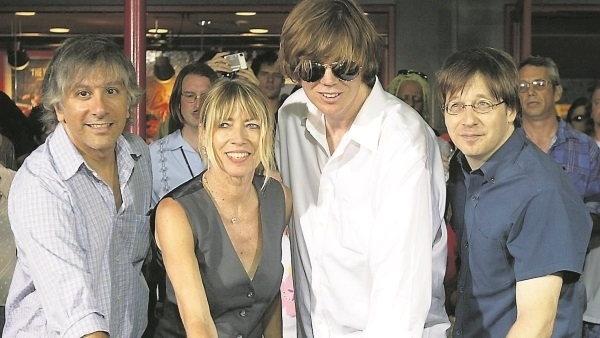
Sonic Youth member Steve Shelley is in Cork and Dublin this week to talk about one their best albums, writes
Steve Shelley, drummer with Sonic Youth, is chatting down a glitchy phone line about the legacy or otherwise of the band’s classic Daydream Nation album, when he introduces the idea of parenthood. “It’s just another one of our records,” he says with a laugh. “It’s like children — I love them all.”
If so, this particular child is now 30 years and growing, yet in a way, eternally youthful in the very best way. The anniversary of an album that became an alternative rock landmark is now also the subject of a special concert film by Lance Bangs, and excerpts from the movie feature in a series of special events including a sitdown chat with Shelley, with Irish audiences in Cork (March 1) and Dublin (March 2) getting their chance to wallow in the feedback.
Daydream Nation arrived as a double album in 1988 at a time when such a thing was uncommon in alternative music circles — a sprawling, ambitious epic, its spectral lyrics often eluding direct interpretation, yet hitting numerous reference points about late-century America and beyond.
It ranges from the sunshine majesty of ‘Teenage Riot’, to the accelerating tension of ‘Silver Rocket’, through the aptly named ‘The Sprawl’ and into the Hadron Collider that is ‘Cross the Breeze’ — and that’s just the first four songs.
The band toured Daydream extensively, including behind the Iron Curtain. At a show in Vilnius in 1989, which can be viewed in full on YouTube, the sound system is simply overpowered during the aforementioned ‘Cross the Breeze’, yet with a few clicks of Shelley’s drumsticks the band launch back into the song at 100mph, like nothing had happened.
“We had been playing a lot,” Shelley says, with emphasis on the last two words. “We were tight enough that if something happened we could bring it back in.”
Shelley joined Sonic Youth in 1985 and then slotted into what became the classic line-up alongside husband and wife Thurston Moore and Kim Gordon, and Ranaldo. The band’s creativity levels escalated. They recorded and toured the Evol and Sister albums and as Steve says: “When it was time to make the next album we decided we wanted to surround ourselves in it.”
At the time they were also working on and off with other material that had an improvisational, Krautrock influence.
“We were working really hard,” Shelley says, “being a band, rehearsing and writing together and playing shows, and the time you do this, if you’re a good band, it just pays off and where you go is where the music takes you.
We got to the point where Daydream was possible, and decided it would be a double album. We thought it would be pretentious in some ways, like a prog band, like ELP, or Yes — that’s why there are these in-jokes, like the trilogy song titles, the symbols [on the album sleeve denoting each band member] — we were making fun of ourselves.
Yet the music was also deadly serious, and heavily influenced by Double Nickels on the Dime by Minutemen and Zen Arcade by Husker Du, both double albums.
Studio engineer Nick Sansano was more familiar with hip-hop groups (Public Enemy dropped in on some Daydream sessions and Chuck D later guested on Sonic Youth’s album Goo), but the alchemy worked a treat.
“It’s a weird process,” Shelley says of recording. “You’re together every day for hours at a time, like in a science lab. When doing it you want it to be great, you hope it’ll be great, then it’s being mastered and pressed, you’re hoping your friends like it. We didn’t know it was a breakthrough record of any kind. You put everything you have into it, you hope these records resonate. We didn’t know it would resonate for years.”
It did, and from the very beginning, with the band featuring in ‘best of’ annual lists in prestigious music publications and ultimately landing its first ever US primetime TV slot.
“It was the first time we were on those lists,” Shelley says, referring in particular to the difficulty in making a national breakthrough in a country as vast as the US.
That first primetime television exposure is referenced at the Daydream Nation events, which includes old footage and segments from the era when the band was making its push into a broader popular consciousness, intermixed with excerpts from Lance Bang’s concert film named after the album, shot over two consecutive shows in Glasgow in 2007.
The band archive has hundreds of hours of footage, but as Steve says wryly “no one buys DVDs any more”. And so the Daydream “movie night” came into being, or to use another term employed by Shelley, “It’s like a cinematic mixtape”.
The drummer has never thought of Daydream as a milestone and is happy to leave discussions about its legacy to others. But does he have a favourite song?
“‘Hyperstation’, the second song in the trilogy [which rounds off the album]. Not because it’s a big, hooky song, but when we played that set live, that was a part in the show where I would kind of lose myself, not thinking, I was just playing music and I really love that feeling. Not thinking or counting, you’re going with the flow — it’s almost a state of exhaustion because it’s one we would play late in the show.”
Shelley is a naturally industrious guy. As well as running Sonic Youth’s label, he’s also a regular on the drum stool for a host of acts, including Sun Kill Moon and more recently with Harmony Rockets, which released one of last year’s sleeper classics with the song ‘Atropos’.
Ask him if he misses Sonic Youth, and the answer is instant. “Yeah, oh yeah,” he says with obvious and deep intent. “Of course.”
In a rolling era of reunions, this is one that’s unlikely to ever happen, the end of the group coinciding with the collapse of the Gordon/Moore marriage. And yet there is still an electricity around an album first
issued in 1988. Shelley demures at the idea that he is some kind of torchbearer for the band, pointing out that Ranaldo and Moore will be attending some of the events around the documentary. He looks back fondly at the band and this period of his life, but he’s not one for dwelling in the past.
“I try not to go with contentment too much. Maybe, to my fault, I am never satisfied, I always want a little bit more or to improve something. To explain it in Daydream Nation terms, I would be the one saying ‘lets play that one more time’ in the studio, ‘I think I can do that better’.”
Maybe it’s those perfectionist probings we have to thank for an album that, 30 years on, shows no sign of loosening its hold on our imagination, no hint that its thunderous power will ever wane.
Hazy memories of that Cork gig with Nirvana
There is something like 150 paces between the doors of the Triskel Arts Centre and the site of the old and much-missed Sir Henry’s venue in Cork city, and while Steve Shelley doesn’t remember details of a very
famous gig there all of 27-plus years ago, it’s not a complete blank.
August 20, 1991, and Sonic Youth were playing the venerable Leeside venue, supported by an emerging trio from Washington state called Nirvana. Roughly 10,000 people have claimed to be there. Steve Shelley
actually was. “Of course I remember playing with Nirvana because it was such a treat and they were amazing, you didn’t know what was going to happen.
“Was the Cork gig before or after Dublin?” he muses.
If Cork was before Dublin it was one of the first legs of the tour and I remember Dave Grohl in the band.
This wasn’t just a case of the drummer’s union, but Steve witnessing the evolution of a band that were also firm friends of his own outfit.
“It was the first we saw of Dave with the band. It was still great. That was the biggest surprise.
“We saw them with two or three drummers, they remained great with all the drummers. That was the great thing — that none of the players took away from what they were doing.”


CONNECT WITH US TODAY



Be the first to know the latest news and updates