For Brendan Courtney now it’s time to talk about mam
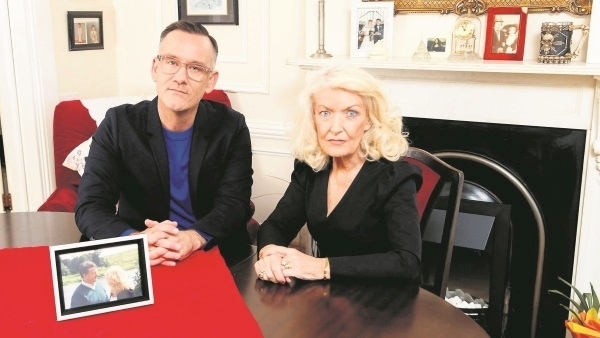
In a follow-up to his moving RTÉ documentary about his father’s failing health, Brendan Courtney turns his attention to his newly-widowed mother, writes
An aging mother dealing with widowhood, a middle-aged son trying to help a parent too shell-shocked by bereavement to make decisions for her future — it’s an all-too familiar predicament.
However, fashion designer and TV presenter Brendan Courtney tackled this common problem in an unusual way.
He made a television documentary about it. Courtney’s question is how much responsibility do we need to take for our ageing parents — and how much responsibility lies with parents themselves to sit down with adult children and discuss the choices facing them?
“We’re an ageist culture,” says Courtney (46), whose hit 2017 documentary We Need To Talk About Dad struck a chord with thousands of people around the country, generating a massive public response through thousands of letters, emails and phone calls.
“We don’t want to think about ageing. Age is seen as a bad thing. It’s seen as a weakness and as something that’s unattractive. Even my mother hates talking about ageing!”
We Need To Talk About Dad focused on the Courtney family’s struggle to find the best possible care for their father Frank after he suffered a second, and severely disabling stroke, almost a year to the day after his first.
“We didn’t prepare in any way for the possibility of him getting sick again, even though we’d been warned he probably would.
We didn’t choose to ignore it; we just didn’t know any better. We didn’t have any facilities in place, for example a downstairs bathroom. Dad was a builder and we could have done that,” Courtney recalls now.
We Need To Talk About Dad aired in January 2017. The following June, Frank passed away. Last year was a very difficult one for Courtney for other reasons too - his best friend died suddenly in March and shortly afterwards his sister was diagnosed with lung cancer.
“The year 2017 was a year that you just had to cope with,” he recalls.
“It was very busy, but as the dust started to settle, we got on with it and started to talk about the possibility, the notion, of a follow-up documentary to We Need To Talk About Dad.
Every single person I met seemed to want to know what happened afterwards - what happened to my Mam and how was she?” Just under 18 months on from Frank’s death, Brendan’s mother Nuala, a clinical psychologist in her 70s, continues to cope with the effects of bereavement.
She’s dealing both with the emotional and financial fallout of losing her beloved husband, whom she first met at the age of 15 and the stark reality of facing a new life as a woman alone. Given the complexity of choices facing his active, healthy, but now-widowed, elderly mother, Brendan made the decision to create a second documentary, this time about Nuala.
“We Need To Talk About Mam is about people who are older, who are in the full glow of health, but who find themselves widowed or in empty nests; people who have too big a house,” Brendan explains.
But, as he discovers during the documentary, Nuala herself is not yet quite ready to plan for the future.
“I wanted to get Mam engaged in looking at the various options.
Her attitude seems to be that I’ll look after things, but what I’m trying to get across to her is that these are her choices and that she needs to make choices so that we don’t have to make choices for her. While I was making the documentary I found that many older people won’t talk about what might happen in the future.
The programme charts the efforts of the 46-year-old and his siblings as they try to help Nuala decide how to live her life after the end of a 50-year marriage to the love of her life.
“My mother is intelligent and healthy. She’s on no medication, whereas I’m on blood pressure tablets,” says Brendan, who adds that Nuala still drives and has a busy counselling practice and a full and enjoyable social life - but, he observes, as the years pass, things will inevitably change: “Mam cannot work forever so we’re looking at her financial set up, wondering, what is the plan?
“The documentary is based around the fact that Mam is getting older and we haven’t prepared for contingencies around this. It looks at how my mother struggles to figure out who she is after living for 50 years with the same person. It’s heart-breaking. Everything you understand is gone. But this is life. We have to accept it, live with it and plan for it.”
However, the issues around getting older are things many Irish people don’t want to even think about, he observes — yet in other cultures, these challenges are dealt with very pragmatically: “In Demark or Japan or the USA for example, this is seen as the third stage of life. People prepare for it.”
Irish people, on the other hand, tend to avoid the subject, he believes: “Culturally, we don’t trust pensions, for example. I’m intelligent and I work hard and I have a nice two-bedroomed apartment in the city,” he reflects, adding however, that he’s also one of those who mistrust pensions: “Only about 30% of Irish people take out a private pension - I don’t have a pension; I still don’t trust the idea,” he says.
His mistrust of pensions, he reveals, was further underlined by the experience of a nurse he talked to: “I talked to a nurse who had a pension - and who lost everything in the crash in 2008. She ended up homeless and living in her brother’s shed at the age of 65, after being retired by the state. She’d worked like a dog all her life, educated herself and invested in a pension and it still let her down.”
One of the options available to Nuala Courtney was downsizing to a smaller house from the four-bed semi-detached family home in Tallaght — but because of the proliferation of larger, family-style housing available in the area, things were not that simple: “Mam did seek to free up her house and move to a smaller house nearby in Tallaght where she lives, but there’s nothing; there are no houses available.”
And, as Brendan points out, any small houses which do come on the market tend to be staggeringly expensive.
Mam has a big side garden so we also looked at getting planning permission to build a small house in the side garden. It’s basically about re-thinking the family home and making it work for the entire family.
The documentary explores other alternatives too — the possibility of taking in tenants, for example, or of engaging in a completely new way of life.
Brendan and Nuala visit a unique co-operative housing initiative in Kildare which replicates the ‘Student Dormhouse’ experience for its residents. They also hit the Irish ex- pat retiree trail to Alicante and experience what life is like for the residents of an Active Adult Community in Florida.
“We travel to Spain and to Miami to investigate how people retire successfully there,” he says. “There are a lot of challenges, a lot of laughs; it’s lighter in mood than my father’s documentary, and I’m very proud of it. The big question asked by the documentary is - what does successful ageing look like in this country?
We all need to engage with this - mams, dads and their adult children together. Unless someone has a brain injury or a mental illness, they need to engage with people about what they would like their care to be.
Courtney did become frustrated with his mother’s inability to engage, he admits, but the experience also taught him a lot about the grueling aftermath of bereavement: “It’s a long process and you cannot force people to make decision,It’s particularly hard for the one who is left to make a decision without the person they have spent their lives with. They’re not only bereaved but they are also alone and that is a very hard thing.”
However, he insists, the reality is that older people owe it to their adult children to have this admittedly difficult discussion.
“I want to say to older people that you owe it to your children to have this conversation. I would go as far as to say it is both selfish and unfair not to explore your options with your child. Burying your head in the sand is no longer acceptable given the society we live in and the ever-diminishing options that are available.”

CONNECT WITH US TODAY



Be the first to know the latest news and updates

















