The big business of being Gwyneth Paltrow
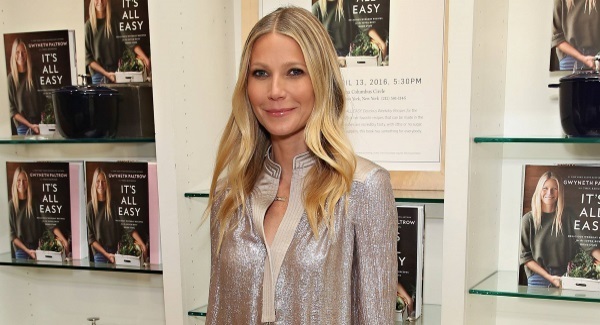
Gwyneth Paltrow marked 10 years of Goop at the brand’s London pop up last week. looks inside the growth of the most controversial brand in the wellness industry.
On a Monday morning in November, students at Harvard Business School convened in their classroom to find Gwyneth Paltrow.
She was sitting at one of their desks, fitting in not at all, using her phone, as they took their seats along with guests they brought to class that day — wives, mothers, boyfriends.
Each seat filled, and some guests had to stand along the back wall and sit on the steps.
The class was called the Business of Entertainment, Media and Sports. The students were there to interrogate Paltrow about Goop, her lifestyle-and-wellness e-commerce business, and to learn how to create a “sustainable competitive advantage”, according to the class catalogue.
She moved to the teacher’s desk, where she sat down and crossed her legs. She talked about why she started the business, how she only ever wanted to be someone who recommended things.
The first iteration of the company was only these lists — where to go and what to buy once you get there — via a newsletter she emailed out of her kitchen, the first one with recipes for turkey ragù and banana-nut muffins.
One evening, at a party in London, one of the newsletter’s recipients, a venture capitalist named Juliet de Baubigny, told her, “I love what you’re doing with Goop”.
GP, as she is called by nearly everyone in her employ, didn’t even know what a venture capitalist was. She was using off-the-shelf newsletter software. But De Baubigny became a “godmother” to Paltrow, she said. She encouraged her vision and “gave permission” to start thinking about how to monetise it.
GP didn’t want to go broad. She wanted you to have what she had: the $795 G Label trench coat and the $1,505 Betony Vernon S&Mchain set.
Why mass-market a lifestyle that lives in definitional opposition to the mass market?
Goop’s ethic was this: That having beautiful things sometimes costs money; finding beautiful things was sometimes a result of an immense privilege; but a lack of that privilege didn’t mean you shouldn’t have those things.
Besides, just because some people cannot afford it doesn’t mean that no one can and that no one should want it. If this bothered anyone, well, the newsletter content was free, and so were the recipes for turkey ragù and banana-nut muffins.
By the time she stood in that Harvard classroom, Goop was a clothing manufacturer, a beauty company, an advertising hub, a publishing house, a podcast producer, and a portal of health-and-healing information, and soon it would become a TV-show producer. It was a clearinghouse of alternative health claims, sex and intimacy advice, and probes into the mind, body, and soul.
There was no part of the self that Goop didn’t aim to serve.
“I want to help you solve problems,” said GP. “I want to be an additive to your life.” Goop is now worth $250m, according to a source close to the company.
The minute the phrase “having it all” lost favour among women, wellness came in to pick up the pieces.
It was a way to reorient ourselves — we were not in service to anyone else, and we were worthy subjects of our own care. It wasn’t about achieving; it was about putting ourselves at the top of a list that we hadn’t even previously been on.
Wellness was maybe a result of too much having it all, too much pursuit, too many boxes that we’d seen our exhausted mothers fall into bed without checking off. Wellness arrived because it was gravely needed.
Goop’s first newsletter left GP’s kitchen in 2008, right when the economy was collapsing around us. It wasn’t just the homes people no longer owned and the jobs people no longer had.
It was the environmental crisis. It was the endless exposure of corruption. Whom exactly were we trusting with our care? Why did we decide to trust them in the first place? Who says that only certain kinds of people are allowed to give us the answers?
These phenomena gave an easy rise to Paltrow, who was at first curating teas and lingerie and sweaters she thought you’d like.
People were looking for leaders, and she was already committing public displays of ostentatious wellness: She showed up at a movie premiere with cupping marks on her back; she let bees sting her because I don’t know why. Suddenly Gwyneth Paltrow, the movie star, was a major player in an industry that was big business.
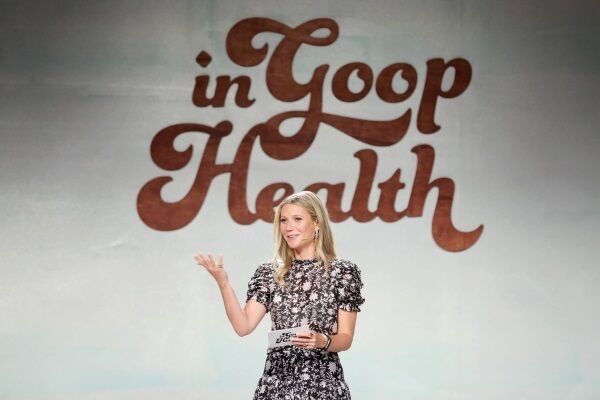
The Goop campus in Santa Monica consists of four squat grey buildings, where in June a diverse group of about 200 young, exuberant, well-dressed people were working hard to plan the coming weekend’s event, the In Goop Health wellness summit. GP sat at her desk behind the glass walls of her office, which was spare and also decorated in shades of gray.
Her golden hair fell over the paper she was reading.
She was wearing a tank top, shearling-lined white Birkenstocks, and Goop x Frame wide-legged palazzo jeans.
Back when she wore them at Harvard, I’d never seen anyone else wear them. Now she was making them, and everyone else I knew was wearing the same style.
We ate salmon hand rolls. She was trying to be low-carb today, but it wasn’t happening. There was too much going on.
The wellness summit, a day-long immersion in Goop-endorsed products, panels, doctors, and other “healers”, was a “heavy lift for the team”.
The summit is great, don’t get her wrong. All three so far have sold out, with tickets ranging from $500 to $4,500, the highest of which included two dinners with GP, plus two nights at Casa del Mar. But lately she has been wondering if the summit does everything it needs to. She worries that she’s just serving the same customers over and over.
She met a woman who took a very long bus ride from she thinks rural Pennsylvania to the Goop summit in New York in January. “79% of our American customers aren’t in New York or Los Angeles,” where these summits are held, she said; they’re in secondary markets.
So how do you bring them in? There have been pop-up Goop stores everywhere from Dallas to Miami. There would be a digital pass to the summit.
But you can’t taste a plate of ancient grains and avocado in citrus dressing on a computer. You can’t feel someone push warm oil with a jade roller over your skin through an iPad.
You can’t eat a piece of chocolate that will supposedly not just regulate your hormones but restore your sex life — chocolate! — on your phone. You can only watch some panels and one-on-one conversations. So she’s thinking they might take the thing on the road.
Can you believe this? She was incredulous. She still remembers sitting in her kitchen in London, celebrating a day when $45 had come in because of an advertising partnership.
The newsletter was at first kind of mainstream New Age-forward. It had some kooky stuff in it, but nothing outrageous. It was concerned with basic wellness causes, like detoxes, cleanses, and meditation.
It wasn’t until 2014 that it began to resemble the thing it is now, a wellspring of both totally legitimate wellness tips and completely bonkers magical thinking.
Goop knew what readers were clicking on, and it was nimble enough to meet those needs by actually manufacturing the things its readers wanted.
When a story about beauty products that didn’t have endocrine disrupters and formaldehyde got a lot of traffic in 2015, the company started Goop by Juice Beauty, a collection of “clean” face creams, oils, and cleansers that it promised lacked those things.
When a story about “postnatal depletion”, a syndrome coined by one of the Goop doctors, did even-better-than-average business in 2017, it introduced Goop Wellness, a series of four vitamin “protocols” for women with different concerns — weight, energy, focus, etc. Goop says it sold $100,000 of them on their first day.
The weirder Goop went, the more its readers rejoiced. And then, of course, the more Goop was criticised:
By mainstream doctors with accusations of pseudoscience, by websites like Slate and Jezebel saying it was no longer ludicrous — no, now it was dangerous. And elsewhere people would wonder how Paltrow could try to solve our problems when her life seemed almost comically problem-free.
But every time there was a negative story about her or her company, all that did was bring more people to the site — among them those who had similar kinds of questions and couldn’t find help in mainstream medicine.
With assaults coming from all sides, Goop began to dig its heels into the dirt, not only because dirt is a natural exfoliant and also contains selenium, which is a mineral many of us are lacking and helps with thyroid function. Now Goop was growing only more successful. Now Goop was a cause, and GP was its martyr.
The quarterly Goop magazine was introduced last autumn with a picture of GP’s bikinied body covered in mud and just one cover line: “Earth to Gwyneth”.
She does things like that to demonstrate a kind of self-awareness around what she knows is the rap on her, that she’s a privileged, white rich lady who is into some wacky stuff.
That issue, like the second issue (with a cover photo of her and Falchuk and the words “In Deep”), was $15 on newsstands and a product of a partnership with Condé Nast.
At first, it seemed like a perfect fit. “Goop and Condé Nast are natural partners, and I’m excited she’s bringing her point of view to the company,” said Anna Wintour, Condé Nast’s artistic director and editor in chief of Vogue, when the deal was announced in April 2017. The print product would be a collaboration — Goop content overseen by a Vogue editor.
It didn’t work out. “They’re a company that’s really in transition and do things in a very old-school way,” said GP.
The parting was amicable. “But it was amazing to work with Anna. I love her. She’s a total idol of mine. We realised we could just do a better job of it ourselves in-house. I think for us it was really like we like to work where we are in an expansive space. Somewhere like Condé, understandably, there are a lot of rules.”
The rules she’s referring to are the rules of traditional magazine making — all upheld strictly at an institution like Condé Nast. One of them is that they weren’t allowed use the magazine as part of their “contextual commerce” strategy.
They wanted to be able to sell Goop products (in addition to other products, just as they do on their site). Condé Nast insisted they have a more “agnostic” editorial approach.

The company publishes magazines, not catalogues. But why, GP wanted to know. She wanted the Goop magazine to be a natural extension of the Goop website.
She wanted the reader to be able to do things like text a code to purchase a product without even having to leave her inert reading position and wander over to her computer. A magazine customer is also a regular customer.
But the other rule is — well, the thing couldn’t be fact-checked. Goop wanted Goop magazine to be like the Goop website in another way:
To allow the Goop family of doctors and healers go unchallenged in their recommendations via the kinds of Q&As published, and that just didn’t pass Condé Nast standards. Those standards require traditional backup for scientific claims, like double-blind, peer-reviewed studies.
In 2016, a division of the Council of Better Business Bureaus began an inquiry into Goop for deceptive marketing claims about the life-optimising powers of Moon Juice products, which appeared on the Goop site as a key ingredient in a smoothie that GP drank every morning. (Goop voluntarily stopped making these claims.)
And last summer, the watchdog organisation Truthinadvertising.org sent GP a letter that referred to numerous instances of deceptive marketing claims — that the site’s products cured, treated, or prevented inflammation, autoimmune diseases, and more.
Goop replied and adjusted some of its claims in the short period the letter allotted, but the organisation found its response inadequate and reported Goop to the district attorney’s offices in both Santa Cruz and Santa Clara. (The DA’s offices did not comment.)
A gynecologist and obstetrician in San Francisco named Jen Gunter, who also writes a column on reproductive health for The Times, has criticised Goop in about 30 blog posts on her website since 2015.
A post she wrote last May — an open letter that she signed on behalf of “Science” — generated more than 800,000 page views.
As of June, there were 2.4m unique visitors to the site per month, according to the numbers Goop provided me.
The podcast, which is mostly hosted by Elise Loehnen and features interviews with wellness practitioners, receives 100,000 to 650,000 listens per week.
Goop wanted to publish articles about autoimmune diseases and infrared saunas and thyroids, and now it can, on its own terms — sort of.
After a few too many cultural firestorms, and with investors to think about, GP made some changes.
Goop has hired a lawyer to vet all claims on the site. It hired an editor away from Condé Nast to run the Goop magazine. It hired a man with a PhD in nutritional science, and a director of science and research who is a former Stanford professor.
And in September, Goop, sigh, was set to hire a full-time fact-checker. GP chose to see it as “necessary growing pain”.
But something strange happened. Each of these pronouncements set off a series of blog posts and articles and tweets that linked directly to the site, driving up traffic. At Harvard, GP called these moments “cultural firestorms”.
“I can monetise those eyeballs,” she told the students. Goop had learned to do a special kind of dark art: To corral the vitriol of the internet and the ever-present, shall we call it cultural ambivalence about GP herself and turn them into cash.
You couldn’t win with everyone. Or maybe it’s just that GP disrupted the contract between the celebrity and the civilian who is observing her.
In a typical women’s magazine profile, the implicit pact is that the celebrity will not make the woman feel bad by implying that the woman could have what the celebrity has if only she would work:
“It’s all in my genes, what can I say!” proclaims the celebrity.
But GP was different. She would talk openly about the food habits and exercise obsessions that allowed her to look the way she did. People think they want celebrities to speak honestly, but we’re not really that happy when they do.
She didn’t know why people felt the way they did. She said the decision to stop acting and pursue Goop was not difficult, but it had nothing to do with her reputation.
“I really liked acting,” she told me. “But at a certain point, it started to feel frustrating in a way not to have true agency, like to be beholden to other people to give you a job, or to create something, to put something into the world.”
What can she say? It’s hard to talk about herself like this. How can she really understand who she is in the culture anyway? She’s the only one who can’t see herself clearly. All she knows is whatshe hears, and she once heard that she eats in front of the mirror naked.
She doesn’t understand it. She doesn’t think she’s perfect. She is the way she is because of hard work. How could people hate her for that?
It’s just hard work. It’s just intention. The content is free, and it’s all right there. Go to her website. Do some meditation. Just eat more produce. Take some time for yourself. Hydrate.
"We’re so hard on one another," said GP. "We’re so hard on ourselves, too.
"That’s all we do as women,” she said.
We just kick the shit out of ourselves. It’s like that inner critic is so vicious, and it’s like: Why do we do that? It’s so nuts.
She added: “People say that there’s no link between emotions and consciousness and physical illness. And yet look at the plethora of autoimmune diseases around you. One man to 10 women have autoimmune. We literally have turned on ourselves.”
CONNECT WITH US TODAY



Be the first to know the latest news and updates









