The 'spider web' of Tuam could touch anywhere
The State seems terrified of what might happen if one mass grave is excavated but, without it, the living can never know peace, nor the dead rest, writes
If Children’s Minister Katherine Zappone’s public consultation in Tuam was planned to create a false equivalence between those who want justice for the Tuam Babies, and those who would rather see the past covered up, it backfired spectacularly.
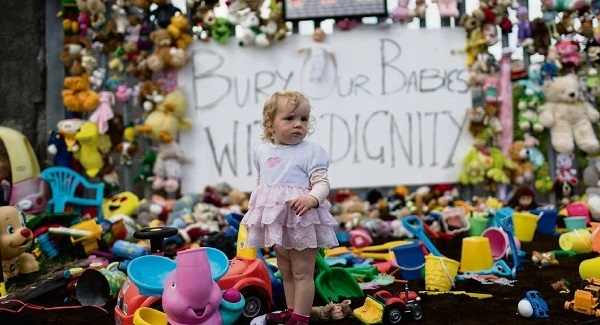
The sun was shining in Tuam last Monday evening, and small children were playing at a makeshift shrine
outside the Ard Rí House Hotel. A wall of colourful toys — 796 teddies donated by local people — surrounded a hand-written sign reading: “Bury our babies with dignity.”
Inside, a crowd of almost 200 people had gathered to meet Ms Zappone.
She was in Tuam as part of a consultative process to gauge public opinion on the future of children’s remains found on the site of the former Tuam mother and baby home. The mood in the room was sometimes angry, sometimes incredulous, with the point made repeatedly from the floor that public opinion should have no part in matters of criminal justice.
Ms Zappone’s department had decreed that the meeting would be closed to media, but a few of us felt — whether representing media old or new — we had a duty to be there. The days when Church or State dictates what the
public learns should long be past.
As the meeting began, Ms Zappone said she had a difficult balancing act between respecting the wishes of the Tuam Babies’ families, and the wishes of the residents.
I asked if, in the event of a body being discovered buried in my back garden, the gardaí would ask me whether I’d mind if they investigated, or whether I’d prefer a nice, quiet Mass was said and the whole thing covered up.
How about 10 bodies? How about potentially 796 bodies?
Ms Zappone replied that gardaí have no reason to suspect there was anything “unnatural” about 796 children dying in the Tuam home.
I reminded her that, in 1949, when the Bon Secours nuns were paid by the State the equivalent of over €110 per child per week to care for those children, the infant mortality rate in the Tuam home was five times that of the rest of the country.

Anna Corrigan, whose quest to find her older brothers sparked the entire Tuam Babies story, told Ms Zappone the Tuam site is a crime scene in two open garda investigations into her missing brothers.
She believes this is not just a scandal involving child neglect by Church and State, or illegal burials only yards from a consecrated graveyard.
“This is about forced adoption,” said Ms Corrigan.
“This is a spider’s web that spreads out all over Ireland, and you, Minister, are terrified of it, because you don’t know how far it will go. Tuam is only a microcosm. But, Minister, if we get Tuam right, everything else follows.”
Tuam has been at the centre of an international storm since 2014, when Alison O’Reilly broke in the Irish Mail on Sunday a story headlined ‘A mass grave of 800 babies’.
Ms O’Reilly’s initial source was Ms Corrigan. Ms Corrigan’s mother, Bridget Dolan, then unmarried, gave birth to John Desmond, a healthy baby, in the Tuam Home on February 22, 1946. John died on June 11, 1947, one year and three months old.
He was described in the April 1947 inspection report as “a miserable, emaciated child with voracious appetite and no control over bodily functions, probably mentally defective”, and on his death certificate as “a congenital idiot”. His younger brother, William Joseph, was born healthy on May 21, 1950.
The record of William Joseph’s date of birth was altered to April 20, 1950. He is registered as having died in the Tuam Home on February 3, 1951. No cause of death is given and he is not recorded on the national death register.
A garda introduced Ms Corrigan to Catherine Corless, a Tuam-based historian. Ms Corless, at her own expense, then sourced the death certificates of 796 babies who died in the Tuam home between 1925 and 1960. There are no records of their burials.
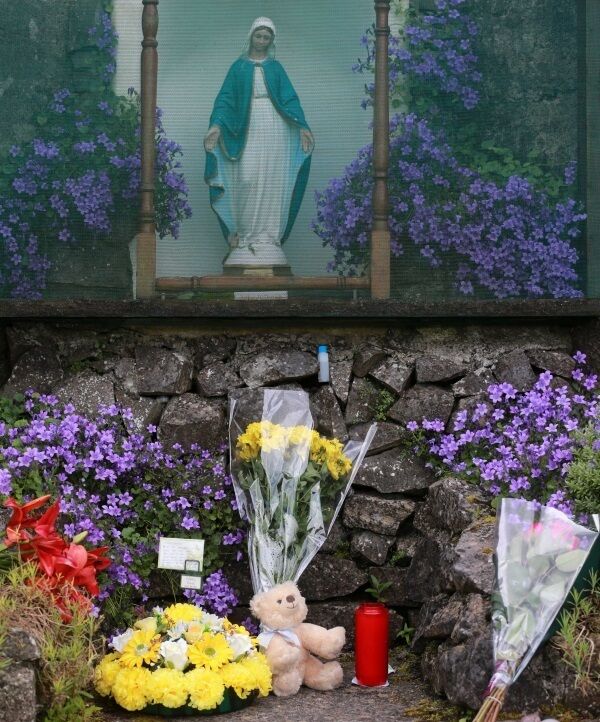
In 2013, Sr Marie Ryan of the Bon Secours order told Ms Corrigan: “As I understand it, there would … be a very good possibility [John’s] remains were buried at the small cemetery at the home itself. This is located at the back of the home and was operated as a general grave.”
Independent researcher Izzy Kamikaze established that the plans of the Tuam home show that the location of this “general grave” matches that of a large, decommissioned underground Victorian sewage treatment system, a series of interlinked, vaulted cesspits. In March 2017, the Commission of Investigation into mother and baby homes confirmed the presence in those chambers of “significant” amounts of human remains.
Even now, Ms Corrigan feels that her brother William may be alive, illegally adopted in America. She wonders if John might be alive too. Without a full excavation, we can never know whether all 796 babies recorded as having died in the Tuam home are in the ground beneath Tuam’s Dublin Road Estate.
From a crowd of almost 200 people, one man seemed to misunderstand science and said excavation would be “pointless” as DNA analysis would take “20 years”.
Only one other person said she opposed excavation. She said she felt exhumation would “violate those children all over again”.
Adrienne Corless, an archaeologist and Catherine’s daughter, responded to Ms Zappone’s concern that legal problems might prohibit an excavation.
“If there was a motorway being dug there, there would be no legal problem to excavate,” she said.
Tom Ward, a Tuam home survivor in his 70s, made an impassioned plea: “We are the people who were born in that bloody goddamn home. We want every one of them babies taken out of there and buried decent.”
If — as some in Tuam suspect — the purpose of consulting the public on how a mass grave should be investigated was designed to establish false equivalence between those who want justice for the Tuam babies and those who want a memorial on the site and no further investigation, it backfired spectacularly.
After the meeting, one Tuam survivor had tears in his eyes when he spoke to me of the portrayal of Tuam as a town divided.
“It was supposed to be 50/50. They said it was 50/50. By Christ, they got their answer,” he said.
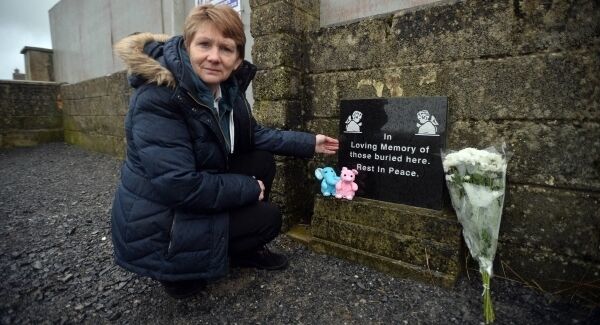
At the meeting, 99% favoured exhumation, DNA analysis and, where possible, the return of those children to their families. That’s an overwhelming result, but again, since when do we outsource criminal justice to popular opinion?
The State seems terrified of what might happen if the precedent of excavating one mass grave is established. There are likely unmarked graves in every town. Tuam is only part of a bigger scandal, one which Conall ÓFátharta has chipped away at in this newspaper for years.
Twentieth-century Ireland’s obscene obsession with women’s sexuality, its cruelty and its pious fixation with “respectability”, created an industry of incarceration and forced adoption. The spider web of Tuam could go anywhere, touching lives unknown and unknowing.
The Tuam Babies story caused international horror. If Ms Zappone has an eye to her legacy, she must know that the world is watching very closely. Without a full excavation, the living can never know peace, nor the dead rest.

CONNECT WITH US TODAY



Be the first to know the latest news and updates
















