How Proportional Representation works
If you’re a first time voter - or even if you’re not - you may be slightly confused by the Irish voting system.
Along with Malta, Ireland is one of the few countries to use PR-STV, or Proportional Representation with a Single Transferable Vote, to elect their national parliament.
Considered by some to be the fairest option - it is, as its name suggests, proportional - it can also be a complex one.

All constituencies in Ireland are multi-seat constituencies - with three, four or five seats depending on population size.
Therefore, instead of picking just one, proportional representation means that voters can indicate their first and subsequent preferences for the listed candidates on the ballot paper.
And while the voting process is quite straightforward, the count is a little more complicated.
The Vote
The ballot paper will have the names of the candidates appearing in alphabetical order, with their photographs and their party emblem( if applicable). There can be up to 25 candidates on the ballot paper.
To allocate your vote, you must indicate your first choice by marking No 1 next to your first preference, No 2 by your second choice, No 3 by your third and so on.
You can choose to order some or all candidates or you can just stop at one.
The order of your preferences will instruct the person counting the votes how to distribute your single transferable vote so think carefully before deciding.
So that’s the easy part out of the way - now to dive into the tricky stuff.
The Quota
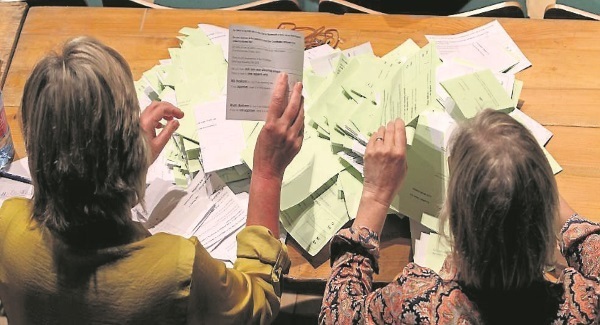
Once the voting is over, the ballot papers are taken to the counting centre where they are sorted, counted and any invalid votes are discarded. The quota - the number of votes a candidate needs to get elected - is then calculated.
This is done by dividing the total number of valid votes cast in the constituency by the number of seats available plus one, and then adding one.
For example, in a constituency with 4 seats and 100,000 votes cast, the quota would be calculated as follows:
So the quota of votes is 20,001. This is the lowest number of votes that four candidates can get (80,004) but not five (100,005), ensuring only four are elected.
Once a candidate obtains that number of votes, they are elected.
The First Count
During the first count, votes are sorted by first preference. If one or more candidate reach the quota, they are elected and off they go to be lifted on shoulders.
If no one reaches the quota, candidates enter the Thunderdom… the second count.
The Second Count
If a candidate has been elected after the first count, their surplus votes are then redistributed according to voters indicated second preference.
Here’s the Citizen Information website on how the votes are distributed:
“For example, if candidate A receives 900 votes more than the quota on the first count and on examining all of their votes, it is found that 30% of these have next available preferences for candidate B, then candidate B does not get 30% of all candidate A's votes, candidate B gets 30% of A's surplus, that is, 270 votes (30% of 900).”
Basically, if an elected candidate has 900 votes that he doesn’t need (ie above the quota), than 900 votes are picked at random from their total and redistributed according to second preference.
Got it? No? Too late we’re moving on.
If no candidate has reached the quota at the second count, the candidate with the lowest number of votes is eliminated. All their votes are then distributed in accordance with the next available preference on their ballot paper.
Third and Fourth and Fifth and... Counts
If one or more candidates are elected, then, again, their surplus is redistributed according to preference. If no one is elected, the candidate with the least votes is eliminated.
This process of election, elimination and redistribution of votes continues until all the seats have been filled.
The last seat can be filled either by a candidate exceeding the quota - or by a candidate being elected because it is clear that they are ultimately going to receive the required number of votes.
READ MORE:














