Margaret Rooke's new book a fresh and invigorating take on dyslexia
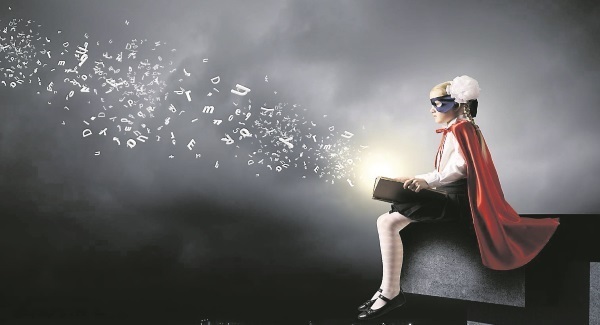
“ONE thing that’s really clear is how different everyone’s experience of dyslexia is,” says Margaret Rooke of the children who feature in her new book .
For sure the experience is not universal. Jed believes his brain was shot through with a lightning bolt of smartness. Elliot believes there is nothing he can’t do. Grace’s friends told her she had special needs.
Ryan Hamilton Black, from Kildare, reckons it gives him superpowers and who would argue given Ross inspired the book’s title?
Rooke’s book is a fresh and invigorating take on dyslexia, told through the voices of children, most of whom see their learning difficulty as something of a mixed blessing. Without doubt, it makes school especially tough and textbooks a nightmare, but it also gifts children with an atypical way of thinking that seems to lead to greater creativity.
The author, who lives in Britain, has a personal interest in dyslexia — her daughter Loretta was diagnosed at age 13.
“Our story may not be typical. Loretta did really well in primary school and we presumed she’d carry on doing well in secondary.
“But she stopped progressing. She told us school was chaos and she wasn’t learning anything. We thought maybe the school was chaotic. I tried to intervene but it didn’t go down well.
“Then one day I found a poster she had made for Anti-Bullying Week when she was aged about 11 — she was 13 at this stage — and the poster said, ‘Tell an Adult’. Except it was spelled wrong. And I thought ‘Oh my goodness, she’s dyslexic!’”
Diagnosis came late for many of the children in this book. Rooke says they were told a child can often get by in primary school because they find ways to compensate for the problem areas. But secondary school is a different ballgame.
“You have different teachers, classrooms, subjects. Loretta couldn’t find a way to cope.”
Her daughter was a very positive child but suddenly felt labelled and worried she couldn’t achieve what she wanted to achieve. Rooke was determined she would fulfil her potential and helped her with her GCSEs.

“We did a lot of work on them together. And she did her A-levels — two creative subjects and sociology. But she decided she wasn’t going to university because she’d had enough of education.”
Some of the kids’ stories about their school days are heartbreaking. The panic is palpable when tasks prove too difficult; the shame in front of classmates, immeasurable.
Leah wants to work in counselling because she knows “how it feels to get hurt or embarrassed”. She talks of her teacher shouting at her in front of the whole class.
Rooke says the Dyslexia Association of Ireland (DAI), which put her in contact with the Irish case studies in her book, are calling for mandatory teacher training in dyslexia, as well as easier and equal access to dyslexia assessment and supports.
“I think people should be listening to them [DAI]. It’s not fair on the child with dyslexia, or on their parents or teachers or classmates, when the training is not there,” says Rooke.
Most of the children who spoke to Rooke have learned to embrace their condition, largely thanks to the support and encouragement of parents, teachers, and peers. Others still struggle.
Rooke — who has written several books on dyslexia , including the best-selling Creative, Successful, Dyslexic featuring high achievers such as Darcey Bussell, David Bailey, and Richard Branson — says it’s really important for parents to identify their child’s strengths and play to them. “So much of the focus now is on results, results, results. There’s real competitiveness in the playroom. But really it would help all of us if we celebrate what they are good at, be it cooking or whatever.
“The most important thing is for the child to know there is someone on their side, be it parent, aunt, uncle, friend, telling them they are not stupid, they have their own talents. That you believe in them — that’s a huge way towards ensuring a successful future.”
So what of Rooke’s daughter, now aged 19? She has that entrepreneurial spirit that Rooke believes is especially strong in people with dyslexia. And she’s harnessing it well. She’s on the cusp of launching her own shoe design and manufacturing business and has been to China to set up a supply chain.
“I spoke to her on the phone and she said ‘Mum, I’m learning every day. She never said that to me before.”

Rooke gives the last word to one of her contributors, Isobel, 17, from Wales: “Ideas are what’s important — not the ability to remember a sequence of letters.
“If you find a way to deal with global warming or clean out the oceans, no one will say, ‘I’m not listening because the spelling is wrong.’”
It was a relief
“I never let the other kids hear me read. I asked the teachers not to ask me and they just thought I was shy.
“On the bright side, I was always good at art. The teacher would always pick me to draw things and the other kids would say, ‘That’s so good.’
“When I went into secondary school, things went downhill further... The teachers thought I was lazy…. I used to pretend to be sick…
“We had to read out loud and, if we had a test, the teacher would call out the scores in front of everyone. I just thought, ‘Someone help me.’ It was all so public.
“I would spend these moments on the verge of tears. I would be sweating and so embarrassed.
“When the educational psychologist told me about the dyslexia it was arelief.. I didn’t just feel stupid anymore.”
CONNECT WITH US TODAY



Be the first to know the latest news and updates














