Kevin Barry reconnects with Cork in his new play, Autumn Royal
Fat Larry is dead. “He took a massive banger, back in ’87,” as one of the characters in Kevin Barry’s new play, Autumn Royal, puts it. For most who will see the play, the tragic demise of bandleader Fat Larry James had probably slipped by unnoticed.
Chances are, however, that many know his hit tune ‘Zoom’. If not, they’ll be well acquainted with it by the time the curtain comes down on Autumn Royal, which premieres at Cork’s Everyman next week, a stone’s throw from where the play is set.
The R&B classic has a major role in the story. ‘Zoom’ may have originated in Philadelphia, but for the Limerick-born author, it will forever be associated with the city he lived in for most of the 1990s.
In Barry’s time, Leeside had calls on being the black music capital of Ireland, and provided the soundtrack for some very formative years. He’d regularly hear ‘Zoom’ on nights out, and the tune was also a mainstay in the record bag of local DJ Fork, whom Barry shared a ramshackle house on Ballyhooley Road with.
That the influences of those years should still pop up in Barry’s work isn’t surprising. Even now, when he sits down to write, he says his characters often start speaking to him in Cork accents.
“I was in Cork when the short stories and stuff first started to work out for me,” recalls Barry, who recently penned an appreciative memoir about the city in Granta magazine. “And I think you stay very attached to the place where you started to make some headway. It also fed hugely into my first novel, City of Bohane. It just keeps showing up.”
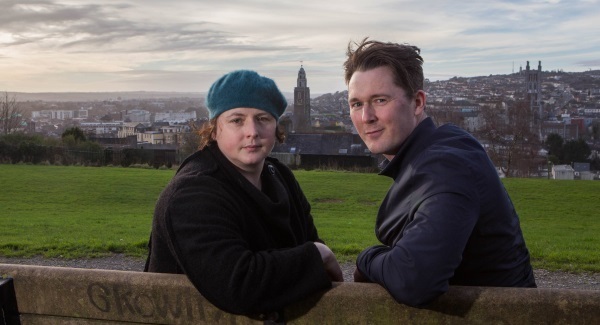
As an outsider, he also has the eye to appreciate the things that many natives take probably for granted. “I’ve always loved walking up around Patrick’s Hill, Richmond Hill, up around there. It’s a very cinematic city, it has elevated views like nowhere else.”
Even in beautiful great places, however, awful things happen. Not surprisingly for a man whose work is often tagged with the description ‘darkly comic’, Autumn Royal isn’t quite from the Bord Fáilte school of script writing. Set in a house on one of those hills Barry loves walking up, it largely revolves around a brother and sister addressing one of the great issues of our time: what to do with an aged parent.
In what the writer calls a “deranged sitcom”, the discussion by the two main characters swings from the nursing home that gives the play its name, all along the spectrum to the pillow-over-the-face option. You’ll laugh along the way, sometimes uncomfortably.
“For nearly all of us, one of the first big ethical questions you come up against in life is how are are you going to deal with the old folks,” says Barry, 47. “Often we don’t cover ourselves in glory. Everybody has this in their family story to some degree or other. What makes it such a dilemma ethically and all the rest of it, is that there is no easy solution. At one stage in the play, the sister says to the brother, ‘It’s them or fuckin’ us’... it’s their lives or our lives.’ And what do you do in that situation?”

Little Kingdom
The world and language of Autumn Royal are closer to Barry’s short story collections, There Are Little Kingdoms and Dark Lies the Island, than his novels, Bohane and Beatlebone. In 2008, he had moulded three of his early stories together for a play produced by Meridian in Cork, and has long had an urge to give the dramatic form a proper go.
He regularly reads play-scripts by the likes of Harold Pinter, Brian Friel and Marina Carr —“You’d horse through them in an hour” — and is aware from the reaction he gets at his prose readings that many people enjoy the aural qualities of his work. In other words, it wasn’t a huge leap to write a play after he had finished Beatlebone.
Barry has two more plays at a drafting stage, including one for the Abbey (almost inevitably, it features a Cork family). A horseracing film is also being mooted, and City of Bohane continues its life in entertainment limbo as still being ‘optioned’ for a movie or TV series.
Is he planning on penning a sequel to that debut novel? “That was supposed to be the next book but another one has come along and kind of poked its way in front of it. I think I am going to try to revisit it, but it was 2008 when I started Bohane which is a long while ago.”
In the meantime, Barry is obviously having a more fruitful experience revisiting old haunts rather than old work, and remains mindful of something Cork writer Conal Creedon told him many years ago.
“He said that when you’re on Patrick’s Bridge you’re at the centre of the universe, and anything beyond it is just a rumour.”
I got a lovely present in the post from Simon Tong of two albums by his band, the Magnetic North. He used to be in The Verve and Gorillaz, but this is sort of ambient folky stuff. He said he really liked Beatlebone and he thought I might be into this. They’re two brilliant records.
I got a proper record player a few years ago so I got back into vinyl again properly. There’s nothing like it. The oul’ dub reggae is still a mainstay, and whenever I go to a record store I come out with King Tubby and the like.
The broadband is temperamental where we live in Sligo, but we can just about manage Netflix. I really enjoyed the first season of Bloodline, but the second collapsed in on itself a bit. I watched the first few episodes of The Crown but it was all a bit sumptuous.
I heard somebody describe it as like watching an aquarium, there’s almost nothing going on. It looks amazing but the whole message is: ‘Toffs are magnificent!’.
Jon McGregor’s Reservoir 13, a fabulous novel about a girl going missing in Yorkshire in the 1970s. Also, Conversations with Friends, the first novel by Sally Rooney, which will be published later this year.
And I’ve been reading the last volume of Beckett’s letters. I’ve always been more interested in him as a character himself than the work. He’s a great character and comes across as very kind, with a great breadth of learning.
This last volume is heartbreaking — he’s getting old and knows the end is coming, but the flashes of gallows humour still come through. I’ve read the four of them, and they’re some work of scholarship.














