Book review: Crime and criminality by Chad Posick and Michael Rocque

One of the most innovative branches of neuroscience to emerge during the late 20th century was social neuroscience: the study of the neural processes that underlie social behaviour.
Principally, it built on the core disciplines of neurology and social psychology while also drawing on evolutionary biology, genetics, and psychiatry. It’s main aim is to study what happens neurologically during social exchanges.
Because criminal activity is, at its most fundamental level, a social event, social neuroscience became an extremely important field for deepening the understandings of what goes on in an individual’s mind when a crime is committed. Moreover, criminal activity is often triggered by jealousy, or a number of the so called moral emotions.
That’s just one of many arguments that both Chad Posick and Michael Rocque — two American academics in the field of criminology— put forward in The Criminal Brain: Understanding Biological Theories of Crime (2nd ed).
The book is a meticulously well researched work of dedicated team scholarship. The first edition was written by a globally renowned professor of Criminology at Northeastern University, Nicole Rafter, who died earlier this year.
Posick and Rocque have now updated the first edition, with two new chapters, while also revising, and complementing other parts of their mentor and teacher’s earlier work. One of the key things to remember is that crime is inherently a social event, the book argues. There is a social context that all crime goes through.
And the dynamics of those are important when we start to look at why people become offenders or victims, Posick and Rocque explain.
Violent crime, particularly, involves a breakdown of self-regulation, says Posick when we begin chatting.
“Self regulation and self control is a major component as to why people engage in criminal behaviour,” the criminologist explains. Historically, nearly all theories put forward attempting to understand the criminal brain were biological: Some were more daft than others.
During the late 18th century, Johann Caspar Lavater, posited the rather bizarre idea that outward appearances of certain individuals could automatically be used to tell who would and would not commit a crime.Then there was the concept of phrenology: a radical 19th century theory which attempted to read a person’s character by looking at the contours of their skull.
Following the disastrous consequences that toxic ideas like the eugenics movement and racial hygiene in Nazi Germany produced, biological theories of criminality were quickly pushed to the side.
“After World War II, what you see [in criminology] is the rise of social learning theories. This suggested that criminal behaviour, like any other behaviour, is learned. Also, social control theory suggests our bonds and connections with society, our family and friends, will all help us to stay away from delinquent activity.
“Evidence suggests these keep us on the straight and narrow. We also know that bonding with other people has an impact on our brain functioning and our biology,” he says.
Over time, though, biological theorising eventually made a come-back. Most notably, the feeblemindedness theory of criminality. This idea — which usually holds more popularity with social conservatives — is a movement that hopes to prevent crime by sexually immobilising people deemed subnormal intellectually.
While its roots are actually in the early 1900s, it resurfaced again in 1994 with the controversial book, The Bell Curve: where psychologist, Richard Herrnstein, and political scientist, Charles Murray, argued that social class is largely determined by intelligence, and that low IQ is one of the main determinants of poverty and crime.
“[The Bell Curve] vastly ignores the environmental influences on things like intelligence. Yes, it is fairly stable over time. But there are things we can do that can change IQ.
"There are things that happen to us that can reduce intelligence and IQ: such an injury or trauma. And these are largely ignored in that book,” Posick adds.
“The Bell Curve also tries to take culture out of the picture; claiming that [criminal behaviours] are genetically based, and can really tell us a lot about ethnic and racial differences, without really paying attention to the sociological forces that can play a part in this.
“While IQ is an important factor in behaviour, it’s certainly not the only or most important one. And to ignore all of those sociological and environmental factors that shape IQ and intelligence — particularly as they deal with racial and ethnic backgrounds — is hugely misleading,” says Posick.
Rocque believes in a political climate in the US that has migrated to the far right in recent months — and where espousing bogus claims of pseudoscience has now become a stark reality — the potential for how criminology develops in the short to medium future could be extremely dangerous.
“In a [political context] how science is interpreted can be used for really bad purposes,” says Rocque. “With the voting in of [president-elect] Donald Trump in the US, we are seeing that we are not immune to such missteps.
So we just need to be really cautious as to what these findings [in the field of criminology] mean, and how they should be interpreted.”
Presently, what has emerged in the field of criminology is what is known as the biosocial model: this recognises that while we are all biosocial beings, social factors pertaining to criminal activity also act on biology too.
In simple terms: we are now beginning to view criminal behaviour as a combination of biology and the environment, in very intricate and complex ways. Posick and Rocque are keen to point out that one weakness of this new biosocial model is its failure to take social factors fully into account.
“The science shows us that it’s the biology and the environment that work together,” says Posick.
“For some things it can be a little bit more genetic, a little bit more biological. For other types of behaviour, it’s a little bit more social. However, almost always, it’s a combination of both,” he says.
It’s this crossover between culture and science that makes Posick and Rocque’s book such a compelling read. They cite, for example, the work of evolutionary theorists, Peter Richerson and Robert Boyd.
In their book, Not by Genes Alone: How Culture Transformed Human Evolution, both develop a model for considering cultural and genetic evolution simultaneously: giving equal importance to both biology and environment.
If criminology is to learn lessons from the evils of its own past, and create a future that is progressive, scientifically sound, and open to nuance, toleration, and pluralism, it must learn to make sure the environment and biology are given equal importance at all times, Posick and Rocque believe.
Rocque cites the work of British psychologist Adrian Raine as an example of how science and culture can learn from one another.
Raine is most known in the field of criminology for doing brain scans, and finding out if there is differences across people who commit violent crimes or people who don’t commit violent crimes; and whether there are differences between people who are psychopaths, and people who aren’t.
His most famous book is The Anatomy of Violence which is a treaty on how biology influences behaviour. This work has been instrumental in showing structural differences in brains, says Rocque.
Raine asks questions like: if there is a difference in the amygdalae —which has a primary role in the brain in the processing of memory, decisionmaking and emotional reactions — in psychopaths and non-psychopaths.
Or, how one responds neurologically to certain stimuli. These things combined, Rocque says, have a pretty big effect on criminal behaviour. Especially since we understand a lot of the decision- making comes from the pre-frontal cortex: the reasoning part of our brain, where self control and reasoning is housed.
“The neurological fields are a really important link to more sociological theories as well,” says Rocque. “For example, self control as an explanation for crime at all times is very important.”
“Because of neurological research, we know where self control is housed in the brain. Sociologists argue self control is almost entirely developed through parenting and environmental mechanisms.
“But with the neurological research, we see that there is a component of the brain that we should also not overlook.
“What we are beginning to see now in the study of criminal behaviour is a combination of biology and the environment. It’s how these things work together that’s really important.
“We now have the technology, and the insight, to start combining both the environment and biology to further our understanding of [criminal behaviour],” he says.
Nicole Rafter, Chad Posick and Michael Rocque
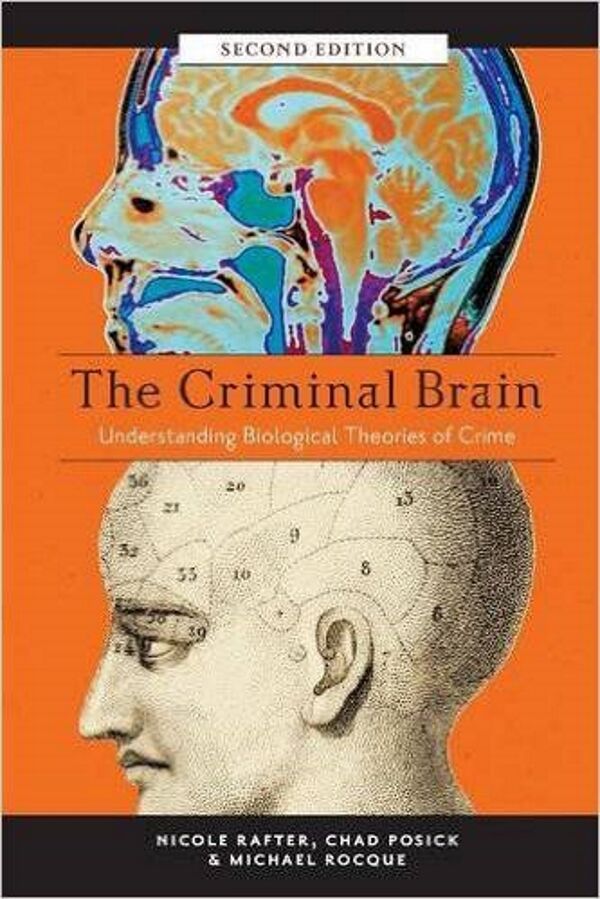
NYU Press, €33.50

CONNECT WITH US TODAY



Be the first to know the latest news and updates

















