Film-maker John Boorman is going in a different direction with his debut novel
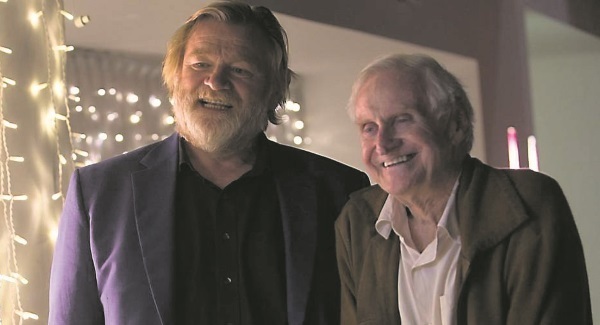
‘Write about what you know’ is sound advice for any debut novel writer and in penning Crime of Passion, John Boorman has done just that. His is a cracking book about film-making, one in which the legendary director features fleetingly, in a token, almost Hitchcockian cameo way.
He’s in good company when he does, as so too does Quentin Tarantino and a host of other Hollywood names. While the primary characters are fictional, there’s a ‘Brad Tullio’ among them. While he shares nothing more than an Italian heritage and a surname with Boorman’s late great friend, Paulo, the inclusion emphasises the personal nature of this hugely informative and engaging novel.
When I arrive for our meeting, Boorman sporting a light tan and casual dress, is sitting on a two-seater sofa. Because it’s small, I go to sit on a nearby chair, but when he cordially pats the space beside him, I obediently sit as directed.
As we chat, Boorman has a refreshing tendency to ponder before he replies; then does so frankly, with a vaguely plummy if entirely agreeable English accent.

On movies, he’s philosophical: “So interwoven are they in our lives that there’s nothing we can encounter that we haven’t already seen or experienced through that medium. They’ve made us second-hand people. Scott Fitzgerald said: ‘Movies have stolen our dreams. Of all betrayals, this is the worst.’”
It has been 46 years since he moved to Co Wicklow from Los Angeles. He moved when American living began to erode his spirit so much that he could feel it shrivelling. Today, he’s still living in the home in which he raised seven children from two marriages. On his 60 acres of land, he has planted 15,000 trees so far, and he’s still planting.
Is he, like Prince Charles, a tree-hugger? “ I don’t … well, I touch the trees a lot,” he says, eyes twinkling. The woody perennials are a topic that clearly intrigues him: “Take for instance the question of how sap rises in a tree; nobody knows how that defies gravity”, he says, before waxing lyrical on a litany of failed theories on the topic.
Boorman’s a man of nature: “A little river runs through my land and there’s a swimming hole, a diving board and a bench there. There’s no one around so I swim in the nude. To me it’s a sacred place.” Having swum there for 46 years, he and the river are well acquainted: “It has a character,” he says. “Sometimes it welcomes me in; sometimes it’s not so friendly.
“But, having walked the 400 yards between my house and the water, on feet that no longer work properly, it’s a matter of honour for me to go in. So I do that, no matter how cold it might be,” he says.

He’s philosophical and candid by nature: “I think I’ve been more honest and truthful in filmmaking than I have been in my personal life and I think that perhaps I have behaved better as a film-maker than I have in my own life,” he offers. “With that, I think my best role has been that of a father.”
He’s less positive on the topic of the future: “Humanity has a criminal record. History tells us that peace occurs in the brief periods between wars. In that sense it doesn’t augur well but on the other hand science has brought great progress and will achieve much more,” he says.
He reads a lot; largely novels, history and the popular science books with which he admits to being ‘obsessed.’ “I don’t have enough mathematics to fully understand science, but even so I read all about it. I find the mystery of living on this planet so extraordinary, that I fear I’m going to run out of time before I discover what everything is really about.”
Despite that, the idea of immortality holds little appeal: “In my view we live too long really,” he says. “Whether we like it or not we’re governed by the same laws of death and renewal that govern vegetables and animals, and any effort to avoid that reality would be disastrous .”

While he has no fear of death, he occasionally gets weary of life and thinks’ it wouldn’t be so bad to get out of here.’ As for what pulls him back he says: “Curiosity is one thing. Love is the other.”
For him, reincarnation is ‘an attractive idea. “I’m very interested in Buddhism. The idea of re-birth is something we can very much observe on this planet.
As for whether he believes there’s anything after death he says: “I just don’t know. I lost a beloved daughter to death and would love to feel she still exists in some form or another. I’m curious and would like to find out. I hope to prize one or two more secrets from nature before I die.”
And kind? “Oh yes, and kind. Love and kindness are the two most important things in this world. Kindness and love. That’s what it’s all about.”















