Sarah Crossan is gaining huge recognition for conjoined twin story
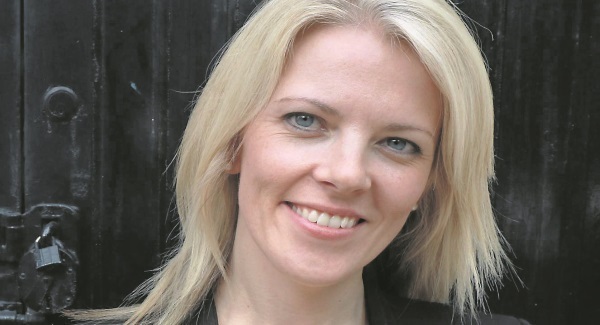
SARAH CROSSAN sounds somewhat shell-shocked the morning we talk. It’s hardly surprising given that the Irish writer, resident in England, is still digesting the news that Britain has voted to leave the EU.
“It’s a really weird morning, it feels like nothing else matters,” she says. It’s a shame to even have to mention the ‘B’ word, given Crossan has plenty of reason to celebrate, having been awarded the prestigious Carnegie Medal for her young adult novel One just days previously.
Described by the Carnegie judges as ”poignant and perfectly crafted”, One is the story of conjoined twins who face a heartbreaking decision as adulthood approaches. Crossan, who spent her formative years in Dublin and is now based in Hertfordshire, was inspired to write the novel by a real-life story.
“I saw a BBC documentary called Joined for Life about Abby and Britney Hensall, who are Minnesotan twins, and I thought it was a fascinating idea for a teen novel. The very idea of being joined to another person in any way is a scary idea, never mind going through that when you’re a teenager and you’re struggling with the idea of identity anyway.”
It is the first time in the history of the Carnegie Medal that it has been awarded to a novel written in free verse. Crossan said the book started as a prose novel. “I thought that would be easier because it was going to be quite a complicated book in terms of medical background and everything but I had written 30,000 words and it wasn’t working.
“My agent told me to start again and I did, in verse. I knew having written Weight of Water [Crossan’s award-winning book about a young Polish immigrant in England] that it is a very time-consuming process. You have to wait for the words to come to you, you can’t sit down and bang out a thousand words a day. So it was a more daunting prospect but once I had finished it and sent it to my agent, and I got a positive response, I knew I had done the right thing.”
Crossan’s previous books, Apple and Rain, The Weight of Water, Breathe, and Resist, have garnered numerous award nods and prizes. But One, which also won the Children’s Books Ireland Book of the Year and Children’s Choice Award 2016, has touched a special chord with readers.
“The response has just been so lovely and amazing. I had nice responses to my other books but I’ve felt really overwhelmed by the reaction to this,” says Crossan, a former teacher. “People who have read it will tweet me to say they were in tears, which I hadn’t anticipated. It’s lovely to have that connection with readers that I haven’t really had in the past.”
One is a powerful and sometimes wrenching read; how does Crossan feel younger readers process such strong subject matter? “I think the issues in the book are dealt with in a way that’s delicate enough that a child can self-censor. There are some moments in it that younger readers haven’t picked up on. I think that’s really important because I’m not in the business of writing brutal stories; I’m in the business of writing stories for children that are palatable for children. I think if you want to write an adult story, write an adult story. I have no interest in disturbing young children or exposing them to things that they are not ready to be exposed to.”
What does Crossan think of the explosion in YA crossover fiction, with many books being marketed at adults as well as younger readers? “I think it’s great for adults to be reading YA, especially as a way for parents or teachers to connect to younger people. Every child is different so when it comes to a child reading YA, it might be that one 11-year-old is ready for it and one 14-year-old is not ready for it. I think it just depends on the individual.
“I’m not advocating censorship — I’m saying a teen novel is a teen novel and an adult novel is an adult novel and if I wanted to write an adult novel, I would do that. The quality of YA is so high, there is so much literary fiction now; you’ve got John Boyne, David Almond, and Deirdre Sullivan, whose book Needlework is a phenomenal example of a crossover novel that deals with a very difficult subject delicately.”
Writing has become a less private endeavour in recent years with the advent of social media and many novelists sharing their work online, not a route that Crossan was keen on taking when she started out.
“I did my apprenticeship on my own without really telling anybody. I was picked up [by an agent] quickly but I know that’s because I spent eight to ten years writing a really bad novel. It was only when I had written something that I thought was half-decent that I sent it out and it was only because my friend forced me to do it.
“I would never encourage people to be sharing work or sending it out if they are not 100% happy with it. There’s a really fine balance between being confident and being arrogant. You need to be your own worst critic and I certainly was. Even now, when someone says they like my book, I say thank you but I’m still thinking it could be better. When I sent One to my editor, I kind of closed my eyes and pressed send because I didn’t think it was good enough. I’m a little suspicious of authors who are very pleased with their work.”
Crossan’s next project has relaxed her attitude to sharing her work somewhat, a collaborative verse novel called We Come Apart, written with Dublin-based author Brian Conaghan. “Collaborating with Brian was absolutely fabulous, the best writing experience of my life really. To suddenly be in this position of writing a chapter and then sending it to somebody and getting feedback within 20 minutes was very peculiar but really freeing. I learned to be less precious about my work. It was very easy to be honest with one another about what was working or not working.”
Given the many demands on her time, and the media attention following her awards success, Crossan has to make a determined effort to carve out time for writing. “It has been a challenge. My husband works long hours so the domestic role does fall on me. I prioritise looking after my daughter, then my writing, then looking after the house. In that order.
“I’m sure it’s the same for every parent. Although as a mum, the guilt is innate, it is part of the fabric of my being. At the same time, I don’t want to be resentful, there’s a balance. I can sometimes find myself feeling quite agitated if I haven’t been given space to write. I have an office at the end of my garden, and I’ll go hide there when my husband comes home. It is really lovely winning the awards but that can’t be the reason I’m doing it. If I’m not getting the time to do the writing, then I’m not really doing what I love.”


CONNECT WITH US TODAY



Be the first to know the latest news and updates

















