John O'Brien is bringing song to his native city for Cork Midsummer Festival
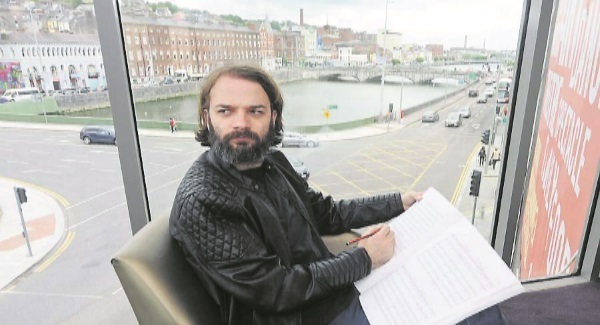
HE BURSTS into the foyer of Cork Opera House like a tornado. “Sorry I’m late. Had to move a piano,” says John O’Brien. The thirty-something conductor, director, and composer has packed a lot into his life, so far.
He has done 40 productions of opera and musical theatre. Pagliacci, Der Vampyr, Faust, for example, and all nominated for prestigious awards. Easter 1916 was premiered by Fiona Shaw and the RTÉ Concert Orchestra. He has done film scores, play scores, short films, choral works, piano pieces, and operatic and orchestral arrangements.
Right now, he’s hard at work on a concert version of La Traviata, to be presented at the Opera House on June 25, with Majella Cullagh singing Violetta. Barely will the curtain have come down on that, before O’Brien begins rehearsing The Merry Widow, also in concert performance at the same venue, on August 27.
Then, in September, comes his own special progeny, the world premiere performance of The Nightingale and the Rose, an opera based on Oscar Wilde’s heartbreaking tale, at the Everyman. O’Brien can’t contain his excitement.
“I’ve had this in my mind for a long time. We’re hoping to stage it as a full production next year, if all goes well. I’m writing the script, the score, everything.”
The only difficulty, he says wryly, is finding time and space for concentrated work in Cork. “There are always people wanting to chat.”
The solution? “I took off to Budapest for a week. Stayed in a cheap apartment, made myself work from 9 to 5 every single day, and went out in the evenings to operas, concerts, whatever was on. Got lots done.”
Why are these operas being presented in concert form? Because then it’s affordable, says O’Brien. “You get all the music, all the arias, but without the frightening costs of staging a full-length production. Of course, the principals will be giving it all the feeling and emotion each story requires”.
Funding is a perpetual problem, and not getting easier, he says. “There is no point in railing against that, because there never was much to begin with. You just have to make the best of the situation and think what you can do to bring music and opera to your audiences.”
Both the Opera House and Everyman are wholeheartedly with him, he enthuses, in keeping up that great Cork tradition of music.
“Over the years, we’ve built up such a following — not just the stereotype of the older, well-to-do, but so many of the younger generation who love opera and will go anywhere to hear it.”
Much of that success is down to O’Brien and the innovative ways he stages his productions (musicians moving freely among the singers, or are perched in eyries high above the stage, an entire brass band exploding in sound from the back of the auditorium).
Typically modest, he attributes much of this to the great people with whom he works. “Performers, costume designers, set creators — they’re all so willing to throw themselves into new ideas, come up with even more exciting options.”
And that is why he’s still here. “Yes, I do go abroad from time to time, when I’m offered a particularly interesting project, but I don’t want to leave here permanently. I’m of this city, and it’s part of me. We have a very special culture, with everybody willing to volunteer, to cooperate. I’m not sure I’d find that anywhere else.”
His main reason for making his hometown his base, though, is that he genuinely believes the people here have a right to hear beautiful music, splendid singing. “If we grow into a society that has no music, no artistic culture, what kind of world are we creating?”
La Traviata, Cork Opera House, next Saturday, June 25, as part of Cork Midsummer Festival















