The wheel of life turns again for Yeats family
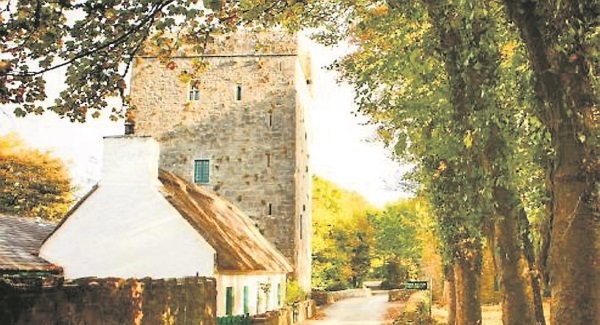
N 1917, William Butler Yeats paid a small sum for Thoor Ballylee, a 15th-century tower house in Galway. The building had long attracted Yeats, given its venerable age (what he called its “severity and antiquity”), its location in Yeats’ mystical west, and its proximity to Coole Park, home to his friend, collaborator, and benefactor Lady Augusta Gregory.
In the hands of his new wife, Georgie Hyde-Lees, the tower became a summer home for 12 years, and a place of inspiration for Yeats. It’s where he wrote his greatest collection of poems, The Tower, on “two heavy trestles, and a board,” in “a chamber arched with stone.”
Yeats also left for posterity a poem “to be carved on a stone at Thoor Ballylee”:
It’s a vision that almost came to pass, twice. Once, before the State restored it in the mid-1960s and, more recently, since 2009, when severe flooding caused its closure as a tourist attraction.
Yeats’ granddaughter, Caitriona Yeats, remembers those days in the 1960s. “We used to go in summer,” she says, “and had an annual trip. It was empty then and needed work, but we would go right to the top for picnics and swim in the river. It was so much fun, but it was falling apart.”
Caitriona Yeats is returning to the tower this week, in her role as a professional harpist. She will be performing as part of the Harvest Moon Festival, one of a year-long series of festivals of the moon that have, in the poet’s sesquicentennial year, marked his work’s frequent lunar references.
Yeats will be joined by Áine Ní Shioradáin, harpist and singer; Michelle O’Sullivan, a poet; and Nicola and Karina Cahill on harp and flute.
Yeats is a soloist with the Danish Radio Symphony Orchestra, and also controls the copyright for the work of both WB and Jack B Yeats. “My father [the late senator Michael Yeats] left me the copyright as I am eldest and so I am the one who has taken over that mantle,” she says. “I take an interest in it now especially, though it’s not very much work. The letters are the only thing still in copyright, but I take care of Jack’s copyright too. I always try to get to the Yeats Summer School in Sligo.”
WB Yeats’s 150th anniversary has, she says, made 2025 a busier year than usual. “It has been great that he has been put forward in the world again, with so much attention this year. Not that he ever really stopped attracting people, but I think there is just so much awareness now”.
Yeats refuses to put herself forward as an authority on the works, and there is, after all, an army of academics who can do that job. But, she says, “the poetry is fantastic. And I’ve read it more than ever this year”.
It wasn’t always that way, she admits. “The poetry was rarely read in our house,” she recalls. “And it’s never easy when you’re young to have a name like that in the family, because you need your own identity, you know. As a young person you have to fight to have own identity.
“As I’ve gotten older it’s become easier. I have had that career as a musician and I have made that identity as a musician.”
Caitriona counts Lisbon and Milan as recent stop-offs on the 2015 WB circuit, but says she is particularly thrilled to be coming back to the tower, now reopened. “It’s wonderful what the locals have done,” she says.
The reference is to the Yeats Thoor Ballylee Society which, through donations and fundraising, succeeded in seeing the tower open again to tourists this summer for the first time since 2009. “I am thrilled that it has been reopened,” says Caitriona. Plans are afoot for an exhibition space, cafe, bookshop, and a host of regular events. For now, the Harvest Moon Festival seems a good way to get to know this remarkable building.














