Exhibit shows that Guinness makes ads with a good pint
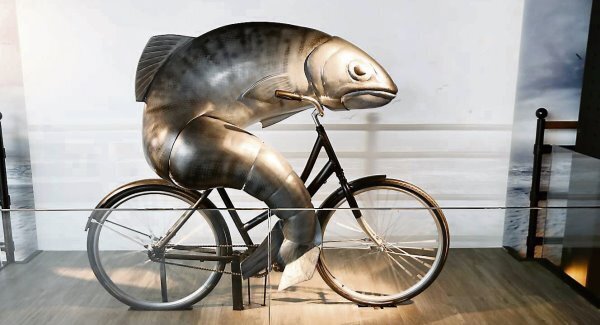
Guinness has been credited with some of the world’s most iconic advertising and, says Ed Power, its quality hasn’t faltered since it launched its first advertisement, to the chagrin of its owner, in 1929

Exhibit shows that Guinness makes ads with a good pint

A MAN dancing around a beer glass, waves crashing against the shore, an exotic bird with a rainbow beak — as advertising, these images sound banal. Mad Men’s Don Draper might arch an eye-brow before coming up with a far cleverer idea.

Yet, from such apparently unpromising ingredients has beer-maker Guinness spun marketing gold. A new exhibition at its Dublin Storehouse tourist centre makes this plain. The number of iconic Guinness ads is striking. The story of 20th century advertising in Ireland — and Britain, where the company’s key marketing decisions were made — is in many ways the story of Guinness.

Examples of their adverts include the stunning ‘Surfer’, from 1999, in which a man on a board tangles with waves transformed into charging stallions, and 1995’s ‘Anticipation’, the proto-viral video of a chap with scary eye-brows pirouetting maniacally as his pint settles. Before those were the iconic billboards of the 1930s and 1940s, the source of such enduring catchphrases as ‘Guinness is good for you’ and ‘Guinness gives you strength’. A pint of Dublin’s favorite stout need never have passed your lips for you to appreciate its stellar brand power.

“Visual identity is hugely important and would have contributed to the global recognition of the brand,” says Eibhlin Roche, Guinness archivist and curator of the new exhibition. “The quality of the advertising is almost as well-known as the [quality of] the pint.”

Ironically, Guinness came late — and reluctantly — to advertising. Established in 1759, it was only in 1929 that the company stooped to the grubby business of touting its wares. Even then, the debut advertisement, in the Daily Mail on February 6, 1929, radiated ambivalence. “This is the first advertisement ever issued in a national newspaper to advertise Guinness,” the notice began — reflecting the suspicions the head of the Guinness family, Lord Iveagh, held towards the medium.

Because Guinness was in two minds as to whether it should hawk its goods, the company’s first advertising agency, London-based SH Benson, was determined to do a sterling job, to win the trust of Lord Iveagh as much as that of the beer-swilling masses. It set high standards, which Guinness would thereafter strive to follow.

It was a young Benson executive who minted the famous ‘Guinness is good for you’ slogan, after being tasked with discovering just what it was about the stout that elicited loyalty among drinkers.

Roche says: “They went to a lot of the pubs in London where their offices were based and asked punters: ‘Why are you drinking Guinness?’” she says. “Nine out of ten times the answer back was ‘Guinness is good for you’. That’s where the slogan came from.”

The Guinness toucan was unveiled soon afterwards. It was the brainchild of John Gilroy, Benson’s in-house artist (and former cartoonist with the Newcastle Evening Chronicle). He created the famous ad in which a seal balances a bottle of Guinness on its nose, as a pair of thirsty zoo-keepers look on.

“Benson was toying with using a human family to advertise Guinness,” says Roche. “Gilroy came up with the idea of a circus. He went to one and saw a sea lion balancing a ball. He thought, ‘well, what if it was balancing a bottle, instead?’ Then, in the early 1930s, the Toucan came on board. Why was a Toucan popular in the mid-1930s? My theory is that it was inter-war London, after the Wall Street crash. Here was a smog-filled city and you had this exotic, colourful bird beaming down from billboards and underground Tube stations — it really caught the public imagination.”

The brand hasn’t always had a smooth journey. It has been criticised for conflating Irishness with alcohol. Especially contentious was the relatively short-lived Arthur’s Day music campaign, with figures such as Christy Moore and The Waterboys’ Mike Scott leading the backlash against what they regarded as a crass, cynical stunt.

But Guinness’s truly iconic ads were created not in Ireland, but in the UK. Gilroy’s illustrations, especially, reflect a wry and phlegmatic worldview that is fundamentally British in tone. That said, several iconic Irish-made campaigns feature in the Storehouse exhibition, most prominently the late 1970s television ad, ‘The Island’, in which flat-capped Currach rowers deliver a precious barrel of porter to the Aran islanders.

The spot was widely praised and won a Silver Lion at Cannes and a Clio in New York. The famous ‘Surfer’ promo, directed by filmmaker Jonathan Glazer, is said to have been based on an earlier Irish ad, ‘Big Wave’, in which a man crests a wave as Louis Armstrong croons in the background. So while Guinness’s marketing strategy was consistently global, glimmers of Irishness could often be discerned in the corners.

“The thing about Guinness advertising, through the years, is that it’s never quite what you expect it to be,” says Roche.”There’s always that extra twinkle in the eye. Lord Iveagh didn’t feel Guinness should advertise — so, from the start, the company was determined that the standard should be as high as possible. That has been the tradition ever since.”

The Guinness Advertising Exhibit is now open at Guinness Storehouse, Dublin.

x

More in this section

Cookie Policy Privacy Policy Brand Safety FAQ Help Contact Us Terms and Conditions

© Examiner Echo Group Limited













