Time to switch off and disconnect from the digital world
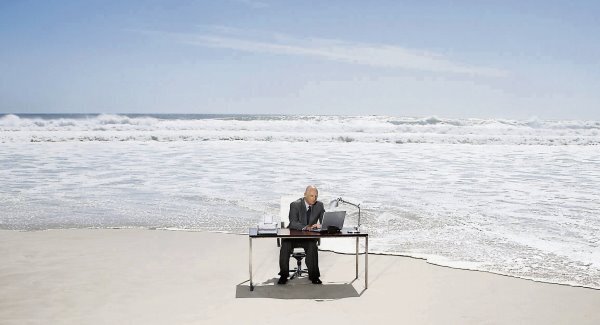
With technology blurring the lines between work and home, people are finding it more difficult to get down time, writes Ailin Quinlan

Time to switch off and disconnect from the digital world

When I called psychologist, Patricia Murray was just back from a holiday abroad. One of her abiding vacation memories is of “men on the beach and at the pool talking shop and loudly giving orders on their phones while their families splashed about in the pool”, something which “entirely jarred with the surroundings of blue sky and easygoing chatter”.

This blurring of boundaries between work and holiday also spoiled the family fun, she says, because those making work calls were “not in the zone of relaxed holidays”, and tended to be “irate and short with the children”. How, Murray asks now, would the children remember that holiday?

Despite an official 37-and-a-half-hour working week, we are in the midst of an overwork epidemic. Much of this, believes Murray, is due to technology which was meant to free us from the office but which instead saw off the 9-5pm week, leaving us psychologically chained to our desks because we can now work anywhere, anytime. But overwork is also a mindset, Murray says.

“We’ve become more lax in how we set boundaries. Work permeates the psyche, whether we’re on the beach, at home, or at the hairdressers,” she says, adding that although some people consider this acceptable, the mind does not, and it “can end up shutting down or worse, throwing tantrums, if not given the respect it deserves in terms of time off and time out”.

Clinical psychologist Patricia Murray

New technology is imposing entirely new pressures on staff, according to a 2012 report by the Chartered Institute of Personnel and Development in the UK in 2012.

The study, which examined the differences between the modern workplace and that of the 1950s, states: “While it has liberated people to work from home or outside the office, it has also created pressure for an instant response, enabled more sophisticated monitoring and surveillance of employees, and blurred the boundaries between work and non-work time.”

Employees had a 48-hour working week in 1952, while on paper in 2012, a typical worker in a full-time job in the UK officially clocked up just 37 hours.

But the reality of their working weekwas much different. Many feel obliged to keep a watching eye on social media, their phone and/ or email and this can substantially extend that sense of ‘being on’.

“The fact is,” says Joe MacAree, business psychologist and MD of the Dublin-based firm JMA Consulting, “that most people in supervisory or management roles are available on the mobile or by email outside of office hours so you’re on duty longer.”

Thus many modern employees find it increasingly difficult to switch off:

“People have a difficulty in winding down, in coming home from work and taking a break. It comes back to the fact that the job is more ever-present and on their minds more. They may be getting emails from work or from people within the business because they are much more accessible. Someone will email a person and then text them to ask if they got the email. It’s quick access, quick response, and a higher expectation of an immediate response. People are always switched on.”

He doesn’t believe the recession made us work significantly longer hours: “Prior to the recession people were already building to those pressures,” he says. MacAree believes that business owners and/or employees should agree a ‘work-charter’ on good practice regarding after-work emails. “You make an agreement not to email phone, or text after a reasonable hour, say 7pm, unless there’s an emergency — and emergency will be defined.”

It’s important to remember, warns Hugh O’Donovan, a coaching psychologist, that smart technology has only been in the workplace with us for a relatively short time. Its long-term impact on the human nervous system is not known. Human beings have a limited amount of attention and energy but technology increasingly requires us to be available 24/7, warns the former army officer who recently published his first book, Mindful Walking: Walk Your Way to Mental and Physical Health.

“As a working psychologist, I see how employers are under increasing pressure to grow and make a profit and how employees are increasingly put under pressure to deliver more with less,” O’Donovan says.

“I’m dealing with people where the demands of organisations are causing unnecessary stress and strain, where people are routinely contacted by a senior manager via email or text at home, at night and expected to respond immediately. This could go on up to 10pm or 11pm.”

Coaching psychologist Hugh O’Donovan.

So what can the employee do?

“We have choices in how we engage with the challenges we face,” says O’Donovan, who argues it’s important to recognise when it’s time to have that “difficult conversation” with a senior manager — to place boundaries around late-night calls and emails.

Technology can also make things worse for personality types such as the ‘worrier’, says Murray, because it doesn’t allow them to disengage from work.

“They are at home checking social media, emails and texts and if they work in a job where they are dealing with different time zones they could be checking 24/7.

“Technology is fuelling that anxiety, and it is mostly about checking. It’s like an addiction,” she warns.

While the worrier will want to unwind — and there are strategies which can help (see panel) — some employees are genuinely reluctant to switch off because they get a buzz from work.

This drive, too, is fuelled by the availability of technology. Unless such employees see the light, they’ll eventually suffer the effects of a poorly balanced lifestyle; depression, fatigue, stress, weight gain and isolation, Murray warns.

“They’ll cover it up with drinks, drugs, with lashing out, and with big purchases,” she explains, adding however, that an unhealthy obsession with work can also lead to relationship breakdown.

“A lot of these people would be in senior positions — lawyers, medics, consultants, entrepreneurs — and are highly paid.”

An always-on lifestyle is bad for them and their relationships, she warns. “It’ll come back to haunt them in their late forties or early fifties; perhaps with a health scare like a heart attack,” she says, adding that she doesn’t believe the recession has any significant impact on this mind-set.

“They might use it as an excuse or they may be encouraged to work harder because of the recession — but the drive is in them.”

Tips to take your mind off the working world

Use your commute home to clear your mind. Play relaxing music in the car and listen mindfully. Or else swap the car for a bike or walking, either will separate work from home.

Change your clothes on arrival home. Have a shower — it creates a boundary and a transition to home-time.

If a work-related issue is nagging, write it down. Do this as early as possible — by 10pm at the latest.

Don’t allow your phone to disrupt your social life — it’s not OK to check work-related messages when you’re out with friends.

Take up a hobby that’s free and easy to do and releases good endorphins — walking, jogging, or photography — and do it four or five times a week.

Join a club which requires some commitment and socialisation — it will give you structure , takes you outside your head, and provides new focus.

Develop your emotional fitness by seeing things as they are — not worse than they are and then visualising things as better than they are.

If you must return to work in the evening put a time limit on it.

If you have trouble sleeping, distract your mind with plans for your next holiday or garden.

x

More in this section

Cookie Policy Privacy Policy Brand Safety FAQ Help Contact Us Terms and Conditions

© Examiner Echo Group Limited













