Vintage view: Georgian mahogany
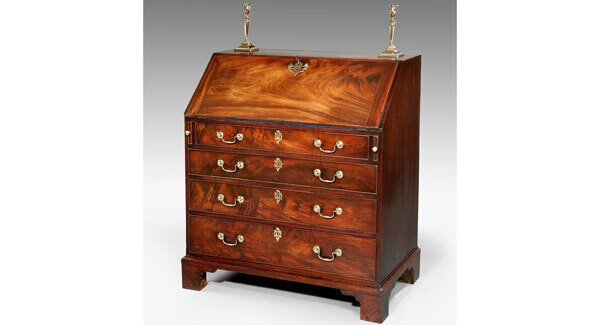
Kya de Longchamps explains why it really is a bright idea to give your home a creative lift with the dark gem that is Georgian mahogany.

Vintage view: Georgian mahogany

LIDE your fingers over the silken finish of a ruby rich piece of Georgian mahogany, and you can feel that first flush of pleasure an entitled gentleperson of the 18th century may have experienced on delivery of their new writing desk or dining table.

Tropical hardwoods have an unsettling history, and mahogany has a sombre story embedded in its very name. It’s a wonder that a mini-series framed around the intrigues of the trade in precious trees has yet to hit the small screen in a luscious period drama.

The wood we recognise in the most gorgeous of 18th and early 19th century furnishings are three species of the Swietenia family of trees, from Central and South America, opening into a wider scattered area that includes Florida in the US, and some of the West Indian islands.

Mahogany was first heard of in print in John Ogilby’s America, published in 1671, and until the mid-18th century was classified by botanists as a kind of cedar for the red colour of its timber.

Similar trees were known in parts of West Africa, and named ‘mo’ganwo’ by the indigenous peoples.

It’s believed that when generations of these tribes were taken as slaves through Jamaica, Honduras and the Bahamas, the name was probably attached to the trees that surrounded some of these colonies to which they were transported.

The Spanish used the dense, oily wood of mahogany for joinery and shipbuilding in the 16th and 17th centuries, and it was such a vital commodity that the trade monopoly was owned by the Spanish Crown from 1622.

By the 18th century, mahogany shared the status of gold, spurring trade wars and treaties amongst the British and Spanish, the Spanish owning the majority of the available forest.

Once the British began to work the tightly grained mahogany from their West Indian territories out of a supporting role in joinery and panels, and onto the face of their furniture (especially Honduran mahogany), the import of this and other tropical hardwoods took off.

Mahogany could be bought relatively cheaply in huge planks, large enough for a grand table top.

It was not only strong and stable but held more detail when carved than the more expensive French walnut (the former favourite of the 18th century).

The French grew sulky in 1709, and banned the export of walnut used for English rifle butts, enhancing the trade in new woods from the New World.

From 1722 tropical woods to Britain were made free of any import duties, an attempt by the government to tickle up the export of English furniture.

Always looking for ways to out-grace their peers, fashionable Georgian gentry became feverish for ‘the mahogany,’ a generic term for dining tables in a high polish in any good hardwood.

Mahogany may have been a luxury commodity but it was soon stripped back to rare tracts sourced by adventuring, itinerant merchants.

These characters were not above poaching trees from Spanish controlled forestry for the British and the merchants of the newly established USA (1776).

By the late 19th century the hunger for tropical hardwood would lead to the large scale destruction of vast tracts of ancient rainforest throughout Central America.

In 1875, 80,000 tonnes of mahogany was imported to Britain from the Americas, and large scale logging ruined the market as trees in large quantities became impossible to secure.

Specialist mahogany surveyors were posted at American seaports to examine and identify quality mahogany from a host of pretenders. Smaller trees and woods not of the genus were a complicating factor for a century before the whole market collapsed in an intercontinental log-jam of greed.

Mahogany was so valuable, that it was said that escaping slaves would often attempt to take a chair or small table from the master’s house on their back in their flight.

Charles Dickens, who pricked the popular conscience in ways far ahead of this time, had a distaste for mahogany, referring to its magnificent colour as ‘the hue of wretched slaves’.

With the passing of these darker passages of our shared history, Cuban, Honduran and Swietenia mahogany have entered the protection of the the Convention on International Trade in Endangered Species of Wild Fauna and Flora (CITES).

None of the three species have been commercially traded in any quantity of cut logs from Central and South America since 1995.

Harvesting is strictly regulated where it is allowed. Most of the late 19th century mahogany you will find on the market today is African in origin, not American mahogany. Swietenia are now commercially grown in Asia with great success, and are expensive and prized with their long growing times and fabulous shades and patination.

The russet beauties in mahogany furniture of the Georgian period are now unique. Most made in commercially extinct wood, they mark a place in an almost forgotten environmental and human tragedy.

More in this section

Cookie Policy Privacy Policy Brand Safety FAQ Help Contact Us Terms and Conditions

© Examiner Echo Group Limited













