Quintet gathers Ireland’s five best sculptors for Cork exhibition
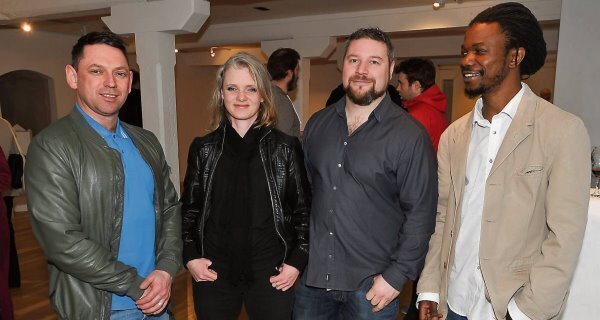
Quintet is an impressive exhibition that gathers work from a number of Ireland’s top sculptors, writes Alan O’Riordan

Quintet gathers Ireland’s five best sculptors for Cork exhibition

Five sculptors have come together for the current exhibition at the CIT’s Wandesford Quay Gallery in Cork. Between them, they give five very different expressions of the shared material base for each of the works — stone.

Letterkenny artist Redmond Herrity brings a witty series that consists of bottles and cans, a dented milk carton, a discarded olive-oil bottle.


They freeze forever in marble momentary shapes of what are literally throwaway objects. The contrast is striking, a comment both on the difference between the material and what’s represented, and on the disposable world we live in as the mass-produced shapes are suddenly frozen and rendered into the artistic realm.

Sligo-based Martha Quinn contributes works based on geometric shape, clean lines and carved patterns in beautiful stone. Corkman Michael Quane, meanwhile, contributes a typically dramatic horse-and-rider composition among other figurative works.

DISCOVER MORE CONTENT LIKE THIS

The man who brought this all together, James Horan, himself contributes a selection figurative works — from round, generously proportioned figures that suggest primitive fertility art, to a more athletic-looking, though never naturalistic, figure.

Horan, a Dublin-born graduate of the Crawford College of Art and Design, is joined in the gallery when I visit by another of the group of five, Blessing Sanyanga. If the show itself gives an insight into the fellowship of stone, then so too does their conversation, as they discuss the peculiarities of their art.

“There’s so much pleasure in sculpting,” says Sanyanga. “There is a stage when you start seeing what you are creating, when you can’t wait for the piece to finish. Even without selling you have that satisfaction, of making something that could last thousands of years.”

Sanyanga gestures to one of his contributions, a limestone octopus. “Imagine when that’s just a block,” he says. “It comes in two ways — I see the octopus in the stone and try to take it out, or sometimes there are naturally shapes in the stone and you have to try to develop them, but not make it too obvious. You have to compromise,” he says.

“You can have an idea,” Sanyanga continues, “but the stone might start leading you in its own direction. It’s beautiful. You can end up creating a very different piece than you thought.”

“Every medium has it’s own pros and cons,” says Horan. “What hooks the stone carvers in is that little fight with the stone. You can have a great idea and start into a piece of stone when all of a sudden it changes because what’s there is fighting back too much…. You end up doing something else.”

Sanyanga doesn’t work from models. “I have to see it in my head first. That’s how my mind works; I can’t stop creating. I can’t stop.”

“I don’t know if it’s particular to sculpture,” says Horan, “but we seem to be quite practical and level headed in comparison to some of the contemporary artists I’ve met. There is a technical element to it, but I suppose if you live purely in a theory world, it can be difficult to lift 200 kilos. Those practicalities always bring you down to earth. You can’t get over that if you are carving stone — it has to be done by hard work.”

As we take in the work, Horan explains the long gestation of this group show. He’s been trying to get the five in the same room since 2007. “It was nice to get them together,” he says. “They work well stylistically together. It’s a good show in that it shows a diversity in what people can do with stone. People have a traditional notion of what stone sculpture should be. But it can be used in a modern or contemporary sense. It doesn’t have to be used to make beautiful figures; it can be what you like. These artists are important because they all do their own thing.”

SCULPTOR’S REVENGE

One of James Horan's figures in the Quintet exhibition in Cork

There’s an element, too, of the sculptor’s revenge here — for once, they are not having to share the gallery space with whatever is hanging on the walls. “Normally, when you do an exhibition when you are a sculptor you’re maybe one of one or two sculptors if there’s that,” says Horan.

“And the rest is printing, painting, photography, so it’s nice to see a purely sculpture exhibition that is about form and shape and texture. It’s different for people coming in also, for them to come into a traditional white-wall gallery with nothing on the walls and just focus on sculpture.

“That’s the other reason I want to do this, so the work wasn’t just secondary to painting — purely form and sculpture.”

Horan’s own selection is pretty representative of his work, down to the quirky inclusion of a lifebuoy, painted red and white, in one of the pieces “I rarely do anything other than figures,” he says. “I like people. I like trying to make a figure from a block of stone, exaggerating proportions in order to get compositions right — turning the figure into shape and form.

“One of the things I try to do is make them as soft and welcoming as possible. I often notice people unconsciously just rubbing the stone. That’s a good sign, a nice thing. It’s obviously doing its job if that’s happening. So, you do struggle with that and try to make new compositions. Sometimes you get a nice cut shape, and that can be formulaic at times. It’s nice to get to the quarry and just get a big rough piece of boulder and try to work out what’s in there, and try to pull out the shapes that are in it.”

SHOULDER TO SHOULDER

Blessing Sanyanga with his busts at Wandesford Quay gallery

One of the more striking works is Sayanga’s ‘Shoulder to Shoulder’, a pair of busts of Nelson Mandela and Katie Taylor. “Mandela was a boxer before he went to prison. After that he became a president,” says Sayanga. Clearly, he’s got high hopes for Taylor.

“Obviously after a few years she’ll have to retire from boxing, but the talent that she has for boxing, another talent always comes out of that. In boxing you get that discipline and leadership.”

Sanyanga’s roots go back to Zimbabwe, where his father and his grandfather both were sculptors. He came to Ireland more than a decade ago, first to Dublin, and for the past five years Cork, where he says he’s happier working.

As talk turns to the city and its history in sculpture, Horan chimes in: “Cork has a very good love of sculpture. More so than the rest of the country. Cork seems to understand three-dimensional work, and I think there’s a particular affinity for stone, given the history of ‘Stone Mad’ Murphy and all that.”

Is this affinity expressed at the sales till? “It can be,” says Horan. “Commercially at the moment it’s hit and miss for everyone. Like a lot of things, sales were increasing up to 2008 and it was very quiet since. But things picked up last year and again this year.”

Quintet is at CIT Wandesford Quay Gallery in Cork until April 25

A separate exhibition, which also features works by Michael Quane and Martha Quinn, among others, is at the Lavit Gallery until tomorrow.

READ NEXT: Alfie proves he is more than just Lily Allen’s brother in Game of Thrones role

DISCOVER MORE CONTENT LIKE THIS

More in this section

Cookie Policy Privacy Policy Brand Safety FAQ Help Contact Us Terms and Conditions

© Examiner Echo Group Limited










