More power to your hormones with age
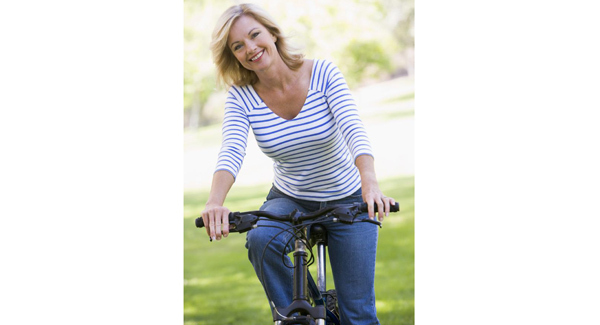
HORMONES become a woman’s best friend after menopause, launching her on a creative, confident path for the second half of her life — and there is scientific evidence to prove it.
While we are more familiar with the negative press the menopause receives — hot flushes, mood swings, and lack of energy — once that transition passes, women enter a testosterone-fuelled phase that liberates them, according to Jill Shaw Ruddock, the author of a book out next week, entitled The Second Half of Your Life.
“This is what happens: We lose 100% of our progesterone, 99% of oestrogen and 70% of testosterone.
"Then when our brain is no longer permeated with oestrogen we become testosterone dominant in the second half of our life and that makes us want to take on new challenges,” she says.
It was in 2011 that London-based Ruddock, who will be 60 this year, wrote the original edition of the book, which has since been reprinted nine times.
She discovered at age 48 that her depression and weight gain were as a result of her having gone through the menopause, in complete ignorance.
This set her off on a four-year path of interviewing more than 200 women and numerous experts not only about the menopause process, but also about how to age well in the decades afterwards — considering our lifespan has extended so much.
As a result, she developed what she calls the ‘five-a-day’ formula which she believes is necessary for healthy ageing: 1. Staying connected to family and friends; 2. Cultivating a passion; 3. Finding a purpose greater than yourself; 4. Exercising almost every day; 5. Eating well.
She then went on to set up The Second Half Foundation and the first British modern day community centre in the NHS hospital of St Charles in London, called The Second Half Centre, which encourages those five-a-day practices among its 1,500 members, all aged over 50, from all socio-economic groups.
In this new edition of the book, she develops in more depth the hormonal theory and the resultant change in brain chemistry, but she stresses that while testosterone can drive women in the second half of their life, the choice is ultimately theirs to act on it, by practising the five-a-day formula.
If the testosterone — which has given males their evolutionary drive — has always been dominant, then why have women not ruled the world, so to speak, post menopause?
Ruddock says: “I think that women believe that growing older is about decay.
“They think ‘I won’t do as much’, ‘I’ll rest on my laurels’, because you know our mothers did that. They don’t do the ‘five-a-day’ and they’re not getting out to do the things they are biologically programmed to do. And then before a woman knows it she becomes old before her time and she gets all the age-related diseases.”
There is no evidence of Ruddock herself resting on her laurels — as she might well do. A former managing director of a London -based US investment bank — managing its $60m (€53m) European Equity business in her early 40s — she is independently wealthy and married to Sir Paul Ruddock, who is estimated to be worth over £200m.
Both are well-known philanthropists, including having heavily funded the Second Half Centre, before it was afterwards handed over to be managed by the Open Age Charity.
She is currently working on a template for the centre so it can be duplicated countrywide “maybe even in Ireland,” she says —her main goal being to prevent isolation and loneliness among those aged over 50.
With two daughters aged 20 and 23, who have both volunteered at the centre, Ruddock’s own passionate drive towards this dream can be traced back to her own socially deprived American upbringing and her sadness around the fact that her own mother ‘gave up’ aged 60 and became depressed and isolated.
“I grew up in an incredibly poor background, in inner city Baltimore,” she says.
“I did not come from a privileged background — quite the opposite! I want to be really clear on this — I came from nothing. I think it is the most important thing I can share with people, that this is not some rich person who ate bon bons all day and whatever. I mean I have worked for everything I have ever achieved.”
If her approach to ageing was a brand, then she is the best advertisement for it; rising from the ashes of her own difficult menopause to share her new-found knowledge and offering a practical social solution to ageing isolation.
Her book is immensely readable and offers advice on tackling ‘Second Life’ challenges including relationships, and sexual and financial issues.

CONNECT WITH US TODAY



Be the first to know the latest news and updates

















