Book review: Inherent Vice
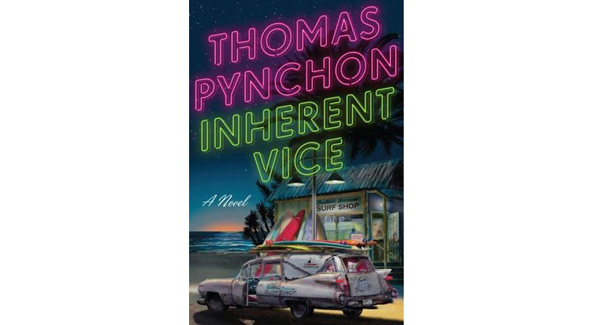
by Thomas Pynchon

Book review: Inherent Vice

LOS ANGELES in 1970 is a world of flower power in terminal wilt. Charles Manson is awaiting trial and the ‘summer of love’ has broken hearts. Private investigator, Doc Sportello, a leftover hippie with a fondness for the best highs, gets a visit from his ex-girlfriend, Shasta.

Her latest flame, a property development mogul, Mickey Wolfmann, is being played by his wife and her lover, who want to commit him to an asylum. But Mickey is protected by Aryan brotherhood bikers.

Doc follows the trail to a brothel and wakes up with a sore head alongside a murdered body, while his old nemesis, a part-time actor and perpetually violent “renaissance” cop, Bigfoot Bjornsen, waits with the news that Wolfmann and Shasta have vanished.

Doc is approached by an ex-junkie named Hope, whose husband, a famed surf-rock sax player and one-time friend of Shasta’s, named Coy Harlingen, apparently overdosed. Hope believes Coy has faked his death. Doc finds Coy, who is working undercover for the government, and learns of a mysterious boat named the Golden Fang. Then, matters turn really complicated.

Famously reclusive and enormously talented, Thomas Pynchon is one of the most important figures in 20th (and now 21st) century literature, a writer whose novels are defined by their dense narratives and symbolic complexities, and by their towering intellect, scale and ambition.

From his debut novel, V, published in 1963, though The Crying of Lot 49 and the National Book Award-winning Gravity’s Rainbow, to 1997’s astonishing Mason & Dixon, he set the bar for American fiction at an intimidating height, and drew comparison with Melville, Dickens, Conrad and Joyce as an epic mind.

His output has increased. Against the Day, in 2006, was a wild, thousand-page slab of historical science fiction, and last year’s Bleeding Edge was a 9/11 state-of-the-cybernation story.

In between, in 2009, came Inherent Vice. His most readable book, it was an obvious pastiche, a heavily psychedelic twist on Raymond Chandler’s hard-boiled Philip Marlowe classics. It was too quickly dismissed as lightweight.

On the back of the big screen adaptation by director, Paul Thomas Anderson, it has a deserved second chance.

Whether it is pastiche or not, die-hard fans will recognise the familiar Pynchonian touches: puns, side-splitting dialogue, peculiar character names, dope, rock ’n’ roll, lazily long and beautifully unfurling sentences, and the constant background paranoia.

But where his more challenging novels feel like intellectual marathons, this is an easygoing stroll. The post-modernistic reflexes have slackened in favour of a convoluted but clean plot.

The result is a warm and joyous read. There is softness about this book, but also a tinge of melancholy. In telling a (for him) relatively straightforward story, Pynchon has put the 1960s in perspective, especially with the hindsight of what was to follow. Inherent Vice represents a world on the brink of apocalypse.

x

More in this section

Cookie Policy Privacy Policy Brand Safety FAQ Help Contact Us Terms and Conditions

© Examiner Echo Group Limited













