Gavin Quinn has oldies but goodies in the Abbey
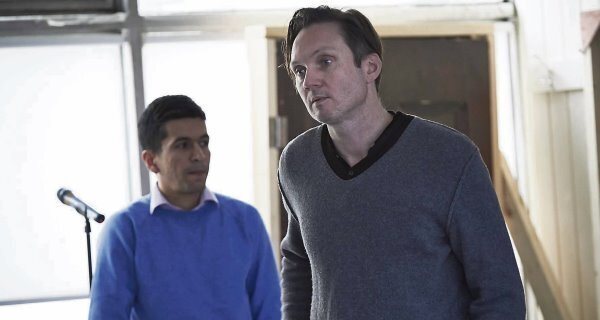
Shakespeare’s comedy is set in a retirement home, and uses some of the Abbey’s veteran actors, writes Alan O’Riordan.

Gavin Quinn has oldies but goodies in the Abbey

GAVIN QUINN’S directorial debut at the Abbey is steeped in the history of the national theatre. His Midsummer Night’s Dream will feature John Olohan, Des Cave, Máire Ní Ghráinne and Peadar Lamb, four cast members of a 1979 production, the last time the play was staged at the venue. Furthermore, Quinn has also cast Áine Ní Mhuirí, who joined the Abbey Company in 1965; and Des Nealon, whose first role was in 1956.

And these are not the only highly experienced performers. Playing the four ‘young’ lovers are John Kavanagh (Lysander), Áine Ní Mhuirí (Hernia), Gina Moxley (Helena) and Barry McGovern (Demetrius).

Barry McGovern and Gina Moxley

That’s a fine array of talent, but ‘young’ is perhaps not the correct word. There is a conceit: Quinn shows me the set during a break in rehearsals. It’s a nursing home — realistic in its details, its furniture, its mobility aids; but impressionistic, too, with its wide spaces and seven-metre-high walls.

The design is by Aedin Cosgrove, Quinn’s longtime collaborator and, with him, a co-founder of PanPan Theatre Company. Twenty years ago, Quinn says, Cosgrove worked as an art therapist at a psychiatric retirement home. “I was reminded of that special atmosphere,” he says, “and these residents arguing over who was the maddest. So when we were talking to Fiach [Mac Conghail, the Abbey’s director] about doing a production of A Midsummer Night’s Dream, we had this idea that it would be a good way to start, to have the lovers as senior actors. It takes a different look at love and what people perceive in terms of the vitality of love amongst older characters. That idea then linked into the idea that ‘wouldn’t it be really great to get this large ensemble of Irish actors together’?”

Quinn’s directorial debut at the Abbey has been a long time coming. The idea was mooted a decade ago, when Mac Chongail first took over as artistic director. “Ten years goes by very quickly,” says Quinn. “But, eventually, we hit on the right project. We always talked about different ideas, and he was always very open about discussing what plays would work in what context.

“But I’m glad we waited. It feels like the right project at the right time. Fiach’s very keen on the idea of these established actors being in the show. It’s an interesting experience for the Abbey to have these actors back.

“We knew they would bring something very special to Shakespeare, speak the lines very well and have great knowledge of the play.

“There are people in it who are playing younger parts than they did in 1979. It’s kind of an interesting mix. What it means is that many of the themes of the play, the different kinds of love — sisterly love, young love, ideal love — all those things take on a different context when the older actors are saying the lines. It gives a different feel to the text.”

The text is the thing. Quinn has dissected Shakespeare in the past, but here he’s presenting the whole play. “It’s such an unusual play, so experimental in itself, such an incredible structure, with these shifts in time and space,” ” he says. “It’s a crazy play, in many ways, so it seemed like the best thing to do would be to figure out a way to present the whole play in a way that was engaging with the story clear. It’s all there in the themes and poetry, the power of the language.”

Quinn’s most successful take on Shakespeare was a Hamlet that took the form of a rehearsal. The audience chose who played the Dane (it was called, helpfully, The Rehearsal: Playing the Dane). In it, the part of Ophelia became one long speech, all the characters’ lines stitched together as a performance in itself.

“This reminds me of that experience,” Quinn says. “The realisation of how brilliant and effective the words can be when they are performed simply, allowing the words to do more work than you think they can. Sometimes, it just works. It’s hard to achieve and hard to put your finger on.

“It’s hard to translate ideas onto the stage, but I remembered that feeling when it was achieved again.”

Over the past two decades, Quinn has become the most cosmopolitan of Irish theatre-makers. His productions display a deep critical engagement with the history of European and world theatre, while also reflecting a keen sense of theatre’s place in the culture: the anxieties and possibilities of our postmodern moment. Yet, there is fun in the work, too; it’s never po-faced, even if it is intellectually rigorous.

Quinn has made the Oedipus myth into a series of songs by a garage band, and staged King Lear in a replica of the lead actor’s apartment. Most recently, Quinn’s version of The Seagull took its lead from Chekhov himself, settling not for one play-within-a-play, but many, cluttering a version of the Russian classic with allusions to everything from ballet to Girls and Snoop Doggy Dogg.

Yet here, the central idea seems almost cosy, a kind of reunion. Is Quinn conceding to the implicit demands of the Abbey’s audience, and a six-week run?

“It is a different prospect,” he says. “You have to make a show that’s capable of being performed that many times. It has to work for that many people. But the conceit, really, is just a place to get the play going.

“We’re not stuck in this one concept; it evolves. It’s not parody or pastiche, it’s an inherently theatrical piece that brings out so many skills from these actors in the presentation on stage. There is a high degree of poignancy, but I think that’s okay. We can’t be sentimental, of course, but as long as it’s from the text, we can earn the right to that, if the audience gets it, and it doesn’t feel like a sweet trick.”

Shakespeare’s greatest comedy has plenty that is sweet in it, certainly.But there is darkness as well as light here: death threats, capricious meddling spirits, what could be interpreted as a caustic look at the fickleness of love.

“The tone of the play is very elusive,” says Quinn. “In parts, it is very moving and touching, at other times it seems like an odd, cruel play — people playing games with each other. That will be interesting to see — how the audience react to the piece.”

  • A Midsummer Night’s Dream opens at the Abbey Theatre, Dublin, tonight
x

More in this section

Cookie Policy Privacy Policy Brand Safety FAQ Help Contact Us Terms and Conditions

© Examiner Echo Group Limited













