The enduring appeal of Hello Kitty
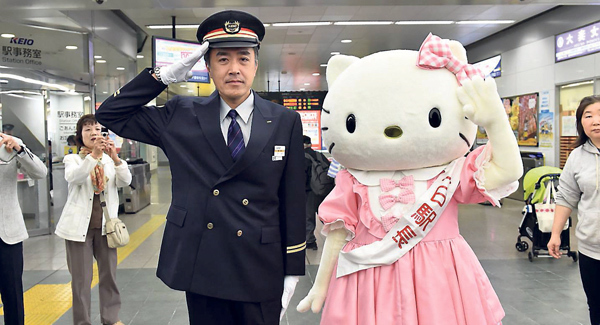
When Hello Kitty opened its first café in Australia last month, more than 1,000 people showed up. Back in 2000, seven people were injured in Singapore in a virulent outbreak of Hello Kitty fever as crowds jostled at fast-food outlet running a special promotional event.
Hello Kitty is little more than a graphic but for 40 years — the Japanese-based brand celebrated four decades in existence in November — this mouthless kitten-girl, who stands ‘just five apples high’ has somehow become a global trend.
To some she is completely anodyne, yet Hello Kitty has a massive following across all ages and all sectors of society around the world.
‘Kitty Chan’ as she is affectionately known in Japan, is stamped on everything from clothes to handbags, shoes, toilet paper, pencil-cases and teddy-bears to umbrellas, video games and even aeroplanes. She even has her own perfume.
There are more than 50,000 different Hello Kitty products in more than 130 countries around the world and it’s estimated Hello Kitty is now worth an estimated €7bn.
Loved by celebrities such as Lady Gaga, Paris Hilton, Mariah Carey and Avril Lavigne, who brought out a single called ‘Hello Kitty’ her fan base now borders on the cultish — in fact, every year a number of adult fans tie the wedding knot in special ceremonies held in Puroland, in Tokyo the theme park run by Hello Kitty manufacturer Sanrio.
In Ireland we may not get quite as carried away but the blank-faced kitty is everywhere to be seen; the well-known logo appears on everything from pencil cases to lunch boxes, toys, clothes and jewellery.
Irish children have a strong affinity with Hello Kitty, says Dryden Geary marketing manager of Smyths Toys.
While Hello Kitty may not be the hottest brand on the market right now, he says, it’s consistently popular and always endures.
“Children are never disappointed if they get a Hello Kitty toy for Christmas. It’s not the top toy this year, but it’s a very steady burner. Children seem to simply love the cuteness of it,” he says.
Small children don’t necessarily understand that Hello Kitty is a trend. “They just look at a toy and think it’s really cute and love it. That’s the secret of Hello Kitty — and it’s stood the test of time,” says Geary.
“The things that kids like can be incomprehensible to adults and that’s the beauty of Hello Kitty— kids identify with it.”
But Hello Kitty’s appeal is not limited to the small ones — the brand’s appeal to older children, such as the pre-teen market is powerful, says Pat Kinsley, managing director of the Dublin brand-building agency Neworld Associates.
The pre-teen mindset here is no different to their peers in other countries, he says.
Tweens are attracted by the Hello Kitty logo’s ability to offer a sense of innocence and security, combined with burgeoning independence.
“They are not little children. They consider themselves almost adults. Irish children would be very similar to pre-teens in the USA.”
They don’t want to seem childish, he says, yet pre-teen girls still secretly learn for security. They tend to like Hello Kitty because it offers them a ‘safe ‘form of independence.
The pink colour in the logo is cutesy, but not too cutesy, he says: “It’s about growing up and drifting away from familiar family security while at the same time having the safety net Hello Kitty offers.
“There is also the tongue-in-cheek element in that ‘I can wear this but I can still be bold inside’. Like Ugg boots, Hello Kitty is their first form of independence in that it is the first thing they may be allowed to buy themselves.”
While it’s a statement about ‘who I am’, which is a form of independence, says Kinsley, there is security to be found in the fact that it’s a club of Hello Kitty fans, in that they all sport the same logo.
“They know they are in that club because they have the product — there’s security in that for pre-teens.
“It makes them look independent on the outside from their family, yet they are able to belong to something else.
“This goes down in Ireland as much as anywhere else,” he says, adding that the Hello Kitty particular brand of innocence is “kind of nice”, compared to Mickey Mouse, who tends to be more streetwise.
Maybe. Google Mickey Mouse and you’ll get more than 23m results. Search for Hello Kitty, though, and you’ll pull up some 33m results.
Now who’s the most streetwise?
* Conceived by the Japanese manufacturer Sanrio, Hello Kitty, is based on a British schoolgirl — and not even a cat, even though she has whiskers and cat ears.
* Hello Kitty’s full name is Kitty White. Her dad is George, her mum is Mary and she has a twin sister called Mimmy.
* She was born on a vinyl coin purse on November 1, 1974.
* Her favourite thing to eat, is her mum’s homemade apple pie.
* Hello Kitty has a cat called Charmmy Kitty. She stands five apples high and weighs three apples. Her blood type is A.
* Hello Kitty has a boyfriend called Daniel.
* Such was her global appeal, the character was appointed the children’s ambassador for UNICEF in the United States in 1983 and in Japan 10 years later.
* In 2008 she was appointed by the Japanese government as its ambassador of tourism in China and Hong Kong.
CONNECT WITH US TODAY



Be the first to know the latest news and updates

















