Pat Kenny, best in show
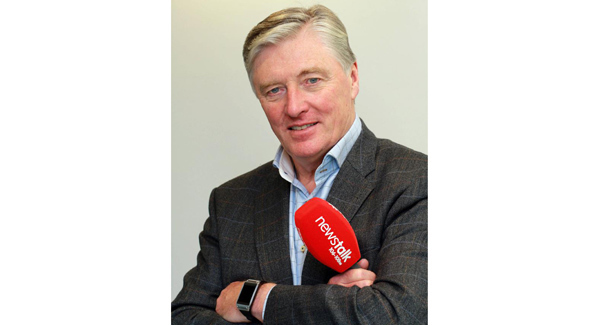
WHEN Pat Kenny was studying engineering, he used to get in and out of University College Dublin on a Honda 50. He has since replaced that “great” but “polluting” old motorbike with a BMW C1, with its space-aged roof and on-board loud speakers. He uses it to get to work.
“Actually, the more rainy it is, the more likely I am to use the bike,” he says.
“Simply because the traffic is so heavy, you have more liberties to overtake the traffic, but you have to watch yourself. You really have to concentrate on the bike. People open car doors without thinking, or they back out of driveways without seeing you. You have to be alert. So, by the time I get in here, I’m wide awake and raring to go.”
Motorbikes and mopeds, and fast cars, are not what people think of when they think of Pat Kenny, but even a cursory glance at the broadcaster’s career shows his capacity to surprise. That I meet him in a boardroom above Newstalk’s studios would have been unthinkable a year ago.
When it was announced that he was to leave RTÉ, it caused a tremor in the world of Irish radio. Not least because of the decision’s timing. When most 66-year-olds are retired, Kenny moved out of a well-paid job with the State broadcaster into the harem-scarem of independent radio.
“There were two things that attracted me to it,” says Kenny. “One was the fact that although I had worked as an independent contractor all my life, I hadn’t worked in the independent sector, so there was an interesting appeal there. There was also the realisation that if I don’t do it now, I’d never do it. Newstalk were looking to do something with their mid-morning and if I said no there’d be no knock on the door again.”
That his move might raise a few eyebrows was part of the attraction, and when I ask him if he likes to ruffle feathers, he answers with a grin and a matter-of-fact “Yes, I do”. Whatever his critics might say about him, there can be little doubt about his mettle. Kenny likes a challenge.
“I didn’t have anything left to prove in RTÉ,” he says. “When you do the number-one TV show for ten years and your radio show is the biggest show in its time slot, you’re kind of wondering ‘is there something else to do?’ I wanted to be in a situation where, rather than defending something, I was growing something.”
He appears to be doing just that. According to the Broadcasting Authority of Ireland’s latest Joint National Listenership Research figures, Kenny’s audience has grown by 20,000 since the last book, in March and April of this year. That brings him up to 134,000 listeners and has increased the station’s reach, in that time slot, by nearly 90,000 in the last year.
“You get an initial leap when a new programme like this happens,” says Kenny. “But, happily, it has held and it seems to be growing. I always said that it would be a two-year project to find where we’re going to plateau, so I hope we continue to rise over the next year. We know from the stats that we are very big in Dublin. We know there’s a young demographic. I don’t seem to frighten them off.
“We seem to have taken the older cohort, as well. When we go around the country, doing outside broadcasts, it’s mostly the people who are free to go to these things are retired and they turn up in spades.”
As Kenny says, the listenership figures are quite an achievement when you consider the limited resources available to Newstalk compared to RTÉ. Kenny puts most of the show’s success down to the backroom team of five. But there is also the fact that the station is a leaner and more agile broadcasting beast.
“I have more of an editorial input here, that’s for sure,” Kenny says. “The editorial lines are much shorter. The CEO here is, literally, from here to the wall. The station editor, Garrett Harte, is a few feet away. It’s just a knock on the door. So you can get a decision straight away. It might not always be the decision you want, of course, but it’s a decision.
“In terms of resources, it is tighter. In RTÉ, we had all your reporting resources and all the correspondents around the country. We don’t have that luxury here, so it means they [the team] work really hard to get the material together. It’s certainly cosier and there’s no place for anyone to hide. You can’t come in and not do your best,” Kenny says.
For Kenny, the future of the show lies in its ability to develop and adapt.
“It’s evolutionary, really; you add things in and see how they work,” he says.
“Interviewing Bill Clinton [this year] was obviously big, but it’s not those interviews. They do help solidify the programme, of course, but it’s more the consistency of the offer. It’s a very mixed bag. It’s light and shade. It can be music, as well as talk. It can be hilarity. It can be highly emotional and serious and saddening.”
During his career, Kenny has covered many terrible and tragic events. He recalls the casualties and injuries at Enniskillen as being particularly difficult. But he says he tries not to carry the emotion. At the same time, he says he has always been wary of cynicism.
“It’s the one thing you have to guard against,” he says. “I just did an interview with Jackie Stewart and he said that when he was campaigning for driver safety, a lot of the journalists didn’t want the safety changes he was campaigning for, because it would make the sport too safe and would mean less danger, less death and, therefore, would make it less interesting to the public. So you have to guard against that sort of cynicism; the ‘oh I wish the Government would fall, that would give us something to do’.”
You would think there is little left for Kenny to achieve as an interviewer, but he has one or two people on his wish-list.
“I have a fascination for Gorbachev,” says Kenny. “But interviews through translators don’t really work; you never get a flow.
“Assad would be very interesting to interview, at the moment, and he has perfect English. I’d have to arm myself with all the information available; chapter and verse. The last thing you want is to be caught out when you say ‘oh, you’re responsible for XYZ’ and he says ‘no, I’m not’ and questions your resources.”
An interview with Assad seems unlikely anytime soon, but you never know. Pat Kenny is full of surprises.
I didn’t have anything left to prove in RTÉ. When you do the number-one TV show for ten years and your radio show is the biggest in its time slot, you wonder ‘is there something else’?

CONNECT WITH US TODAY



Be the first to know the latest news and updates

















