Take a trip back in time to your Irish College days
I DON’T miss much about being a teenager. I do not miss the constant threat of the Leaving Certificate. I don’t miss blushing furiously anytime I saw someone I fancied. I don’t miss everything being so unfair. I also don’t miss my unfortunate fashion choices and dependency on O’Neill tracksuit bottoms and Gap hoodies.
I do, however, miss Irish college. It’s been 10 years since I attended a summer course in Coláiste na Rinne, in Co. Waterford, but, at the same time every year, I feel a pang that I’m not on my way down there. So this June, my sister, Katie, and I took a road-trip down to our old summer haunt.
The three-week summer courses were my first taste of freedom. Rinne was the site of my first kiss, aged 15, at the end-of-course disco. It was the site of my second kiss, too, half an hour later, with another young buachaill, when I realised there wasn’t that much to it and I’d better catch up with everyone else.
Rinne was the site of many other firsts: it was where I first learned I was ‘from the country’. I had thought that living five minutes from Cahir qualified me as a sophisticated urbanite, without realising my use of the phrase ‘the town’ outed me as a culchie.
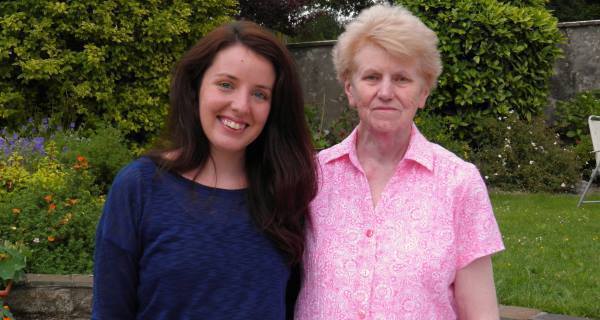
Katie and I call to the house of our former bean an tí, Siobhan de Faoite. Siobhan’s house is a mile from the Coláiste, up a steep hill, and I can remember the trauma of trudging up and down it six times a day, to the Coláiste and back. But we came back for five summers straight. The food was that good.
“The walk is horrible, but the food makes up for it” — so went our sales pitch to friends to convince them to come and stay. On the way down in the car, Katie and I had reminisced about Siobhán’s food: the hearty dinners, the huge breakfasts, and the hot, buttery toast and plates of biscuits that awaited us when we came up, ravenous, exhausted and flushed, after the night-time walk up from the céilí.
“You two were always good to eat,” Siobhan says, and I beam at the compliment. I’m still “good to eat”, but it’s not the kind of thing a grown women is congratulated on very often. More’s the pity.
We used to walk the mile up to the house after the morning’s classes, hoping against hope that chips were on the menu. They usually weren’t, but that didn’t stop us believing that we could smell the chips frying from half a mile away, only to arrive to a plate of pasta.
As we make the familiar journey from Siobhán’s house down to the Coláiste, little has changed. Inside the canteen, we meet Tomás Ó Cadhla (known as Tomás Rua), the bainisteoir feidhme, or manager of operations, Mathúin Ó Caoimh, principal of the summer course, and Caroline ní Ríagáin, one of the summer teachers.
All three are familiar faces to us, even if we aren’t to them. Ó Cadhla was a cinnire (prefect), Ní Riagáin taught us both, and Ó Caoimh used to lead the céilís every night.
Ó Caoimh is impressed by our attendance record, but it’s nothing compared to his. He’s taught at Rinn for 43 consecutive summers. This year, due to the unprecedentedly warm weather, the céilís have been abandoned in favour of supervised nightly trips to the beach. “Ah, if you could only bottle it,” says Ó Caoimh, wistfully. “I can’t remember a cúrsa like it.”
I ask how much the college has changed in the last 10 years. Not much, they say. Even mobile phones have not had a huge impact. As I look out the window at the children milling around, not one is walking around like a zombie, checking their Instagram and Twitter feeds. No, the accessory of choice on campus is an unexpected one — the hurley, or camán to give it its proper, Gaelic title.
Ní Riagáin says that each weekday morning she has to ask several scoláirí to leave their hurleys at the top of the classroom. “They’re like extensions of themselves,” she says. Many of the students are enrolled in the GAA skills course, a new initiative at Coláiste na Rinne. Accredited by Croke Park, students have two hours a day of GAA training, and receive a certificate at the end of the three weeks.
Katie and I brush shoulders with a group of scoláirí as we explore the campus. The students on this course, Cúrsa A, are between the ages of 10 and 15. The girls are wearing leggings, instead of O’Neills, and probably talking in ‘lols’ and ‘wtfs’, but, otherwise, my late-1990s adolescent self could blend right in with them.
Caroline rounds up a group of students to talk to us. All are unanimous in their love for Irish college. Surely, it can’t be as great as I remember it, can it? Yes, it really is that great, they assure me. “But do you actually speak Irish when the teachers and cinnerí aren’t around?” Katie asks suspiciously.
A young man speaks up. “Well, our parents have paid a lot of money for us to come here, so it wouldn’t make sense to waste that by speaking English.” (Now, one swallow may not a summer make, but I like to think that this very grown-up answer is proof of a more economically-savvy generation waiting in the wings.)
The young man is wearing a Tipperary jersey, a Tipperary county jacket and Tipperary-branded tracksuit bottoms. I guess he’s from the premier county. “Upperchurch,” he says. Patrick Buckley was a student at Scoil na Leanaí, Rinn’s boarding school for 10-to-13 year-olds, and he’s back again for the summer course. Buckley and his friends appear genuinely enthusiastic about Irish college and the benefits of speaking Irish.
Coláiste na Rinne was never a college where you were tossed out at the first utterance of a word as béarla. The staff understand that there’s more to Irish college than enforcing rules. “An honest effort to speak Irish, that’s all we ask,” Tomás Rua says. That sentiment is echoed by bean an tí, Siobhán, who says that she’s happy if her charges leave her house with a ghrá for Gaeilge.
I certainly have that ghrá, and a lot of that is down to a ghrá for this little village in Co. Waterford.
As we say our sláns and head for the road home, it takes an honest effort not to wish away the freedoms of adulthood for just one more summer of being young again and away at Irish college.














