Top tea test —not just a mug’s game
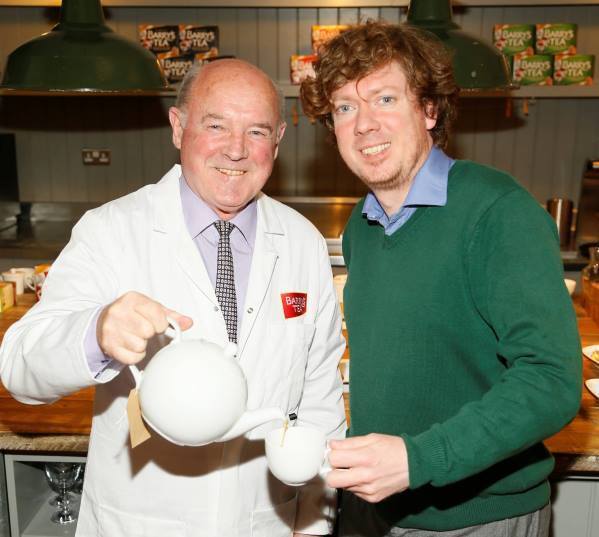
A lot goes on behind the scenes before you sip your cuppa. Jonathan de Burca Butler meets a master tea-blender and puts himself through a taste test

Top tea test —not just a mug’s game

I MEET master tea-blender, Denis Daly, in a restaurant off St. Stephen’s Green in Dublin. The Cork native has worked for Barry’s for the best part of 45 years and today he has invited me to take part in a flash course in the art of tea-tasting.

Laid out before me are four cups with the labels Kenya, Rwanda, Assam and Loose Leaf. I was poured four cups of tea and advised to add a dollop of milk.

“That’s the way I taste it,” says Denis. “That’s how the customer tastes it, so it’s better that way.”

With that Denis picks up a cup and sucks the tea out of it with hoover-like sound that goes right through the head. Just as quickly, he spits the tea into a spittoon, dribbling none of it onto his pristine white coat.

He points out that the three country-labelled teas in front of us are all very different both in colour and in taste. It his job to combine them to make the Loose Leaf tea that Barry’s loyal customers have become accustomed to over the years.

“Obviously because tea is a crop it doesn’t stay fresh all year round,” he explains as he lines up another row of cups on his workbench. “So what we have to do is keep tasting the samples that come into us to get the right combination so that you can have pretty much the same flavour year round.”

Later he shows me packets from Burundi, Uganda and India as well as the aforementioned Kenya and Rwanda. It his job to decide which of these are duds and which ones are making their way to Annie Cloherty’s kitchen in Connemara.

“I’d normally taste maybe 16 or 17 [types of tea] in one tasting,” he later explains. “I’d do most of my tasting in the morning but if it warrants it, I’ll do five or six tastings in a day. All the tea is tasted at a North window because it distributes the same light and it has to be even to make sure the colour is good.”

All told the flash course lasted the guts of an hour and knowing that I was now an expert in all things tea my editor decided to set me a task. I was to purchase four teas and see if I could tell the difference between them. Never one to turn down a challenge and thinking myself a bit of an expert I took it on with relish...and a Victoria sponge from the local bakery. Later in the week I relieved the local shop of a packet of Tetley’s, a posh-looking box of Twinning’s English Breakfast, a box of Barry’s Original Blend and its arch-rival in the Republic, Lyon’s.

From the off, the Tetley’s looked as grim as the Yorkshire Dales it is famously associated with. The round bag sinks rather than floats and as I mark the bottom of the cup with a blue pen, TET, I’m not looking forward to consuming it. The Twinning’s English Breakfast doesn’t look as red as the Irish teas and has a more chocolaty colour. After five minutes I removed the tea bags and added a dollop of milk as per Denis’s recommendation. The cups, which were uniform, were then switched around 15 times.

I was fairly certain that Cup D was the Twinnings because, even with the milk in, it was still so light in colour. It was harder to tell the rest of them apart. I went to taste Cup D. I hoovered up la Denis but almost scalded the gob off myself. Luckily my make-shift spittoon, the kitchen sink, was close at hand.

I decided to wait a few minutes and then I tried again. This time I started with Cup A which had plenty of flavour and was quite robust; the type of tea that would certainly wake you up in the morning.

“Barry’s,” I said to myself.

Cup B was a bit more watery and metallic but had a good if more subtle flavour to it. Maybe this is the Barry’s I thought and switched my Cup A pick to Tetley’s.

I recognised Cup C straight away because I have it every day. I noticed that it seemed to hold the flavour of the milk more than the other two. If this was Lyons I might need a change I thought.

I knew without doubt that Cup D was the Twinnings. It was the most expensive of the four but much like its colour the taste was bland and anaemic.

It turned out I was spot on. Your scribe is a bit of a connoisseur, even if he says so himself. Getting into the tea-tasting game might be a bit tough however. In Ireland jobs in that particular field are hard to come by.

When Denis started his training under Anthony Barry there were no fewer than 17 different tea companies in Cork alone, each blending and packaging their own product. Apart from Barry’s and Barber Daly’s those companies are now gone.

Barry’s was set up in 1901 by James Barry. Today the company accounts for 40% of tea sold in Ireland.

At 3.22kgs per capita, Ireland is the third largest consumer of tea behind Turkey and Morocco. That’s quite a lucrative market. But has the recent upsurge in coffee consumption dented the tea industry? “We’re still drinking tea,” says managing director Tony Barry. “Obviously we don’t drink it like our grandparents did but it’s natural enough because there’s a lot more happening. It’s not just coffee, there’s chocolate, there’s energy drinks, lifestyles have changed.

One of the perks of Denis’s job is that he travels regularly to tea producing nations. He has built up strong relationships with farmers, many of whom have had their lives transformed by the revolution in tea growing that started in the 1960’s. Prior to that decade, most tea was imported from India and Sri Lanka but later East Africa began to develop its industry. Kenya, for example, now produces some 65% of the world’s 460 megakilos of tea. It is a country that is close to Denis’s heart.

You’re talking maybe four or five million people [involved in the industry]. So one of the most satisfying things for me going to Kenya over the years is seeing the growth of a new middle class who are more educated.”

After over four decades of swilling and spitting tea, Denis’s love for the brew has not diminished.

“When I go home, my wife usually has my dinner ready for me,” he says. “Then I’d have a cup of tea. I might even have another one before I go to bed. It hasn’t changed. It’s a lovely drink really if it’s good quality.”

Even at 69-years-old Denis says he will wait a while before retiring.

He “still enjoys the work”. But should he decide to hang up his white coat Barry’s have my number.

Now, where did I put that cake?

x

More in this section

Cookie Policy Privacy Policy Brand Safety FAQ Help Contact Us Terms and Conditions

© Examiner Echo Group Limited













