THE BIG READ: A World Cup Special
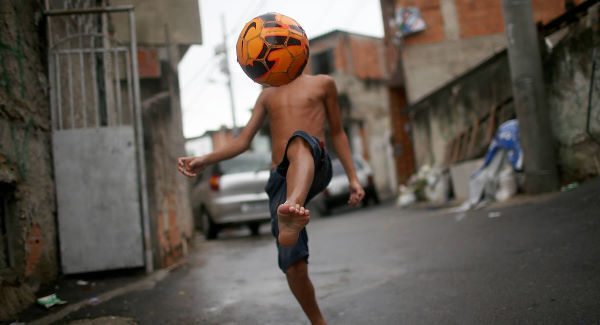
THE other day I stopped into my neighbourhood bistro for a bite. It’s usually a laid-back place, with a great jazz soundtrack, but when two guys in dark suits walked in the mood chilled. They were “fiscais” — Rio shorthand for city inspectors — snooping for irregularities. Proprietors in Rio de Janeiro dread these sorts of visits: Fiscais always find something. They might be persuaded to look the other way, for a price. Brazilians call it wetting the official hand.
With Brazil in the global headlights, and 600,000 foreigners expected for next month’s World Cup, hands are getting wetter. “My blood freezes when I see them,” whispered the bistro manager as the suits marched into the kitchen. “You work hard, follow the rules and still you get taken advantage of. Makes you want to join the protests.”
Plenty of Brazilians have done just that. Organised labour is seething, with teachers, bus drivers, bank tellers and police staging strikes. Squatters seize empty buildings while slum dwellers ignore orders to evacuate neighbourhoods slated for sports arenas. On any given day the air is thick with smoke from city buses that irate protestors set ablaze. What happened to the sunny country that was the talk of the emerging markets and claiming its place on the global stage?
Brazilians are sore in part because their country has changed, and mostly — odd as it may sound — for the better. The assets that made Brazil the toast of Latin America and a rising powerhouse are real. The country is a stable, flawed, but functioning democracy. It’s got the scrappiest press in the continent, and judges with minds of their own. Last year, the Supreme Court defied political rainmakers by convicting 25 politicians, bankers and businessmen in a huge political payola scandal.
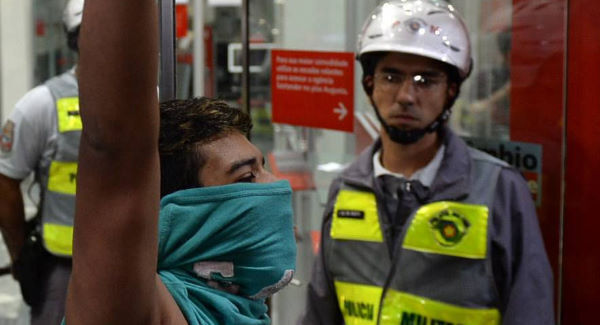
Forty years of ginning sugarcane into ethanol have made Brazil the benchmark for clean-burning fuels. The cheap and simple cash-transfer programme, Bolsa Familia, which costs a trifling half percent of gross domestic product, is now a template for poverty-busting in the developing world. Brazil even managed to combine economic growth with falling inequality, a rarity in the emerging markets where booms generally widen the wealth and income gap.
Brazilians, though, are quick to point out that these gains are halting and partial, and they have little patience for the all-boats-rising hype of the official spin cycle. In a recent poll, 68% of Brazilians said they wanted “deep changes” in the way the country is run. That kind of unhappiness drove tens of thousands into the streets last year to rail at everything from shoddy public services to light-fingered bureaucrats.
As discontent flares, the danger is that policies that work get tossed out with the broken. One of the keystones to progress in Brazil’s cities, for instance, is pacification. Since 2008, security forces in Rio have “pacified” 38 of Rio’s most notorious urban slum complexes where gangs made the rules and kept half a million “Cariocas,” as Rio natives call themselves, under the yoke. As Rio goes, so goes Brazil. That’s why the country has watched closely as Rio has struggled to restore peace.
Pacification has driven down lethal crime across Rio. Inner city murders dropped 38% in the first quarter of the year compared with the same period of 2008, though murders have jumped in the flatland suburbs. In pacified zones, murders also fell 26.5% in 2013 from the year before.
And yet as pacification spreads, the police have been stretched, and have themselves become targets: 16 have been gunned down on duty this year, three in “pacified” areas. But often cops are the problem. Police killed 85 people in the first three months of this year, more than double the number of the first quarter of 2013.
One of the casualties was Amarildo de Souza, though not officially so. Last July, the construction worker was picked up for questioning in Rocinha, a large favela, and never seen again. His disappearance (he’s presumed dead) triggered a national outpouring, with artists and soap opera stars turning “Where’s Amarildo?” into a street meme.
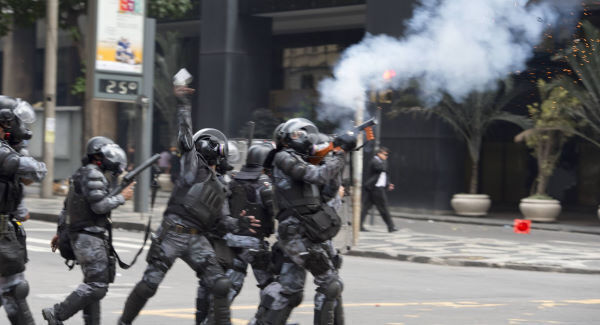
The anger suggests that community protection has hit a wall. Yet Rio would be far worse without pacification, and no one wants to go back to the time when thugs in board shorts and bandoleers played cop, judge and jury.
If you want to turn a cop into a sociologist, just ask why crime is so high. Still, José Mariano Beltrame is worth listening to. A federal policemen turned public safety commissioner for the state of Rio, he knows that policing the police is one of the big challenges of pacification. To keep Rio’s finest in line he installed satellite tracking equipment in patrol cars, security cameras in police stations and applied business-management software to streamline police work.
“Police are the first step,” he said on Brazilian television last month. It’s no use to send in model elite cops, he said, if public services like schools, health clinics and job training don’t follow. “It’s going to take a long time to change the paradigm of violence if these [high-crime] areas of Rio are not occupied by the State. That’s absolutely necessary.”
It’s also an agenda for a society on the rise. As Brazilians step up, they can see more clearly — enough to know what’s missing. “What people are complaining about isn’t new,” Marcelo Neri, an economist who heads the Brazilian office of strategic affairs, told reporters in Rio not long ago. “Maybe they didn’t say anything because they never felt entitled to.” That diffidence is gone. The anger on the Brazilian street is the funk of entitlement. Football is grand, but the land that brought the world the beautiful game wants a country to match.
WHEN Brazil drafted plans to host the upcoming World Cup, this Atlantic beach destination was exactly the type of city it wanted to show off.
A nationwide economic boom was transforming the once-sleepy backwater into a fast-growing city typical of the new Brazil, a country at last poised to make its long-promised leap into the first world.
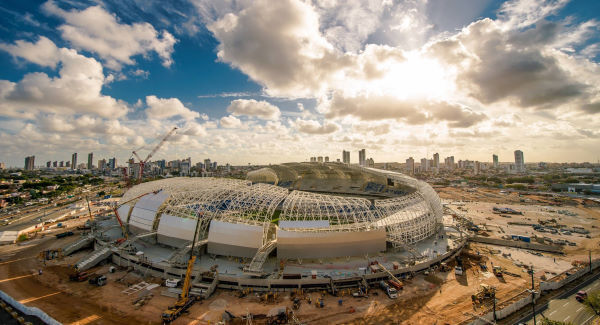
Who cares that Natal, in the historically poor northeast, lies far from the nerve centres of Rio de Janeiro and São Paulo? Or that its stadium, home to middling regional teams, was hardly a venue for big-league football, let alone the world’s most popular tournament?
Natal would build a state-of-the-art new arena, authorities said, and all manner of additional infrastructure, too. They promised a light rail network, a new hospital, a beachfront facelift and wheelchair-friendly sidewalks.
Five years later, and two weeks before kickoff, little besides the arena and a remote, untested airport are complete.
Almost half the more than $1.3 billion in promised developments never began.
“This is a missed opportunity,” says Fernando Mineiro, a state assemblyman for the leftist Workers’ Party, now in its 12th year in national power. “Natal failed to deliver.”
Cities go after the World Cup, the Olympics and other events because the tourism, broadcast exposure and other revenues can justify infrastructure investments and other “legacy” benefits like those that famously remade Barcelona for the 1992 Olympics.
But waste is also common, often leaving idle infrastructure, like useless South African stadiums after the 2010 Cup, as legacies of little but vanity.
Across Brazil, especially its 12 Cup venues, locals are lamenting high costs, delays and stillborn investments.
Bureaucracy, corruption and political squabbling, they say, has led to the usual lack of follow-through that has often hobbled development in Latin America’s biggest country.
A $16bn bullet train between Rio and São Paulo never got off the drawing board. Instead of a new airport terminal, passengers in Fortaleza will pass through a huge tent. A $700m rail line in the farm-belt capital of Cuiabá won’t be ready until well after the Cup.
Nationwide, only 36 of 93 major projects are complete, according to Sinaenco, a trade group of engineers and architects.
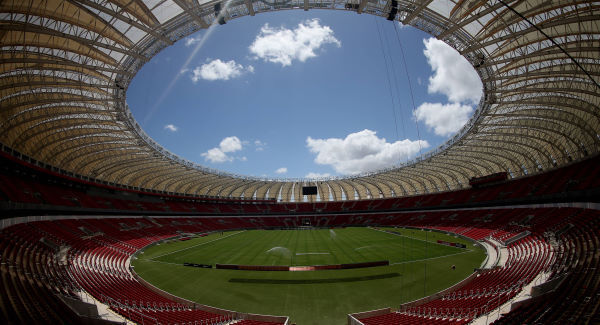
The shortfalls compound already widespread discontent over the roughly $11bn spent on the event. The cost is particularly vexing now that Brazil’s economy, after a near-decade of average annual growth over 4%, has lumbered to half that rate.
Mass protests erupted across Brazil last June during a tournament considered a World Cup warm-up, and smaller demonstrations have continued. The Cup, many Brazilians say, reveals still-glaring divides in a country big on spectacle but weak on health care, infrastructure, education and other vital services.
“It will be a beautiful tournament,” says Maria Santos, a 29-year-old Natal nurse in line for a bus to a hospital where she and colleagues often work without latex gloves and syringes. “But whatever they spend on it would be better spent elsewhere.”
Natal, a city of just under one million residents, is beset by soaring crime, crippling traffic, erratic public finances and local politics so baroque, and allegedly corrupt, that a mayor was recently ousted and the current state governor faces possible impeachment.
“Things haven’t gone quite as predicted,” says José Aldemir Freire, an economist at the local office of Brazil’s national statistics agency. “There were some investments, yes, but not on the scale expected.”
FIFA, football’s global authority, at first expected only eight host cities.
But Brazil’s government and national football kingpins wanted to show off more, scoring regional political points in the process. Brazil, they told FIFA, would prepare 12 venues, unleashing a scramble among second-tier cities.
“We were an ugly duckling,” recalls Fernando Fernandes, a former state secretary for the event.
But Natal had advantages. At the elbow of South America, it is closer to Europe than any other destination in Brazil. Natal’s shoreline, along towering dunes that shape its landscape, boasts more hotel rooms than any host besides Rio, São Paulo and Salvador.
When FIFA announced Natal’s name at a ceremony in May 2009, residents gathered beachside to watch live on a giant screen. Fireworks flared overhead and local officials promptly began making promises.
FIFA required an arena for at least 42,000 spectators — ten times the average for routine Natal games. Local officials decided to demolish the existing stadium and build anew.
They hired architects and calculated a cost of $180m for the new arena. When they sought bids for the job in 2010, though, contractors said it couldn’t be built for that price.
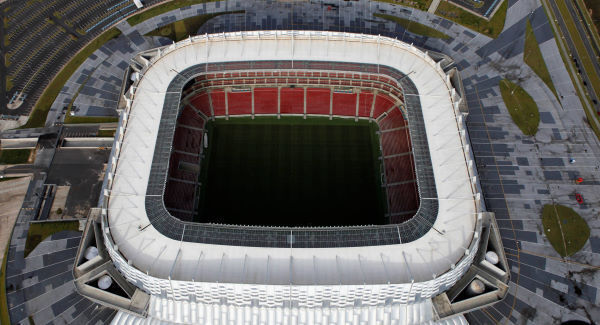
Organisers scaled back the blueprint amd settled for 32,000 permanent seats, the additional 10,000 for the Cup installed only temporarily.
In February 2011, OAS, a São Paulo builder, took the job. The federal government, meanwhile, agreed to finance an airport.
Though an existing airport easily accommodates Natal’s passenger traffic, local industry wanted another facility to boost cargo capacity. The federal government would invest roughly $260m but would rely on a contractor to build it and the state of Rio Grande do Norte, of which Natal is capital, to lay access roads.
The city, for its part, agreed to improve traffic and drainage near the stadium. But the promise of six new tunnels and two new viaducts stalled.
Locals pressed then-mayor Micarla de Sousa for results.
“She did absolutely nothing,” says Carlos Eduardo Alves, Natal’s current mayor.
De Sousa said she struggled to secure financing. She also suffered health problems that led her by early 2012 to announce she wouldn’t seek re-election.
In October 2012, two months before her term’s end, a state court ousted her, alleging irregularities in city contracts. De Sousa denied wrongdoing. She says her removal was orchestrated by opponents and notes she has yet to be charged with a crime.
Regardless, Natal by 2013 had little city work underway.
Alves, the incumbent, says he revamped the plans and says most of the ongoing work will be completed, or cleaned up, by showtime.
Stadium neighbours, weary of the jackhammers, are sceptical.
The state, too, is under fire. The stadium contract, a partnership with the builder, obliges the state to reimburse construction loans and pay management fees. Over two decades, it is expected to pay over $900m, approximately five times the job cost.
While most locals say they like the stadium, with its undulating roof, they worry about the bill. “We have real concerns about the ultimate price,” says Luciano Ramos, an auditor with a state court reviewing the contract.
The state is also criticiszed because it is only now finishing the first of two airport roads.
Governor Rosalba Ciarlini blames bureaucracy and high personnel costs, an “inheritance” from previous administrations that she says limit the state’s ability to invest.
Controversial herself, Ciarlini faces impeachment efforts because a state court earlier this year found she favoured political allies with pork-barrel spending.
Ciarlini calls the ruling politically motivated. The stadium’s cost, she says, will be offset by revenues from future events, even though critics say Natal has neither the football heft nor the pull on the concert circuit to guarantee profitability.
The price of the partnership, she says, is the cost of long-term financing.
NIKE’S latest World Cup ad, featuring Real Madrid star Cristiano Ronaldo, was seen by 78 million people in four days. Then it went to television.
Though the vast majority of fans will still watch World Cup matches on TV, the marketing battle has gone online. Nike’s four-minute spot was released on YouTube and Facebook during an April 25 event in Madrid showcasing the shoemaker’s latest cleat. Within hours, Ronaldo — the most popular sports star on Twitter — had sent it to his 26 million followers. A shorter TV version wasn’t broadcast until April 29.
“I’m pretty sure what I launched today will be around the world in a second,” Nike’s brand president Trevor Edwards said at the Madrid event. “We’re almost at a point where it’s hard to calculate what is on television versus what’s on the Web.”
Nike says its TV ad buying during the World Cup is declining as it increasingly uses Facebook, Twitter and YouTube to reach fans in a battle with Adidas for supremacy in the global soccer-products market, which NPD Group estimates will grow by 8% this year to about $17 billion.
Adidas will spend more on Internet promotions than on television for this year’s World Cup: about half of its media expenditure for the tournament will go online, versus a fifth at the 2010 event in South Africa, according to chief executive officer Herbert Hainer.
The current campaign, Adidas’s biggest ever, “will be heavily supported by social media,” Hainer said. “It makes us absolutely fresh and new.”
Corporations will spend about $68.5bn on TV this year and $56bn online, according to researcher eMarketer. In 2010, the year the World Cup was in South Africa, television advertising was more than double online, eMarketer reports. By 2018, advertisers will spend 17% more on Web ads than on TV, the researcher predicts.
Facebook marketing executive Carolyn Everson said: “Four years ago the centrepiece was television. This is going to be a mobile World Cup.”
Google reports that searches related to the tournament over the past four years have outnumbered those for the Olympics, the Super Bowl, and the Tour de France combined.
Even so, the month-long World Cup is also the planet’s most- watched sporting event — largely on television. About 400 million people are expected to see the contest’s final match on July 13, and each of the 64 games will garner viewership roughly equivalent to the Super Bowl, according to Futures Sport + Entertainment, a London media-analysis firm.
The rise of smartphones is changing how fans watch matches.
For the World Cup, Adidas is setting up media “newsrooms” in five cities, including Shanghai and Moscow, with copywriters, filmmakers and photographers ready to post photos and video clips. Nike is deploying more than 250 people to feed social media.
Facebook estimates that 500m of its 1.28bn users are soccer fans, and that 110m of those are males aged 13 to 34 in big markets — a demographic coveted by advertisers.
Nike’s digital marketing chops can be seen in its deal with Ronaldo.
LionelMessiOnThePitch_large.jpg[/timg
Ronaldo has the 14th-most-followed Twitter account, the highest rank of any sports star, according to TwitterCounter.com. Adidas brand ambassador Lionel Messi doesn’t even have a Twitter account.
Nike surpassed $2bn in soccer sales for the year that ended last May, and its footwear sales in Western Europe shot up 24% for the quarter ended February 28, excluding currency effects. Adidas expects to reach its goal of €2bn in soccer revenue this year, CEO Hainer said, after first-quarter sales of shoes, jerseys and other gear surged 27%.
Adidas is out to prove it can hang with Nike in marketing. The company on May 24 debuted an online and TV spot called “Leo Messi’s World Cup Dream,” showing the Argentine superstar imagining his opponents’ preparation — then hitting the field and trouncing them.
At 5-foot-7, Messi lacks the model-dating glamour of Ronaldo, who appears nude on the cover of this month’s Spanish Vogue artfully covered by his girlfriend’s white dress.
Messi “is not the flashiest guy off the field,” said Tom Ramsden, Adidas’s marketing director for soccer. But “he’s dedicated to his family, team and nation,” Ramsden said. “That’s something we’ll definitely celebrate.”
CONNECT WITH US TODAY



Be the first to know the latest news and updates

















