Vintage view: Antique watercolour
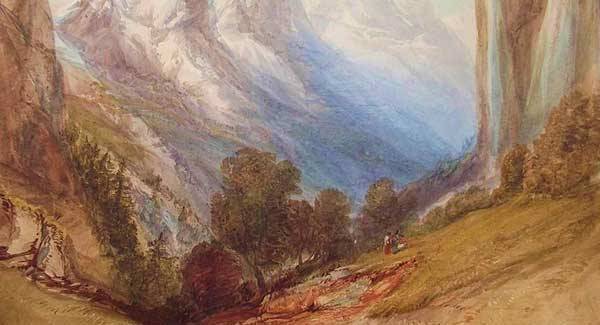
There is a luminous intensity to a well-painted watercolour that’s unmatched by other media. Still, you may have noticed even quite nice 19th century pictures sell for less than similar quality oil paintings, unless executed by a highly desirable artist or master.
Lost like postage stamps, modest watercolours are littered up to the rafters on the walls of big salesrooms. Despite the difficulty in executing them successfully, serious collectors still regard watercolour as easier to handle than oil paint, and they are championed more by illustrators and amateurs than great artists.
Furthermore, watercolours must be displayed in controlled condition out of direct light, making their hanging more problematic than that of oil or acrylics. Committed to paper rather than canvas or board, they do have to be carefully framed and handled. The JMW Turner watercolours and drawings given to the National Gallery of Ireland, in the Vaughan Bequest, come winking into the dimmed light of a windowless room at a January exhibition for this very reason.
Watercolour painting developed as a means of ‘colouring’ drawings in the 18th century and using a mixture of pigment, solvents and other additives, combined with water in various dilutions to deliver an intensity of colour. Used alone, it is a pitiless medium as mistakes cannot be rectified in fragile washes on paper as they can by lifting wet oil paint or over-painting. In Victorian times it became popular as an independent medium, and was beloved by lady and gentleman artists who would pluck at their watercolour box to record travels, or to simply relax and pass the time in an acceptable upper-class occupation.
Ideal landscapes of local countryside and exotic settings glimpsed on the Grand Tour, were uncontroversial additions to the roomscapes of a respectable home. Ancient ruins at sunset, lush botanical illustrations, perfectly behaved Highland cattle studded about on imaginary mountains — the general 19th century watercolour covers crowd-pleasing, universal themes.
It’s unlikely you’ll trip over a melting Constable or fiery Turner at a local house clearance or auction house, but there’s an endless parade of antique and very picturesque topography in watercolour on offer.
If you spot something you like, and if you can’t make out enough of the painting from the ground, ask for the frame to be taken down off the wall. The first thing to figure out is — is it a painting or a print?
If it’s a famous scene — think print right away. In a shop or auction room ask for a description from the seller and this should be backed up in a written receipt of ‘original watercolour’ if you buy the piece. Gouache is a term to describe opaque watercolour with a better hiding power than traditional watercolour blocks or tube paint.
Chances are you won’t be able to unframe a painting at something like a boot-sale, but you can turn it over and see if there are any useful gallery, dealer labels or other identification on the reverse.
Not all paintings will be signed. Commercial prints are broken down into a series of tiny dots, so have your most eagle-eyed companion slide their nose to the glass or eyeball the paper.
A symmetrical impression into the paper or numbered edition even with an original signature- indicates a print, (not a game-changer if you like the artwork, but not a watercolour either).
Look at the piece side-on, along the glass. Can see some irregularity and weave to the paper? Thinner paper treated to washes of watercolour may be a little wavy — but prints left in damp conditions can be also.
You might make out some pencil work from a loose sketch or the supporting lines for what was a tinted drawing.
If there’s a slight bit of slippage in the framing, look between the inside of the mount and the paper for an unfinished edge intended to be hidden by the mount. As with all antiques, condition is vital, and especially important in a visual piece of artwork set over a small area.
Foxing on paper caused by damp, inappropriate storage or hanging conditions can ruin a watercolour. Years of being strung up in sunlight can have faded the original colours or may have obliterated detail in part or all of the painting. Ensure you are happy with the appearance of the work as it is. The frame may turn out to be worth more than the painting, but having a frame restored is not cheap either. What appeals to me about a vibrant watercolour is its immediacy. Landscape paintings were often done quickly ‘plein air’, with those fluid lines and soft puddling of colour you can still feel the moment of commitment and measure when the soft sable brush touched off the paper more than 100 years ago.


CONNECT WITH US TODAY



Be the first to know the latest news and updates









