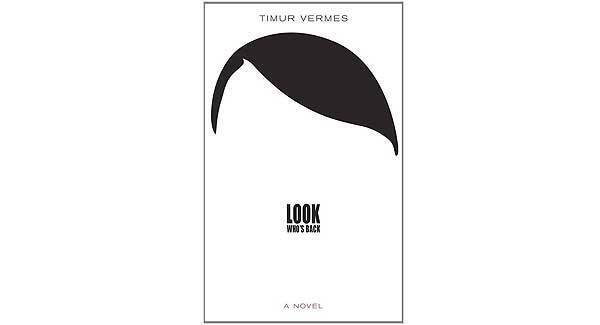
Look Who’s Back
IF EVER proof was needed that Germany remains unsure how to deal with its Nazi past, it lies in the state’s treatment of Mein Kampf.
Officially you can’t buy Hitler’s collection of political thoughts because there has — deliberately — not been a print run for over 70 years.
But with the former Furhrer having bestowed his rambling work on millions of his fellow countrymen, many old copies survive and it’s perfectly legal to own and trade in them.
And you can read the book in full in any public library but you can’t take it outside the premises to peruse at your leisure at home.
Timur Vermes has a theory about that one. “It’s so maybe you can be watched as the dangerous poison gets into your head,” he muses.
If that’s the case, then Vermes has been under a lot of surveillance because he scrutinised every word of Mein Kampf to enable him become Hitler’s voice for a book that’s been rattling cages in his native Germany for the past two years.
Now published in English for the first time, Look Who’s Back, which topped the German bestsellers list for weeks following its publication in 2012, brings the dictator and his plans for world domination to a vast new audience, albeit not in the way Hitler intended.
Look Who’s Back is a dark satire that explores how a society could be taken in by Hitler by transplanting him to the modern day and watching him renew his influence in a society that once again fails to ask questions or challenge the consensus.
He inexplicably awakens on a patch of wasteland in Berlin in 2011 to find Germany has lost its way during his 66-year absence and is clearly in need of his masterful direction if it is to restore its greatness once again.
Mistaken for a Hitler impersonator who never leaves character, he quickly secures a slot on a popular TV comedy show, becomes a YouTube sensation and builds a massive following among a celebrity-obsessed society that can’t get enough of his outrageous orations.
Audiences lap him up, presuming his pedantic pronouncements are one big joke and failing utterly to see the joke is on them as the re-energised Hitler begins plotting his electoral return.
There is plenty of comedy along the way as the 1940s Hitler gets to grip with ‘U-tube’ and the ‘Internetwork’, embracing with enthusiasm their potential for spreading propaganda on a scale Goebbels could only have dreamed of.
He’s baffled by the big and small of this strange new era. Watching dog-walkers pick up their pets’ poop he can only presume the collection of canine excrement to be a sign of mental ailment, and listening to politicians plan the withdrawal of German troops from Afghanistan, he is appalled at the idea of depriving citizens of the glorious opportunity to die in service.
For anyone brought up believing the best advice for getting along with Germans is ‘don’t mention the war’, it comes as a surprise to hear that ten out of the 11 publishers Vermes approached with the book wanted it and that the reaction to it at home has been largely warm.
“None of those who could have been offended were offended but there were people offended on their behalf,” Vermes says.
“It’s quite a German reaction I guess — to speak for the ‘weaklings’, to say I’m not Jewish myself but how must they feel?”
Other critics have taken issue with the portrayal of Hitler as a charming and earnest individual who impresses all he meets with his unwavering conviction in his own beliefs and his almost avuncular curiosity about others.
“There are people who are saying Hitler could not have been like that, that it’s not possible to start a Holocaust and to also comfort your secretary when she’s having trouble in love [as our modern day Hitler does], because that’s not how I have learned about Hitler.
“People think only of the shouting, ranting Hitler but in reality, people found him attractive and they were connected to him in some way. You aren’t attracted to monsters and thinking of him in that way does not help us to understand what happened.”
In reality, Hitler won many supporters for policies like providing affordable homes for young couples so that they could start families and appealing to motorists to drive slowly past kindergartens.
The impression was that he was fond of children but the underlying rationale was that he needed an abundance of youngsters to ensure a steady supply of fresh manpower for his army.
“It shows that we don’t go to the core of things, not even the important issues. We decide on the value of things on labels — what does it look like or sound like?” says Vermes, who doesn’t believe time has sharpened society’s critical powers.
“Whenever you look at history you don’t see so many differences. We really don’t learn a lot.
We love the explanation that people fell for Hitler back then because they were stupid or they didn’t know where it would lead to.
“That’s the funny part in the book — we all know what this guy has done and that he is going to do it again. He makes no secret of it. He tells it to you and he’s absolutely serious. And still we can’t help being on his side.
“Obviously, if there are people agreeing to everything he says then I say, congratulations, you passed the test — you’re a Nazi.
“I can’t help you with that. This book is not about reforming Nazis. But what this book should show is that it’s easier to follow Hitler than you thought.”
Vermes, a journalist who ghostwrote several celebrity autobiographies before embarking on Look Who’s Back, writes at an interesting time for Germany with the copyright on Mein Kampf expiring at the end of next year and public debate running over whether to allow a publishing free-for-all or try to impose fresh restrictions.
“What I would recommend strongly is to publish it and to beat it with its own boredom,” says Vermes, who believes allowing proper access to and analysis of the often tedious treatise would demystify it and render it harmless.
Not that he completely dismisses people’s fears that what happened in their grandparents’ Germany could recur in their grandchildren’s time.
“I don’t want to give them advice but I’m convinced that that thing the neo-Nazis are lacking most is a charismatic leader.
“Then they need more flexible policies — include something about the protection of animals for example to give them a more mainstream appeal. Then a lot of things could happen.
“We are at the moment quite safe because we are wealthy but what if we have to pay for Europe? How democratic would we be? Would we think it’s fair?
“We don’t always want to know the answers. We’re all hoping the European debt crisis turns out well so that we don’t have to answer those questions. But there is no law that makes it illegal to be stupid and if the majority in a country turns out to be stupid, you should not try to convince them. You should try to get out. It’s fast and it’s safer.”








