The New York Nobody Knows: Walking 6,000 Miles in the City
William B Helmreich

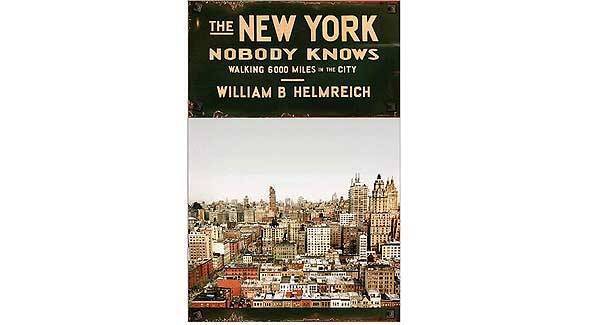
The New York Nobody Knows: Walking 6,000 Miles in the City

NEW YORK? New York, oh how we Irish think we know its streets and avenues and blocks, or perhaps even a borough or two of it. We’ve visited on holidays, gone on shopping, architecture or art gallery breaks in the boom, mucked in with J1 visas, gone underground illegally and overground and into skyscrapers on upward career trajectories.

We might have fallen in love there, or at the least fallen in love with it, and come back again enchanted, informed, enriched (or, on this reviewer’s first, grim-times c1978 NY visit, robbed) and frustrated. We’ve stayed put there, put down roots there and made this great, true-forged melting pot city our own, Erin go Bragh and all that Blarney baloney.

Even if we’ve never been there, we feel we have been immersed in it and introduced to it, knowing the place vicariously and its huge energy, thanks to TV, myriad movies, literature, popular culture, or even from Twin Towers/9-11 kinship.

Dozens of other nationalities feel the same, though. The Irish are far from unique in feeling a bit at home in New York, entitled to our thin sliver of a very big apple. Despite 170 years of emigration across the Atlantic, we Irish are very much in the minority there, albeit strong in Queens, Brooklyn and the Bronx 
 and we are about the only tribe which gets to shut down Manhattan’s 5th Avenue for a day’s patriotic marching fervour each March 17.

Thankfully, New York’s plenty big enough to share, and generous with it. Population has gone over eight million, one third of those weren’t born in the US of A. Over 170 languages are spoken across its communities; there are some blocks where English isn’t even one of those daily-use languages: Chinese, Korean or Spanish are the patois de jour.

At a time when the world’s population is tilting inexorably towards urban and city living, New York is one of the world’s standard bearers of civilisation and ethnic evolution. For the most part.

One of those truly entitled to say he’s seen more of New York and its few mean and not-so-many mean streets, is city resident and university sociology professor William B Helmreich. Helmreich (clue: not a particularly Irish surname) has walked just about every block in the city.

That’s about 121,000 blocks or about 10,000 kilometres of pavement, from swanky Manhattan sidewalks and stoops to industrial wastelands in the sticks, wearing out nine pairs of walking shoes (SAS or San Antonio Shoes, “made for seniors’ comfort”, the Texan firm boasts) and here given their first rugged sole-searching adventures in Manhattan.

As a child, with his father (to whom the book is dedicated), he’d ride subways to the last stop on the line, get off, and explore seemingly alien neighbourhoods — within their city. Subsequently, they’d do the second, or third stops. The urban voyages must have ignited a wanderlust, stout limbs and good constitution (his dad lived to be 101 years old), plus a ready and on-going curiosity, because decades later, Helmreich has reprised and expanded the odyssey on foot. He has branched out to blocks in the Bronx, in Brooklyn, Staten Island, and Queens. Is there book in it? Damn right, there is. It’s called The New York Nobody Knows: Walking 6,000 miles in the city. And to its credit, given its sociological/ ethnographic bent and heft of academic background mixed with a genuine passion for his native place, it’s only occasionally pedestrian.

It’s such a great trek, a grand project and an idea for a book, and could have taken a voyager in any of a thousand/million directions, with one random meeting or chance comment leading to something utterly revealing, unnerving, revelatory, moving. It could have been jazz.

However, with blocks and blocks to go before he publishes, plus a professorial sociological bent and fascination with ethnic groupings, (topics like gentrification and neighbourhood evolution weigh heavily), there has to be a framework, a logic, a plan, a grid, a score. Also, there’s also a whole backpack of academic back-up, as evidenced by a 36- page bibliography (so much for metaphorically travelling light and fleet of foot), a neighbourhood glossary, a decent index and 25 pages of notes — with just six themed, central chapters.

That a lot of baggage for a free-strolling flaneur and it does point up the dichotomy of approaches, from a learned professor and ethnographer. Ethnography’s where a society or culture’s is studied by immersion within it, and here’s he’s doing a road-trip of exploration, on foot, over several years, having thousands of conversations on the streets, and conducting hundreds of interviews, from casual chats with menten (maintenance) men, to formal interviews with ex-mayors.

Among those interviewees were office holders Michael Bloomberg, David Dinkins, Ed Koch and Rudy Giuliani, the latter the man who brought ‘zero tolerance’ to the city’s streets. Civil libertarians might cavil — and to be sure New York is nearly up there with London in terms of CCTV penetration — but it’s safer than it’s been for decades.

The city all but collapsed financially and, consequently, socially in 1975, and Helmreich gives fair recognition to Giuliani for reversing this, with an annual murder rate dropping from as high as 2,000 deaths a year to about 500. It made New York’s streets safer for everyone, residents, visitors and sociology professors alike, and Helmreich is quite engaging as he explains how he managed not to get mugged or seriously challenged passing though areas of rife deprivation, social inequality, drug-taking and violent, macho gang control (Tip 1: Don’t wear red).

Prior to his four-years of purposeful walking, the author reminds us he was used to taking his City University NY students on learned walks’n’talks. En route with him now in this easily-read and nicely-paced book, we almost incidentally pick up on things as diverse as ‘tar beaches’, which are rooftop gardens for sunbathing, or wall murals as art, political gestures, and community solidarity, including one four-storey Harlem 124th street mural to Bobby Sands and the 1981 Irish hunger-strikers.

It’s hardly surprising given this earnest, ‘senior’ man’s professional/bookish background (and, were he far younger, he might have had more difficulty in passing flash and flesh spots unchallenged) that his didacticsm washes all over this book. Yet, for lovers of New York, that’s a reason to search it out, and pick out the nuggets and the, eh, ‘learnings’. Sure, it doesn’t have shiny pictures, or lyrical passages of discovery and description of the great writers of yore; it’s no Thackeray or Dickens sociological travelogue, and he doesn’t dwell on architecture, food or music. Despite being determinedly people-centric, it isn’t even great on picking up on street argot. Many of the personal stories he chooses to relate are, inexplicably, pretty dry. You’d come back with better stories from walking into an Irish bar there 
 and Helmreich wryly admits to curiosity on seeing a bar with a Jewish name over the door. ‘Man does 6,000 mile walk 
 but not enough bars?’

The New York Nobody Knows is no hip Time Out travel guide — rather, it is a time-spent guide, with spurs earned, and cortisone injected, from a man who has walked the walk, and talks New Yoick.

More in this section

Cookie Policy Privacy Policy Brand Safety FAQ Help Contact Us Terms and Conditions

© Examiner Echo Group Limited













