The father of American folk music
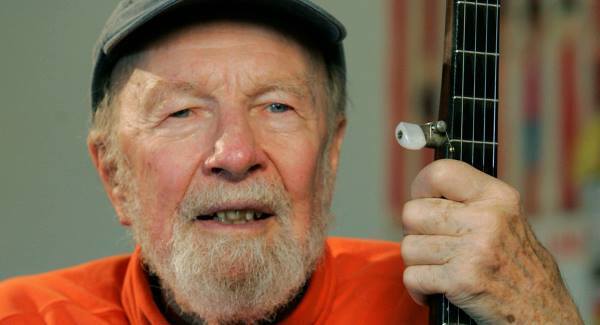
Seegerâs influence in the revival of American folk music and song was immense. Along with writing some of the most celebrated protest songs of a generation, he spearheaded the arrival of singersâ circles, folk clubs and folk festivals.
Seeger got his first introduction to American folk music at the Asheville Square Dance and Ballad Festival in 1935. He was 16, and later described the experience he had there of falling in love with the five-string banjo: âI liked the rhythms. I liked the melodies, time-tested by generations of singers. I liked the words.â
After learning to play the banjo, in the late 1930s he toured the southern and western states of the USA with the bluesman Leadbelly, and later with the legendary protest singer Woody Guthrie. Seeger then helped to form the Almanac Singers in 1940; this group featured some of Americaâs leading musicians, including Sonny Terry, Brownie McGhee, Alan Womax, Woody Guthrie and Leadbelly. The band were very political in their approach to music, performing and recording songs related to race, labour and class issues. They had an enduring influence in the rise of protest songs. Very soon thousands were singing Woody Guthrie-penned tracks such as âDeporteesâ, âThe Dust Bowl Blues and âThe Union Maidâ, a song about Mother Jones.
After a spell in the US Army during World War II, Seeger formed The Weavers, who had a hit in the 1950s with âGoodnight, Ireneâ. But McCarthyism was on the rise in the USA and, just as quickly as the Weavers topped the charts, it was over; they were blacklisted. In 1955 Seeger was subpoenaed by the House of Un-American Activities Committee and he received a prison sentence. However, the term was revoked and he played his music where he could, at summer camps, classes and music gatherings.
Seeger helped cultivate an urban folk music revival in the 1950s in New York and Boston and other cities. The movement gathered momentum through the 1950s and â60s with folk clubs springing up all over USA and spreading to Britain, Ireland and Australia. He was also involved in setting up folk festivals. While on the board of the Newport Festival, he helped Bob Dylan get an invitation to perform. Dylan thrived at the festival and was acclaimed as the voice of a new generation.
In 1965, however, Dylan decided to play a concert with members of the Butterfield Electric Blues Band. It is reported that Seeger got so upset over the extremely loud electric sound that he threatened to disconnect the equipment. When asked in 2001 about how he recalled his âobjectionsâ to the electric style, he said: âI couldnât understand the words. I wanted to hear the words. It was a great song, Maggieâs Farm, and the sound was distorted. I ran over to the guy at the controls and shouted, âFix the sound so you can hear the words.â He hollered back, âThis is the way they want it.â And I said, âDamn it, if I had an axe, Iâd cut the cable right nowâ.â
Seeger has left behind a wonderful canon of protest songs that are still sung and will go on to be sung all over the world for many years to come. âIf I Had a Hammerâ, written with Lee Hays in 1949, was a vision for a United America. âTurn Turn Turnâ was covered by The Byrds in 1965 and made the charts. The words of the song come from Chapter 3 in the Book of Ecclesiastes â Seeger did the rest.
In 1947, Seeger adapted âWe Shall Overcomeâ, which became the defining song of the Civil Rights movement. At the funeral of Martin Luther King, Jr in 1968, it was sung by a crowd of more than 50,000. The track was also recorded by Joan Baez and she sang it at Woodstock in 1969.
âBig Rock Candy Mountainâ was made famous by Harry McClintock, who sang it on the soundtrack of the 2000 Coen Brothers movie, âO Brother Where Art Thou?â
With the Weavers, Seeger adapted âWimowehâ from a South African song. âWimowehâ is probably most recognisable to our generation as The Lion Kingâs âThe Lion Sleeps Tonightâ. The Weavers also recorded Leadbellyâs âIrene Goodnightâ in 1965. It stayed at No 1 in the American Charts for six months, and has since been covered by Johnny Cash, Jimi Hendrix, The Grateful Dead, Dr John and Tom Waits.
Pete Seeger was a musician for nearly 80 years and his legacy is the revival of American songs that matter. Seeger sang to end racism and stop fascism, to stop the Vietnam War and to save the Hudson River. He sang to change things, and was a veteran of hundreds of Civil Rights marches. In his words, âa good song reminds us what weâre fighting for.â
* William Hammond, is a musician, set dancer, and author. He is also director of Cork Folk Festival.














