JFK: The final salute
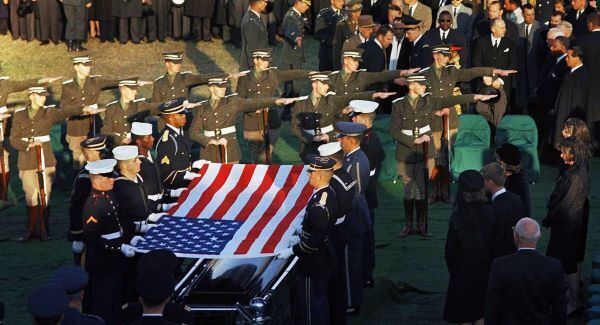
Fifty years later, they remember those hours as an eternity, the muffled beat of the distant drums growing louder as the funeral procession crossed the Potomac River and entered Arlington National Cemetery.
They were closer to the grave than anyone, this chosen honour guard, about to deliver the performance of their lives.
Opposite, a phalanx of press photographers from around the world jostled for position, training cameras on the 27 soldiers as reporters asked, “who are those guys?” The answer astounded them.
The cadets were from Ireland, fresh-faced 18- and 19-year-olds who, just a day earlier, had been whisked from their barracks on a remote, wind-swept plain in Co Kildare to travel, along with then President Éamon de Valera, to Washington for the funeral. With names like McMahon, Coughlan, Sreenan and O’Donnell, they hailed from towns and villages all over Ireland. Most had never been abroad, never been on a plane. Yet there they stood, a foreign army on American soil about to give a final, silent salute to a US president with an Irish name: John Fitzgerald Kennedy.
Even today, they marvel that in her darkest hour, Jacqueline Kennedy requested of the US State Department that the Irish cadets who had mesmerised her husband with a memorial drill for the dead, during his visit to Dublin just months earlier, perform that same drill by his grave.
“This is not the land of my birth, but it is the land for which I hold the greatest affection,” Kennedy told the cheering throngs at the end of his historic, four-day visit to Ireland in June of 1963.
His trusted adviser, the late Ted Sorensen, said: “The joy never left him.”
Joy consumed Ireland, too, as it welcomed home its anointed son. Kennedy’s great-grandfather had emigrated from Co Wexford in 1849, and the Irish took an intensely personal pride in their connection to America’s first Irish-Catholic president.
From the stately chambers of Dáil Eireann, in Dublin, to his ancestral home on a farm in Dunganstown, where he drank tea with relatives and broke from his bodyguards to join a children’s choir in a rousing rendition of ‘The Boys of Wexford,’ Kennedy was rapturously welcomed.
“Occasionally, in the history of a country, a thing happens that means more than can be put quite into words,” wrote Patrick O’Donovan, in The Observer. “The visit of President John Kennedy to Ireland was one of those things.”
Kennedy wrote, in a thank-you letter to de Valera, that the trip had been one of the most moving experiences of his life. A highlight, he said, had been a wreath-laying ceremony by the graves of the leaders of the 1916 Easter Rising, in Dublin.
As part of the ceremony, 26 army cadets, led by an officer, had performed a special, silent drill in remembrance of the dead.
Their slow-moving solemnity and precision had captivated Kennedy. The drill had concluded with the cadets bowing their heads over their rifles, a gesture of quiet contemplation for the departed warriors.
“That is the finest honour guard I have ever seen,” Kennedy told the officer in charge, Lt Frank Colclough.
Back in Washington, Kennedy requested a film of their drill: there was a suggestion that he wanted to introduce elements of it to honour guards at Arlington.
By then, the soldiers who had performed the drill had graduated, and so it fell upon the next class to make the film. For weeks, the cadets trained daily, practising the 10-minute, intricately choreographed moves. Though it was an honour, some considered it thankless — all this practicing merely for a film.
It was also, to at least one drill sergeant, ominous. The drill should only be performed for a memorial service or a burial, Sgt. ‘An Rua’ (The Red) O’Sullivan had warned the cadets.
It was bad luck, he said, to perform it for any other reason.
The Curragh is a flat, grassy plain in the midlands, famous for its racecourse, its vast flocks of sheep, and its military college. It is where Irish soldiers are trained.
But the sprawling, red-brick barracks was an isolated place for young men in the 1960s, where all orders were in Irish and the daily regimen of study, training, and endless inspections was broken only by a weekly, one-day leave.
Most cadets were on such a leave the night, in 1963, that the late Col. Cyril Mattimoe, then commander of the barracks, received a startling phone call. It was 9:30pm on Saturday, Nov. 23, the day after Kennedy’s assassination. On the line was Lt. Gen. Sean MacEoin, Ireland’s military chief of staff.
“You are providing a guard of honour at the funeral of President Kennedy,” he told Mattimoe. “You have a busy night ahead.”
In personal reflections written years later, Mattimoe described the chaotic hours that followed, as messengers were dispatched to local cinemas and restaurants, and frantic phone-calls were placed to dance halls 60 miles away, in Dublin.
Cadet Jim Sreenan remembers the lights snapping on during the movie, Genghis Khan, and someone bellowing, “all cadets report back to base.” Martin Coughlan recalls “all hell breaking out” as he was summoned back to the barracks, from a dinner with friends.
After being briefed on their mission, the cadets had little time to contemplate its enormity.
They spent the night in a whirlwind of preparations — degreasing their ceremonial Lee Enfield rifles, which had been packed away in storage, ironing their uniforms and practising the drill until 2am.
The next day, they boarded an Aer Lingus Boeing 707, with de Valera and other dignitaries, their rifles tucked under their seats.
Each carried a few pound notes, offered by a thoughtful local shopkeeper, who emptied his till on their behalf.
In Washington, the cadets were greeted by secretary of state, Dean Rusk, and bused to the Fort Myer military base, where, jet-lagged and overawed, they again practised.
“We were nervous and exhausted, and the drill was terrible,” said Peter McMahon.
But the curious American GIs leaning out of the windows around the drill square thought otherwise.
“We, of the Old Guard, marvelled at their deportment and precision drilling,” Martin Dockery, one US soldier, wrote in a piece for an Irish magazine in 2007.
Nor were there any ill feelings toward the special position offered the Irish.
“No one was offended,” said Dockery, now retired and living in Rye, NY. “The drill was so unusual and so moving, we completely understood why Mrs Kennedy had remembered them.”
“All was uncannily still,” Mattimoe wrote of the cadets’ long, silent wait by the open grave. “Nature itself seemed sunk in grief.”
Eventually, the cortege arrived and the Kennedy family walked to the grave. Heads of state moved in behind the cadets. Cardinal Richard Cushing began the prayers. A deafening flyover followed: Air Force and Navy jet fighters, and Air Force One.
And then, Colclough gave the order in Irish — “Ar Airm Aisiompaithe Lui” (“on reversed arms rest”) — and the cadets commenced their drill. Years later, they remember it as near-spiritual.
“It was all very haunting, but enveloping at the same time,” said Michael McGrath. “It was like the drill just became part of you, and we all became one.”
And though it passed in a blur, they knew they had executed it flawlessly.
Afterward, when they had marched away, the cadets were surrounded by senators and congressmen, eager to thank them for their comportment and composure. Back at Fort Myer, their American peers took them out on the town, where everyone recognised Kennedy’s Irish honour guard and strangers treated them to meals and drinks.
A hero’s welcome followed in Ireland, with de Valera congratulating them individually.
Letters of praise poured into The Curragh from top American military officials. But the most moving expressions came from ordinary Americans.
“Your honour guard made me feel proud to tears,” wrote Frank Gulland, who described himself as “just a salesman of building materials, from a small city in Ohio.”
Wrote 11-year-old Jeff Hemus, of San Diego: “I thought the Irish soldiers were real, real good.”
Soon after returning from Washington, the cadets received a gift from their counterparts at Fort Myer — a large, framed photograph of their honour guard, standing at attention at Kennedy’s grave. The picture still hangs in the cadet mess at The Curragh.
On a visit to the barracks this summer, Coughlan and Sreenan reminisced as they gazed at the faded photograph, picking out their younger selves, pausing to remember colleagues who have passed. They pondered the irony of it — that in training for a film of the drill, specially requested by Kennedy himself, they had been rehearsing for his funeral.
Over the decades, the cadets, who became known as ‘Kennedy’s class’, have remained close, hosting annual reunions and trips back to The Curragh. They are planning a 50th anniversary visit to Arlington, later this year. There, they hope to lay a wreath at Kennedy’s grave. They will pause in a moment of reflection.
And they will cast their minds back to that crisp November day, when, with the eyes of the world upon them, they performed the finest drill of their lives.















