When JFK came to town...
It was the day they got married, or passed their driving test or had their first date. I remember it as the day my mother bought me my first long pants for my Holy Communion.
Most of us will never forget the shooting — one of the most momentous and singularly heartbreaking events of the 20th century.
But happier times are just as memorable for those who witnessed them. I will never forget the day JFK was well and truly alive on the streets of Cork a few short months before the assassin’s bullet struck.
It was the time of his homecoming when he came among his ancestral people and shared tea, smiles, devotion, and a feeling of belonging in the land of his forefathers.
If history had been kinder, JFK would be an old man now in his 90s, grey-haired, stooped but unbowed, reassuringly plump but still handsome. I can picture him sitting in a rocking chair, recalling the days when he was the most powerful man on Earth, and perhaps pondering what life would have been like had his family not left Wexford to escape the ravages of the Great Famine.
He might even have enjoyed holidays in the Old Country, golfing with Bill Clinton in Ballybunion or visiting the next generation of cousins in Wexford.
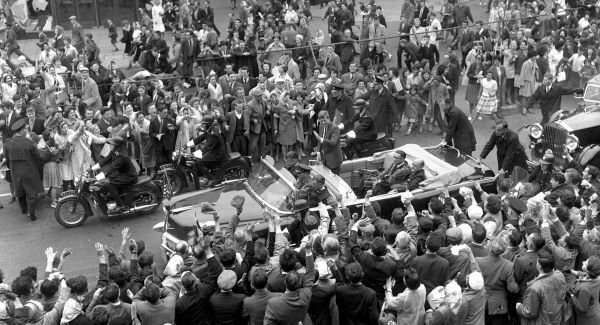
Kennedy spent four days in Ireland as part of a European tour. His visit to Cork on Jun 28, 1963, was one of the biggest events ever staged in the city. Huge crowds gathered in Patrick Street and around City Hall to see the presidential motorcade.
It was an awesome sight. I thought my dad’s Ford Cortina was a cool set of wheels but you could have put it in the boot of Kennedy’s limousine or any of the eight enormous vehicles that made up the cavalcade. At least I counted eight, but there could have been more as I watched in wonder at the parade that snaked down Military Hill in St Luke’s after a courtesy call on the Irish Army at Collin’s Barracks.
Along with what seemed like the whole population of Cork, I was perched near the junction of Summerhill and Mahoney’s Avenue.
At first — being a small six-year-old — I could see nothing, but then my father lifted me high over the crowds so I towered over them all as the presidential parade glided serenely by.
It was a dodgy thing to do as there is a 15ft drop from the main road to the avenue, guarded then only by rusty railings and a crumbling wall. “Jesus, Mary, and St Joseph,” exclaimed my mother as, in the excitement, I began to weave excitedly and my father had to struggle to hang on to me. Mum thought I was about to teeter over the edge to the concrete below.
“Don’t worry, Missus,” said a neighbour reassuringly. “Sure, if the little fella survives this it will be something for him to remember for the rest of his life.”
He was right. It remains one of my clearest early memories.
As the procession slowed down at St Luke’s Cross I got a glimpse of the great man himself. Then, as the presidential car passed the towering bulk of St Luke’s Church, it slowed, perhaps in reverence. All I could see was JFK’s back now, but then he turned and waved, beaming his trademark smile. I waved back and then he vanished around the corner, carried down the hill towards the city centre.
Later that day Kennedy was awarded the Freedom of Cork City by Lord Mayor Sean Casey at a special meeting of the city council. It was made “in token of our pride that this descendant of Irish emigrants should have been elected to such an exalted office and of our appreciation of his action in coming to visit the country of his ancestors; as a tribute to his unceasing and fruitful work towards the attainment of prosperity and true peace by all the people of the world, and in recognition of the close ties that have always existed between our two countries”.
According to City Hall archives, members of the presidential party said the reception given by Cork people excelled anything they had experienced on their tour, and that Kennedy had taken particular pleasure in hearing the US national anthem played by the band of the Southern Command from Collin’s Barracks.
When JFK came to Ireland it electrified a nation that was barely electrified. The 20th century hadn’t quite reached all of Ireland in the early 1960s, although economic expansion and frugal prosperity were on the way.
In the previous 10 years a million electrical poles had been put up, and in 1961 Teilifís Éireann had begun broadcasting. But in the countryside, milk was still transported in churns by horse and cart.
It is hard to imagine now the astonishment felt at the arrival of JFK and his two sisters who were the living embodiment of the Irish narrative: The Fitzgerald-Kennedys emigrating during the height of the Famine and, within three generations, becoming the most powerful family on Earth.
At the time of his visit, Seán Lemass, our first truly modern leader, was taoiseach while Éamon de Valera, a living ghost of 1916, was in the Áras.
It was a marriage of convenience. While Dev looked inwards, tugging at the heart-strings, the ever pragmatic Lemass looked outwards, launching his programme for economic expansion and courting US businesses in particular to invest — and ultimately enrich — Ireland.
The presence of the 35th president of the United States did wonders for Lemass’s dream of dragging Ireland into the fold of wealthy western democracies.
The fact that de Valera was president added a certain solemnity to the occasion, too. JFK was a great admirer of Dev’s courage and tenacity — and the feeling was mutual. They had at least two things in common: they were both American-born and they were both war heroes.
JFK spent four days on Irish soil. Unlike the flamboyance of Pope John Paul II who arrived 16 years later, he did not kiss the ground when he landed here, but puckered up for babies and babes as he was fêted in Dublin, Wexford, Cork, Galway, and Shannon.
The warmest kiss of all came from his second cousin Mary Ryan when he visited his ancestral homestead in Dunganstown, Co Wexford.
He received a rapturous welcome throughout the county and, according to a BBC report of Jun 27, 1963, “he was then driven to Wexford town where he made much of Ireland’s subjugation and religious persecution by the British”.
Hundreds of well-wishers cheered and waved flags on his arrival and a choir of 300 boys greeted him singing ‘The Boys of Wexford’, the famous ballad commemorating the 1798 rebellion.
The president left his bodyguards to join them in the second chorus, prompting one US photographer to burst into tears.
JFK and his sisters met 15 of their cousins, including Mrs Ryan, the owner of the homestead who welcomed him with a kiss on the cheek.
Tea had been laid out on trestle tables in the yard and a banner declared ‘Welcome home, Mr President’. Drinking his cuppa, JFK toasted magnanimously to “all those Kennedys who went and all those Kennedys who stayed”.
CONNECT WITH US TODAY



Be the first to know the latest news and updates

















