The ultimate cycling trip ... ‘I had to drag my bike over horse tracks and hills’
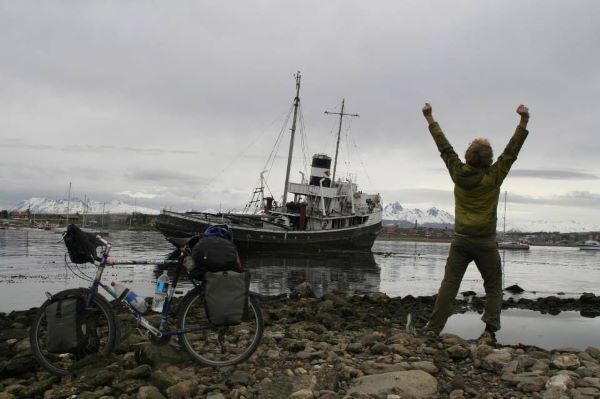
FIFTEEN months and 17,006 miles after mounting his bike in Alaska, Ian Lacey’s adventure cycling the length of the Pan American Highway ended on Oct 10 at Ushuaia, Tierra del Fuego, Argentina.
That’s the northernmost road in North America to the southernmost road in South America in 452 days. The Gorey native’s one constant companion was Santiago, his Surly Long Haul Trucker touring bike. The moment was bittersweet.
“It’s funny how you can give a personality to a few pieces of metal, but, I think, taking the bike apart will be one of those sad moments. I also know it has done its job,” says Lacey. “A lot of people don’t drive their cars as far as I’ve taken this bike.”
On the journey, dubbed 350South, Lacey visited 15 countries on two continents. Lacey’s self-described “adventurous spirit” was restless for a journey, and after finishing a contract in Denver, Colorado, in 2010, it was time to plan his big adventure.
Lacey says he wanted an adventure that would be spiritually, culturally and environmentally enlightening. He wanted to learn about himself and the world.
“I looked at the map and thought ‘what could be human-powered’? and thought of bicycle touring,” says Lacey.
“I had never been a cyclist. But I looked at the Pan American highway on the map, and I thought there was a nice little line there from north to south.”
Lacey learned about cycling along the way. A motivator was raising funds for the Carers’ Association of Ireland. Lacey was a part-time carer for his grandmother, Lily, who died in 2008.
“I watched my mom care for my grandmother, relatively unsupported, because there was poor government assistance at the time. It made me want to do something that could benefit Irish carers.”
Congratulations Ian Lacey @350South for completing an amazing journey down the Americas http://t.co/Q5Hsx4Ww' #youradventure
— Mark Beaumont (@MrMarkBeaumont) November 19, 2012
Lacey set out from the oil fields of Prudhoe Bay, Alaska, on Jul 16, 2011 with American friend, Lee Saville. The pair parted in California.
Lacey was more comfortable cycling at his own pace.
“It’s difficult to be around one other person for so long.
“When I got my first taste of freedom, I kind of realised I needed this mental space to be on my own.”
Lacey’s daily routine was 120km per day, or seven to eight hours on his bike. The journey has changed his perspective on his body’s capabilities.
“If someone told me when I woke up in the morning that I had to cycle to the airport from Gorey, I would say you’re absolutely mad,” says Lacey. “Now, because I don’t know where I am going and because I am so used to it, I never even think about it. I don’t even notice it now, any more. ”
Some days, Lacey cycled 180km to reach a service centre or somewhere he could refuel his stove, or get food or water.
People in Colombia and Mexico were particularly hospitable.
“There, people would come up to you on the side of the road and invite you to their homes and give you a meal.
“I spent a lot of nights in front of people’s wood-burning stoves, because it was safe and also I was getting to meet people and learn a bit about them, and just have a bit of craic.”
Towards the end of his journey, passing between the border of Chile and Argentina, Lacey spent a day and a half dragging his bike over rivers and hills as there were no paved roads, only to end up just 15km from where he had begun.
“I thought I could just cross over a river and walk the 15km, but it took a good day and a half, when I was without safe drinking water.
“Things like this happen every now and again, but you have to push yourself over it and think about rationing food and rationing water. There was no road to cross, so I had to drag my bike through horse tracks, and over hills, to get to the other side of a mountain, where the beginning of the road in Argentina was.”
Lacey relied on the generosity of people. In Peru, while travelling over a mountain pass, construction workers gave him food and water.
“I had water, but maybe not enough and I’d assumed also I could get water from the snow and ice up there, which I actually couldn’t, in the end. I was maybe without food for a day and some construction workers that came by handed me lunch. Things like that seemed to come along. When things were at their very worst, something always seemed to happen for it to get a little better.”
The cyclist was never reckless, travelling with a GPS that regularly sent a signal of his location, but he appreciated the unexpected.
“People talk about what an adventure I am on, and all of this, but my real adventures out here have been when I haven’t planned things.”
At the end, Lacey reflected on the big idea of his Pan American adventure. He hoped that others would be inspired to challenge themselves.
“I was afraid of being belittled by my own idea. I hope I can show others you don’t need a mad amount of experience. It’s a journey that was born in the mind and I knew the physical part would come.”
Lacey says cycling can easily be integrated into the everyday life of Irish people.
“I think a lot of people can do 6km or 7km if they are going to work, and we should have better incentives for people who are getting on their bikes. I never really cycled and now I don’t understand why I never did.”
So what is next for the cyclist? He plans to relax and savour his success in Ushuaia before returning to Ireland on Oct 17.
“The most important thing is they have an Irish bar there, so that is where I will stop first and pay $13 [€10] for my Guinness and be happy about it.”
Lacey, who has been blogging about his journey and documenting it in photographs and videos, plans to write a book about his experience.
“I want to talk about the nature of travel, not ‘I did this or I went here’, but more of the thoughts I’ve had while travelling.”

CONNECT WITH US TODAY



Be the first to know the latest news and updates

















