Mapping our memories
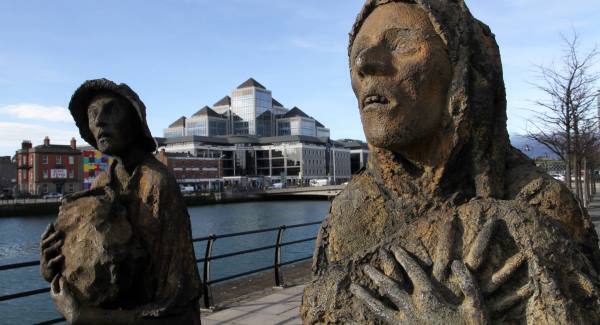
THE Great Irish Famine (1845-52) is seen not only as the most defining event in modern history but as the greatest natural disaster of the modern age.
As many as 1m people died of starvation and famine-induced diseases. If averted births — due to famine amenorrhea (the hunger-induced absence of menstruation), illness, postponed marriages, migration, death and social disruption — are included, this figure climbs to 1.4m.
In addition, at least 1.3m emigrant-refugees fled the country for other lands between 1845 to 1851. Between 1851 and 1855, a further 800,000 people abandoned the island in search of a better life in Glasgow, Liverpool, London, Boston, New York, Toronto, and all parts of the English-speaking world.
The terror that faced those who died during the Famine defies description.
However, we can imagine the scene afterwards, as landscapes and parishes were often left devoid of over half their population, where the number of children had been radically reduced, where only half as many people were still working on the land, where so many households, neighbourhoods, and villages had shrunk or had been swept away, and where most of the towns took on a weary, defeated look.
Young Irelander James Fintan Lalor saw the Famine as a kind of negative revolution, bringing with it a deeper social disorganisation than that of the French Revolution, with a greater waste of life and wider loss of property, “with more of the horrors, and none of the hope”.
The Famine is surrounded by controversy, silence, and shame. Scholars, commentators and politicians argue about what happened and who was responsible. The voices of 1m men, women, and children who died of hunger and disease in cabins, by roadsides, in bogs and ditches, in workhouses and fever hospitals are absent.
If each of these people who died because of the Great Famine could write the stories of their experiences and feelings, we could not bear to read these accounts. And it is likely that the Famine dead would see the narratives of the Great Famine — that we, the living, make — as unreal. The first great silence relates to the Famine dead.
Hence the editors’ decision to begin this Atlas with Eavan Boland’s poem That the Silence of Cartography is Limited:
That the silence of cartography is limited
— and not simply by the fact that this shading of forest cannot show the fragrances of balsam, the gloom of cypresses is what I wish to prove.
When you and I were first in love we drove to the borders of Connacht and entered a wood there.
Look down you said: this was once a famine road.
I looked down at ivy and the scutch grass rough-cast stone had disappeared into as you told me in the second winter of their ordeal, in 1847, when the crop had failed twice, Relief Committees gave the starving Irish such roads to build.
Where they died, there the road ended and ends still and when I take down the map of this island, it is never so
I can say here is the masterful, the apt rendering of the spherical as flat, nor an ingenious design which persuades a curve into a plane, but to tell myself again that the line which says woodland and cries hunger and gives out among sweet pine and cypress, and finds no horizon will not be there.
The poem confirms that the map cannot carry the pain, cannot carry the story of the catastrophe that was the Famine. Only music, and its near neighbour poetry, comes close to remembering the cry of want, the mournful wail of hordes of people as they faced starvation and death.
Here the poet uses the symbol of the famine road as a metaphor for the devastation and terror that so many people experienced. The poem notes that when the potato crop failed twice, relief committees were instructed to provide the starving Irish with roads to build so that they could have money to provide food for their families.
But strict government regulations meant the pay of workers on the relief roads was insufficient to allow many of their dependent households to survive. Both the poem and the atlas recognise that neither maps nor texts alone can fully represent either in scale or particulars of the Famine catastrophe. A diversity of approaches and forms of representation are necessary to try and embrace the meaning of the Great Famine, its causes, effect and long-term consequences.
The editors recognise the need to interrogate the silence and/or selective memory of those who survived the Famine and of their descendants. While we have some stories of those who managed to survive and emigrate, there are thousands and thousands of desperate people who fled this island — losing all faith in their ancestral lands and communities — who were not so successful abroad and whose stories remain untold.
Yet, the Famine and its consequences are still remembered among the emigrant Irish scattered across the world and most especially in Irish-American folk memory. The picture is more complicated for the Irish who survived the Famine and remained at home.
Many were to witness, and certainly some committed, awful deeds to carry on. We have to again ask the question that our parents/grandparents often asked: Why did their parents/ grandparents have so little to say about that awful period? One answer is that the best way of handling such a trauma is not to talk about it.
We need to recognise that survivors, as well as victims, suffered hunger, lost family members and neighbours, suffered the shame of the poorhouses and the terrors of fever. Suffering and pain apart, there is no doubt that both shame and guilt were important determinants of many silences. Did some of our ancestors have to step over bodies to both survive and enlarge their farms and business holdings, make small profits out of the misery of the poor, abandon wives and children, deny food or money to other family members so as to survive themselves, isolate fever-stricken siblings or neighbours in pigsties and outhouses?
Who collaborated with the landlord in the levelling of the many homes of the evicted and who facilitated the often stingy administration of all forms of food relief, whether as union guardians, in workhouse wards, or relief roads, in some soup kitchens or in drawing up outdoor relief lists. If the shame and guilt of these actions were denied, compassion was obliterated between people. Stark choices were made: Moral ambiguities abound. We have to excavate carefully along these fissures and try and expose the wounds, the memory loss, that which is hidden.
However, it is not entirely valid to argue that the Famine was hidden or repressed in the people’s memory. The Irish Folklore Commission contains a rich archive of oral tradition relating to the Great Famine. Over thousands of pages, the memories, stories and interpretations of the Famine are presented for many localities from the perspective of ordinary, and sometimes illiterate, people.
The materials make for harrowing reading: Stories of the bodies of young and old found dead along the roads, of fever-stricken families shunned by their fearful neighbours and of the horror of the poorhouse. It is noticeable that memories of hunger and starvation are far stronger than those of fatal diseases and that relief institutions of all kinds, deemed good or bad, are well remembered.
The greatest odium is reserved in the folk memory for those who acted as agents and estate officials for often heartless landlords and for those who “grabbed” land. Folk memory is faithful to all, landlords included, who were generous to others in those awful times. Yet, these voices which we have recovered from folk memory are the nearest we are ever likely to get to the experience of the poor in the 1840s and 1850s.
However, absent from these IFC volumes are the key decision-makers and administrators in London and Dublin and any sense of the wider structural forces shaping both culpable policies and the Great Famine tragedy.
In contrast, we have inherited the writings of the governing elite in London who directed famine relief operations after 1845 and exercised enormous power over the destinies of millions of the disempowered Irish population.
We have their almost fanatical adherence to, and promulgation of, laissez-faire and Poor Law ideologies. These were born of a new bourgeois English political economy which described the Irish, especially its poorer classes, as deeply resistant to “refinement and reformation” along a cherished English model of capitalist — as opposed to “peasant” — agriculture.
We have the economist Nassau Senior wondering would 1m Irish deaths “scarcely be enough to do any good” in effecting such a reformation. We have the great untruth of Charles Trevelyan announcing in his book The Irish Crisis — written in late 1847 — that the Famine was over. (About 140 years later, economic historian Joel Mokyr’s conclusions are very different: “most serious of all, when the chips were down in the frightful summer of 1847, the British simply abandoned the Irish and let them perish”.)
We have the records of the voices of government appointees to Ireland, from the lord lieutenant to regional and local officials — not to speak of bishops, clergymen, politicians and others — pleading for more food or financial supports, for more local autonomy and for greater understanding from the London administration.
Ireland’s greatest 19th century politician, Daniel O’Connell — who in the late 1830s warned the government that Ireland was too poor to support its (English-imposed) Poor Law system — is remembered in his final year (1847), now ill and frail, speaking at the dispatch box in Westminster and warning the British government and parliament that 2m Irish would die if adequate remedial policies were not adopted.
We have inherited literally tons of official documentation relating to the Famine — committee reports on the operation of the Poor Laws, commissariat reports, papers relating to the relief of distress, correspondence and reports of the Poor Law Commissioners, police reports on “outrages”, and censuses.
There are seven tons of materials alone relating to the activities of the Board of Works in Famine Ireland. And there are thousands of union workhouse volumes housed all across the county libraries, detailing down to the last farthing the money spent on food, clothing, medicine, staff, turf, coffins ... every week in each workhouse union.
Until relatively recently, there was a strange reluctance on the part of historians, historical geographers and others to address these vast documentary archives. A further silence relates to the historiography and geography of the Great Famine.
With some exceptions, including The Great Famine: Studies in Irish History (1957), edited by Robert Dudley Edwards and Desmond Williams, and most particularly Cecil Woodham Smith’s path-breaking and evocative The Great Hunger (1962), research and writing on the Famine, is astonishingly sparse from the 1880s until the 150th commemorations of the 1990s. During the 1960s, 70s and 80s there was also a tendency to remove the Famine from the central stage of 19th-century Irish history. Indeed, the arguments that the real watershed in 19th-century Irish economic and social history was in 1815 (after the Napoleonic wars) rather than 1845 — that such trends as the decline of the Irish language, the shift from tillage to pastoral farming, and the strengthening of impartable inheritance patterns began then — won widespread acclaim.
Looking back, it is still simply astonishing that the amine period, which witnessed over 1m deaths, when 2.5m people deserted Ireland within 10 years, and emigration became deeply institutionalised in Irish culture, which saw the elimination of 300,000 family farms, the virtual disappearance of the cottier class with less than one acre, not to speak of the economic desolation and pauperisation of so many towns — was not seen as a major watershed.
In truth, the Great Famine is a great abyss, a great chasm, between pre-Famine and post-Famine Ireland. This was a profoundly revolutionary period, accompanied by immense levels of violence — ecological, physical, psychological and social — only matched in its intensities and long-term implications by the Cromwellian conquest and settlement in the mid-17th century.
However, beginning with Joel Mokyr’s pioneering book, Why Ireland Starved (1985), there have been very substantial advances in our understanding of the Great Famine from many perspectives, most notably in the work of historians Cormac Ó Gráda, James Donnelly, Mary Daly, Peter Gray, and Christine Kinealy.
Ó Gráda has asked, and continues to ask, pertinent questions about the capacity of the Irish economy and the wellbeing of the potato-dependant Irish poor in pre-Famine and Famine times, on the nature of landlord indebtedness before and during the Famine, on the quality of workhouse management then, and on the functioning of food and credit markets at retail level.
Historical geographers have been less active, although the UCC geography department did mount a major exhibition, Famines Yesterday and Today: The Irish Experience in a Global Context, which was opened by then president Mary Robinson in Nov 1995 and travelled to Boston in 1996.
The map work, photographic and artwork for this exhibition were important foundations for this atlas. A former UCC graduate, Cambridge geographer David Nally is the most recent major contributor to the Famine debate, with his Human Encumbrances: Political Violence and the Great Famine (2011).
This innovative work enlarges our understanding of the Irish Famine in the context of other world famines, particularly those that occurred across the British empire. And critically, Nally raises severe questions about the role and impact of structured, legalised violence during the Great Famine. The British treasury spent £9.5m on Famine relief; maintaining the military in Ireland over the same period cost £10m, and the police a further £4m.
This Atlas of the Great Famine has been strongly influenced by these new and not-so-new research insights. The atlas, begins by reconstructing pre-Famine and Famine Ireland and the roles of the original 130 workhouses, details population decline and social transformations, continues with sections on the scattering of the Irish overseas, the Famine legacy, how the Famine was witnessed, remembered and commemorated, and it concludes with a section on hunger and famine in the world today. There has been no attempt to provide an overarching, unifying synthesis.
Rather, what is recognised in this atlas is the necessity for a great diversity of approaches and perspectives in seeking to illuminate and represent the monstrous reality of the Famine tragedy and its consequences.
Hence, the importance attached to the work of poets, visual artists, musicians, folklorists, photographers, and writers of Irish and English literature as well as the pivotal research of other established scholars and the extensive use of archival sources.
The over 50 essays in the atlas by scholars such as Willie Nolan, Kerby Miller, Chris Morash, Joe Lee, Thomas Keneally, Laurence Geary, Julian Campbell, Marita Foster, Pat Nugent, Neil Buttimer, and Piaras Mac Éinrí are juxtaposed, illuminated, and contextualised by five kinds of images.
Maps are obviously central to the atlas, but archival materials, paintings from Famine times and more recently, photographs of Famine sites as well as numerous illustrations contemporary and current, as well as poetic and other artistic insights are all integral to this endeavour.
The generation and interpretation of 200 computer-based maps of population decline, social transformation and other key changes between the census years 1841 and 1851 is naturally pivotal to this atlas exploration.
On the one hand, the atlas provides original, island-wide, almost panoptic views of the Famine which, while very helpful, are nevertheless limiting in other respects. We can see every parish from above but we still do not know how the Famine affected individual families and communities on the ground.
Hence, the parallel analysis of famine conditions in the provinces, counties, parishes and townlands — and in overseas emigrant destinations — so as to try and tell the stories of particular individuals and families caught up in these terrible events. The sections on the Great Famine in the four provinces of Connaught, Leinster, Munster, and Ulster, therefore, occupy a fulcrum position in the atlas. These provide intimate pictures and insights into Famine conditions in many localities.
For Munster for example, local studies are provided for Co Cork of six parishes in the Union of Skibbereen, on Famine roads in Glenville, and on the Famine in Cove. The famines on the Dingle peninsula and the Co Tipperary civil parish of Shanrahan (modern Clogheen-Burncourt) are also explored and mapped.
What these maps document is a range of human worlds and conditions never previously revealed in Irish Famine studies. While recognising the power and effects of the general political and administrative forces at work and the devastating impacts of the Famine island-wide, the interpretation of these maps and other evidence equally emphasises the diversity of local, county, provincial and emigrant conditions and experiences.
These maps provide the reader with dramatic images of where population decline was greatest. Massive declines along the west coast are well known, although Co Donegal surprisingly escapes this trend. But these maps reveal huge losses of population across all of Munster, east Connaught, and south Ulster.
Also, most poignantly, these parish maps reveal where so many children died. Likewise, the disappearance of close on 300,000 family holdings is mapped island- wide; Co Clare alone was to lose 42% of its farms between 1847 and 1853. One of the major findings relates to the devastation and erosion of vibrant social and economic structures in so many towns.
In addition, the inclusion of empathetic perceptive writings of Famine witnesses such as Asenath Nicholson and extracts from the diaries of observers like Elizabeth Smith provide new and moving insights. There are letters from officials, local spokespersons, and from emigrants, as well as a range of government documents such as Relief Commission and Poor Law directives and notices, landlord instructions, and other proclamations.
There are newspaper extracts including food relief lists of desperate people, notices and reports of evictions and adverts for ship sailing times and exit points.
There are paintings of ships, farmhouse and cottage interiors, street scenes, evictions, distraught families in addition to portraits of key decisionmakers and Famine activists. It is striking how many contemporary paintings are of eviction scenes. Numerous conflicting estimates of the number of famine evictions have been made but it seems likely that 100,000 families were forcefully put out of their homes between 1845 and 1851. The Great Famine era was also an age of great clearances.
Modern photography allows the reader to engage the surviving material culture of the Famine: Famine roads, workhouse walls and dormitories and everywhere the potato ridges frozen in time. Likewise, contemporaneous sketches of awful conditions — queues at soup kitchens, funerals, ruined villages, emigrant crowds by quaysides — are provided from The London Illustrated News and from other sources, including those of drawings of Poor Law buildings by architect George Wilkinson.
Interpretations of the Famine by modern artists such as Basil Blackshaw, Tony O’Malley, Charlie Tyrrell, Annette Hennessy, Rowan Gillespie, and Brian Tolle encourage the reader to stop and reflect on the trauma of the Famine. All these materials and perspectives engage the reader sympathetically rather than analytically.
Reflecting on all the published and unpublished materials on the Great Famine, the dominant feeling evoked is one of sadness. We honour those who gave generously of themselves to alleviate that suffering, including the disproportionate number of clergymen and medical staff who died during the Famine.
We regret the betrayals, failures and inhumanity of those in many positions of authority, especially those with the greatest power and responsibility to shape other people’s destinies. This atlas is a study which seeks to more fully understand the Great Famine and its consequences.
It is also an act of commemoration to the known and unknown dead of the Famine and to the millions who had to flee Ireland.
* William J Smyth is joint editor of The Atlas of the Great Irish Famine with John Crowley (Cork University Press, 2012). He is also the author of the prizewinning Map-making, Landscapes and Memory: A Geography of Colonial and Early Modern Ireland (Cork University Press, 2006).
CONNECT WITH US TODAY



Be the first to know the latest news and updates

















