Collins won intelligence war by a good stretch
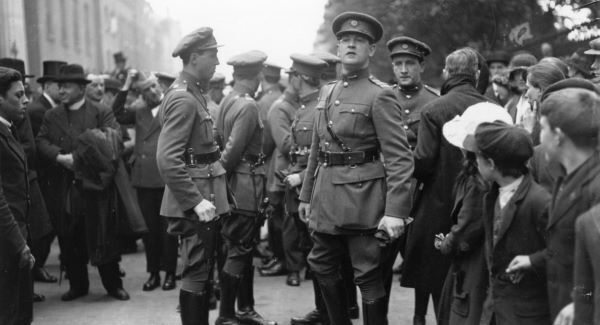
Last Wednesday marked the 90th anniversary of the death of Michael Collins. Ryle Dwyer on a new book on his decisive role in the Anglo-Irish War

Collins won intelligence war by a good stretch

Michael Collins and the Anglo-Irish War

JBE Hittle

Washington, DC, €22.41

JBE HITTLE, is described on the dust jacket as “a highly decorated veteran of US intelligence”, set out in the book “to measure the Anglo-Irish War from the perspective of professional intelligence standards”. He explains that “in a broader sense it is really a case study of Britain’s failed experiment in prosecuting a counterinsurgency under the direction of a national intelligence director”.

It is more about British Intelligence failures than about the success (perceived or otherwise) of the operations led by Michael Collins. The bungling of the British intelligence community seemed to know few bounds.

British intelligence essentially conspired with Irish Republicans to stage the Easter Rebellion. William “Blinker” Hall, the celebrated head of British Naval Intelligence, was aware of the plans for the Easter Rebellion.

Roger Casement had returned from Germany, not to take part in the Rising, but to call it off. When he realised that the British were aware of the plans, he asked to be allowed to appeal to his colleagues to call off the Rebellion. But Hall and company were anxious for the Rising to go ahead.

Hall not only refused Casement’s request, but went much further. “He withheld key information from the Cabinet, hoping the revolt would proceed and the British forces would crush the conspirators, putting an end to radical nationalism in Ireland once and for all,” according to the author.

As the War of Independence developed in Ireland the British appointed Sir Basil Thompson of Scotland Yard as a security czar, but his operations functioned as a bureaucratic roadblock that hindered the co-ordination of police and military resources. “It was a lapse of national security driven by political favouritism and budgetary shortsightedness,” Hittle notes.

Ormonde Winter was put in charge of intelligence under the British commander-in-chief in Dublin, Sir Neville Macready, who had previously served as commissioner of the London Police. While Hamar Greenwood, the chief secretary for Ireland, ranted about the murder gang in Ireland, he was arranging to set up British murder gangs.

The author notes that Winston Churchill was responsible for selection of Charles Tegart at Dublin Castle, where he was such a disaster that he was removed in late-1920. The author was apparently unaware Tegart figured again in Ireland during the early months of World War II when his intelligence reports demonstrated that his lousy judgment had not improved in the intervening years.

“Local Irishmen accept the visits of u-boats with as commonplace an air as they accept the sun rise on a fine day,” Tegart reported from Ireland in 1940. Some 2,000 Germans had already landed in Ireland, “many ostensibly studying folklore”. His report, which was submitted to the British cabinet, noted the Germans were buying up interests in the west and the south coast of Ireland, rooting up hedges and levelling suitable fields for landing grounds. This was hysterical nonsense.

Warren Fisher, who referred to the “wooden stupidity” of those responsible for British policy in Ireland in 1920, noted that “the Castle, police and military were more in competition than co-ordination”. The system of introducing spies from outside, which was so ruthlessly exposed on the morning of Bloody Sunday, amounted to the institutionalisation of idiocy.

There is little doubt that Collins had the upper-hand in the struggle with British intelligence at this stage. He had men inside the British system who were passing on information to him.

One of his spies was “Lt G”, who has never been positively identified. There have been various suggestions, and Hittle comes up with another name, John Chartres, who had been in British intelligence but served on the Dáil staff. Hittle notes that there has also been speculation that either Lily Mernin or Thomas Markham was Lt. G.

James Mackay suggested that Markham was Lt G, but Markham’s role as a spy in Dublin Castle has been grossly exaggerated. He was only appointed to Dublin Castle in 1922, some weeks after the Collins was appointed as chairman of the provisional government. The British actually appointed Markham on the recommendation of Collins himself.

Hence he was not a convention spy, but a conduit to pass on information to Collins that the British wished him to know, without leaving a paper trail. British officials at Dublin Castle knew that Markham was working for Collins.

The British only began to make real inroads into the intelligence operations of Collins through captured documents, not agents or spies. They captured a wealth of documents in late-1920 and 1921.

In a raid on the office of Richard Mulcahy, the IRA chief of staff, for instance, they captured reports indicating that IRA commanders were having trouble getting their men to attack the lorries of Auxiliaries or Black and Tans that were carrying civilians picked up from the streets.

Those civilians were being used as human shields, and General Macready not only reported this to the cabinet in London, but also essentially gloated that the policy was working effectively. By its inaction the British cabinet essentially endorsed this policy of hostage taking.

The book has some very good insights into the intelligence deficit on the British side, but it is weak when it comes to explaining what Collins was trying to do.

His aim from the outset was to knock out the eyes and ears of Dublin Castle through the elimination of the most effective detectives. He believed that the British would retaliate, but if they did so without proper intelligence, they would inevitably lash out blindly and strike at totally innocent Irish civilians. In the process, he confidently predicted that they would drive the Irish people into the arms of the Republicans.

This is essentially what happened on the afternoon of Bloody Sunday when British forces fired indiscriminately into the crowd of spectators at Croke Park. It was also what happened with the burning of the city centre business district in Cork City little over a fortnight later.

“In all my life,” one of the British troops wrote home, “I never experienced such orgies of murder, arson and looting as I have witnessed during the last 16 days with the RIC Auxiliaries. It baffles description. And we are supposed to be officers and gentlemen.”

Unfortunately the book is marred by a number of factual errors that should have been detected in the editing process. The author states, for instance, that Collins quit drinking alcohol in 1920. Maybe if he had, people would not now be commemorating his 90th anniversary.

The author mistakenly suggests that Collins was appointed Director of Information, instead of Director of Intelligence, and that Archbishop Clune of Perth, Australia, came to Dublin before Bloody Sunday — instead of a couple of weeks later — to try to arrange a truce. The date of the execution of Kevin Barry is given as November 2, whereas it was November 1 — All Saints’ Day. The British made a virtual martyr of him.

The author’s mistakes were not of great consequence, but they do detract from what is essentially an interesting and otherwise well-written book.

x

More in this section

Cookie Policy Privacy Policy Brand Safety FAQ Help Contact Us Terms and Conditions

© Examiner Echo Group Limited













