Give it a spin and learn a craft from the masters
This month, artisans, from potters to jewellers, are opening their workshops to tea ch their traditional skills, says Colette Sheridan

Give it a spin and learn a craft from the masters

THE third Cork Craft Month, which runs until Sep 9, is not just an occasion to view beautiful crafts. A new initiative is ā€˜meet the maker’, classes in textiles, ceramics, jewellery, painting, and more, taught by master crafts people. The classes will be at Cornmarket Street and Kinsale Pottery and Arts Cent re. There will also be demonstrations at Blarney Castle, West Cork Crafts in Skibbereen, The Courtyard in Midleton and at open studios throughout the county.

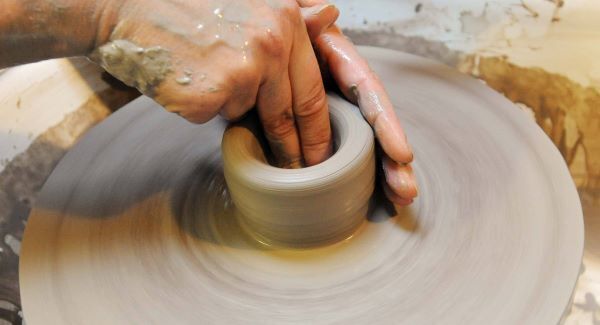
Adrian Wistreich, of Kinsale Pottery and Arts Centre, was a businessman in publishing in the UK. He wanted to be an artist. After training in ceramics in London, he moved to Kinsale in 2000 a nd set up his crafts business. Last week he offered to show me how to make a bowl at his premises, the outbuildings of the 18th century Ballinacurra House. I attended pottery classes as a child, but had never worked on a wheel. Wistreich demonstrated, throwing the clay onto the wheel, turning a lump of it into a perfectly shaped bowl. I messed up building u p the walls. This involved squeezing the clay and pulling it up — in one motion. The faster the wheel is spinning, the faster you can pull up. My clay collapsed into a soggy heap. But just handling the clay is therapeutic and making a bowl becomes easier with practice.

Wistreich, one of the founders of Cork Craft Month, says many crafts people are living ā€œbelow the breadline. Some have to teach to make a living. This year, we’re developing a brand called ā€˜made in Cork.’ All our members will be able to supply the brand and we hope to sell internationally, as well. It’s a huge step forward.ā€ ā€˜Meet the maker’ is a taster for the public. ā€œI think everyone fancies trying to make crafts. In the past year, I’ve had 400 people attending workshops at my studio. They come for a day or they come for a five-day course, where they learn all the techniques and take away at least ten pieces with them,ā€ he says.

Also from England, textile designer Caroline Smith fell in love with Ireland on a holiday and moved to Kinsale in 1990 with her husband. The couple subsequently had two children. Smith completed a degree in printed textiles at the West Surrey College of Art and Design. She runs Plum Designs, selling vintage-designed tea-towels, aprons and cushions.

Smith uses the Angelina technique. Angelina is a plastic derivative. It is a fibre-like peacock-coloured material (or plain white) with a metallic twist, which I laid down on paper, placing another sheet of paper on top. I placed a hot iron on the paper, which fuses the fibre. I added tissue-paper shapes, for example, and pressed them with the iron again. I cut out a heart shape. This basic piece of art can form a picture that can be mounted and framed.

ā€œI teach basic techniques and people can do what they want with them,ā€ says Smith. ā€œI also work with flax. Some of the work I do can be very intricate. For my ā€˜meet the maker’ sessions, I’m going to do workshops in felting and the Angelina technique. I don’t think anyone has fully realised the potential of Angelina as a material.ā€

A former diamond cutter in Israel and in South Africa, Samuel Yolzari runs Silverstone Dimensions in The Courtyard, in Midleton, with his wife, Mairead McCorley. The couple met while living in a Kibbutz in the 1970s. Yolzari works from a small space behind his shop counter, using myriad tools, such as pliers and drills. It is a joy to watch him make jewellery, whistling cheerily as he solders metals together, sometimes using materials such as ebony, a stunning contrast with silver or gold. Yolzari also uses precious stones. I watched him making a pendant out of silver and ebony, with a pearl placed in the centre of the piece. There is a playfulness to some of his jewellery, reflected in pieces that are reversible or kinetic.

Yolzari designs his jewellery but also makes clients’ designs. ā€œSometimes, people have very good ideas. We work together, using the imagination and the reality of what can be done. When I was a diamond cutter, always in the back of my head I was designing jewellery. With diamond cutting, you develop a skill, but there is no creativity involved,ā€ he says.

Yolzari’s jewellery is ā€œmostly one-off pieces. Every design has its own techniques. I also carve into stones that I find on beaches, sometimes putting semi-precious stones onto them.ā€ McCorley, the project co-ordinator of Cork Craft Month, says ā€œthere is a sentiment out there for craft. But people don’t have much money and, unfortunately, they don’t always know what Irish craft is. But they genuinely want to support us.ā€

Yolzari is an Irish traditional music enthusiast and uses wood, from making musical instruments, in his designs. A master crafts man, he is resourceful and imaginative — like the colleagues who will demystify their art at Cork Craft Month.

www.corkcraftanddesign.com

More in this section

Cookie Policy Privacy Policy Brand Safety FAQ Help Contact Us Terms and Conditions

Ā© Examiner Echo Group Limited













