The fight for justice after thalidomide, 50 years on
IRISH thalidomide survivors feel they’ve hit a brick wall. It’s just over 50 years since German pharmaceutical company Chemie Gruenenthal withdrew the notorious morning sickness drug, having accepted under pressure that it was the common denominator in a spate of birth defects in Germany.
In Ireland, thalidomide was imported under a variety of trade names. The most popular sold 51,000 units here in 1961. Chiefly prescribed to pregnant women (a group for whom the drug was never tested) in the late ’50s and early ’60s, expectant mums had no notion the nausea-combating sedative was highly toxic to unborn babies. Depending on when in pregnancy it was taken, thalidomide caused miscarriage, eye and ear defects, damage to major organs and body systems. The main deformity was shortened or absent limbs.
Worldwide, thalidomide left 10,000 babies deformed. Almost 5,000 survive today — 32 in Ireland. They’re now dealing with the cruel fallout of having for 50 years tried to live as normally as possible within often catastrophically-disabled bodies. “For 50 years we’ve endeavoured to use twisted bodies and joints to perform skills ranging from simple daily tasks to phenomenal achievements, like that of Jacqui Browne in Kerry who sailed across the world in an ocean race,” says Finola Cassidy of the Irish Thalidomide Association (ITA).
The cumulative effect of decades of putting pressure on healthy joints to compensate for missing or stunted ones has been “massive and unplanned”, says Cassidy, 50. It’s as if the survivors have become disabled all over again. “There has been marked deterioration in our ability to perform everyday tasks. We’d achieved a level of independence despite our disability. Now it’s like we’ve hit a wall and it’s come like a bolt from the blue. It’s very upsetting, this erosion of independence at the relatively young age of 50.”
Uncertain and scared for the future, the fear is compounded for those who can no longer rely on ageing parents to give the round-the-clock care they’ve provided for decades. “In many cases, there was an interdependence of mother and child. The ITA has at least three members who are in the care of elderly parents.”
From the beginning, survivors felt let down by the Irish State. The ITA says the drug remained on the market for at least seven months after its German withdrawal in November 1961. “It shouldn’t have happened to me,” says Kerry-based thalidomide survivor John Stack, who was born in January 1963. Stack believes there are “four of us in total that could have been saved”. And Dr John O’Connell, a one-time Health Minister, reported that three years after thalidomide’s withdrawal, he was able to buy it in a pharmacy in Ireland.
A 1975 compensation agreement between the Department of Health and parents of 33 survivors, acting on their children’s behalf, gave each child a lump sum ranging from just over £6,000 to just under £21,000, plus a small monthly allowance payable through his or her lifetime. It was completely inadequate for survivors’ needs and was never envisaged to take the children (then aged 12 to 14) into adulthood, says Cassidy — thalidomide survivors weren’t expected to live long. Nor was the award afforded protection of the courts, which would have ringfenced it in the interests of the thalidomide-affected child.
In 2007, the ITA submitted a detailed statement to then Health Minister Mary Harney, covering Government handling of the catastrophe, malformations/impairments suffered by survivors and the ongoing struggle/future needs of Irish survivors. Minister Harney referred the matter to the State Claims Agency, which compiled a report. “It was so hurtful to us — this was the first time in 35 years there was a possibility of consultation with thalidomide survivors and we were excluded from the process,” says Cassidy.
The 2010 report recommended a “take it or leave it” settlement of €62,500, plus a commitment to match the ongoing annual sum being paid to survivors. “This amount wouldn’t get us past the first 10 months,” she says. A British report put the annual cost of living with thalidomide at €46,000. “This is in stark contrast to the State Claims Agency recommendation of a once-off payment for the rest of our lives of €62,500,” says Cassidy, adding the annual sum paid to survivors is “a huge insult” — amounts range from €1.26 a day to €10.08 for someone with no arms or legs and possibly internal damage.
The ITA unanimously rejected the offer. They worked tirelessly to ensure their needs were on the programme for Government when Fine Gael and Labour came into power last year. “We got a promise to ‘renegotiate further compensation for Irish thalidomide survivors with the ITA’. But the minister reneged on all promises and said the Attorney General had advised the State had no responsibility. He wanted to make a gesture to us. Our members were horrified at the word ‘gesture’, that there was going to be no serious negotiation on the promised compensation.”
Thalidomide survivors in Britain have fared better. They received about five times the Irish 1975 awards. In the past 35 years they’ve had various top-ups, culminating in £24m paid to the British Thalidomide Trust for a three-year pilot scheme. Last year, they paid up to €86,000 a year to the most severe cases. The British are now negotiating how best to put the pilot scheme into a permanent annual health grant.
Here, the ITA believes survivors are entitled to the ordinary justice expected by any Irish citizen. “If our disabilities were the result of a road traffic accident, we’d go to court — our disability level and needs would be assessed and we’d be compensated accordingly,” says Cassidy.
Faced now with accelerating physical decline, their own ageing and that of their carers, Irish thalidomide survivors feel a huge sense of urgency. “We need to negotiate now for the balance of our lives because we’ll never find the strength to take up the fight again.”
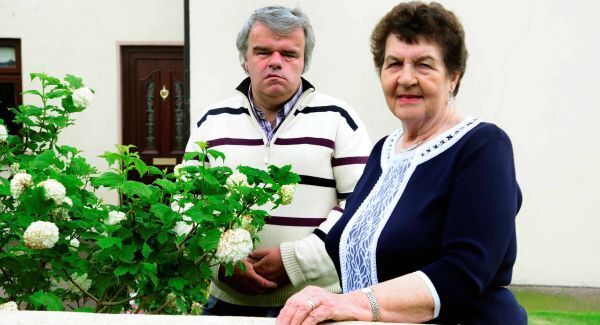
PEGGY MURPHY, 82, from Whites Cross, Cork, took thalidomide during her third pregnancy. Son Martin, 51, is deaf, dumb and has facial paralysis.
“I was constantly sick. My GP said he had a very good tablet to counteract it. I took 12 altogether. When Martin was born, my husband, James, said: ‘there’s something wrong — he’s missing an ear’. James was in a dreadful state. It changed my life completely. I knew he’d never speak or go to school. I was devastated.
“When he was six months, I got a letter referring him to a top paediatrician. He asked if I’d taken a tablet while pregnant. He’d just returned from the UK and the rumour was out — he’d seen babies worse than Martin.
“At that time, there was no school for the deaf in Cork. Martin had to go to Dublin. That was horrendous — I can still hear him crying, banging the windows of the train. He’d come home at weekends. When he was 17 he came home to help me on the farm. He’d get very depressed. He built his own house — his father gave him a site. He doesn’t like going to social outings or family gatherings. He says he can’t hear what people are saying.
“He can do anything in the line of carpentry, but he’s getting older and so am I. I’m caring for him now 50 years. I won’t be around forever. He’s very independent but he’d miss my company. All of his brothers and sisters are brilliant to him, but he tells me his troubles. I don’t know what will happen to him health-wise.
“Thalidomide survivors should be adequately compensated so they can have a decent standard of living. I would love closure on this.”


CONNECT WITH US TODAY



Be the first to know the latest news and updates









