Edith’s last journey
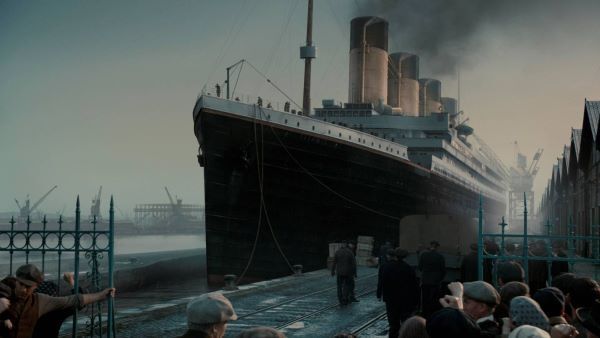
Joan Mitchell was always fascinated by the Titanic — and was stunned to discover her family had a relative on board
GROWING up in County Antrim, I was intrigued by Titanic, and as a child knew the names of the iconic Samson and Goliath cranes.
One of my early memories of Titanic was a movie about the tragic ship, A Night to Remember. That was the first movie I saw on TV, on a cold March night in the mid-1970s when I was eight.
I grew up on a farm and that night we were in the hay shed pulping potatoes for the cows. It was hard work, for two hours every night. That night ‘flew’ as we waited to see our city and our ship on TV. I remember my father’s proud face as he watched Titanic launched, and saw him wipe away a rare tear at its sinking at the end of the movie. When my father died and gave his Titanic book to my son, I was delighted Charlie Boy would have something by which to remember Granddad Charlie. As my son flicked through the pages and told us how many boilers, bulk-heads and lifeboats were on-board, we listened half-heartedly. But then he said there was a woman from Cornwall. Charlie Boy read aloud the name Edith Nile Peacock, from Carnkie in Cornwall. Suddenly, the story of Edith captured us, her small oval portrait in the middle of the page.
Edith was a miner’s daughter, born in into a family of eleven children in 1886. She was brought up in Carnkie, a small village in Cornwall in a two-bedroom granite cottage. She worked locally and met a quiet, considerate young man named Benjamin Peacock. He was in the merchant navy, as were his two brothers — Robert and Ernest. Within a few years of courtship, Benjamin and Edith married in Cornwall and a daughter, Treastall, was born in 1909. Within a few years, they had moved to London, but finally settled in Southampton. In 1911, when the census was completed, Edith was registered as having one living child, one dead child and being pregnant again.
On leaving the navy, Benjamin went to America, ahead of his wife, and settled in New Jersey, where he rented a room in a boarding house run by a Mrs Town, close to the train station in a town called Elizabeth.
Benjamin worked in a factory and saved hard — details of him in the local paper said he was a quiet, conscientious man and was well-respected by his fellow workers. He told Mrs Town he was excited about his family arriving as baby Alfie had been born a few months after he left England.
Benjamin told Edith he would send for his family when he had saved enough money, and in early April he posted the money and Edith booked them all onto Titanic.
There are two versions of what happened on that fateful night. One is that a crewman was helping Edith into the lifeboat and he was holding Alfie. Tragically, the baby slipped from his grasp and fell into the icy waters — Edith and her daughter jumped in to save the baby. Another version is that they were in a lifeboat which capsized.
Benjamin was at the White Star Line offices in New York at 7am the morning after the tragedy. He feared his two brothers were also on Titanic.
Edith and the children weren’t listed on the passenger list and he told his landlady he lived in hope they had missed the ship. Sadly, when the Carpathia arrived his family were not on it. He thought he had lost both his brothers and his wife and children.
His story was covered extensively in the Elizabeth Daily Journal — here is an extract from Apr 23, 1912.
“Benjamin Peacock, who lost his wife and two children in the Titanic disaster, returned to his work in the public service power house on South Avenue, Cranford, yesterday. He told his friends that his wife and two children had been placed in one of the lifeboats, which capsized.
“Mr Peacock has not yet given up hope of finding his brothers, who were also passengers on the ill-fated ship. Less than two weeks ago, Mr Peacock told the men of how glad he would be to have his family with him and showed them a baby carriage for the baby and toys for the older girl. He had brought them from Elizabeth to show them to his fellow workmen.”
My husband is Robert Mitchell. He grew up beside Carnkie in Cornwall and his grandfather was Alfred Nile, a nephew to Edith. Robert didn’t know he had any relations on Titanic, but his mother started to remember talk of a vague relative, but had thought it was just hearsay or a rumour. As we researched more of Edith, she became a real person, and she was given a second chance to tell her story to a new generation.
When Titanic Artefacts Exhibition came to Dublin in 2010, my husband and Charlie Boy went to the event. At the beginning, they got a boarding card, and after they made their way through the exhibition, they stopped at the actual bell from Titanic and checked to see which passenger they each had. Robert said a shiver ran up his spine when he read that Charlie had Edith Nile Peacock. When Robert Ballard (who discovered Titanic on the sea bed) heard this, he introduced himself to Robert and Charlie Boy and was amazed at the coincidence. He gave Charlie some free books, and boarding cards with real passengers’ details on them.
Our coincidences didn’t end there — Charlie Boy sits beside Liam at school and his dad is an architect. Charlie was telling Liam about Edith Nile Peacock, and Liam told him his dad was designing Titanic Belfast’s new building.
I spoke to Liam’s dad and I subsequently emailed him all the information we had on Edith, as there were no family members listed for her.
As a result, we were invited as part of Edith Nile Peacock’s family to the opening of Titanic Belfast centre. We have told family and friends about Edith in the hope of keeping her story alive, as we are her only living relatives.
This weekend we will remember a young woman of 26, thousands of miles from home, on the brink of a new life in America, a woman who had lost one baby and was about to lose her family on Titanic.















