Secret Teacher: Helping our children navigate a New Order
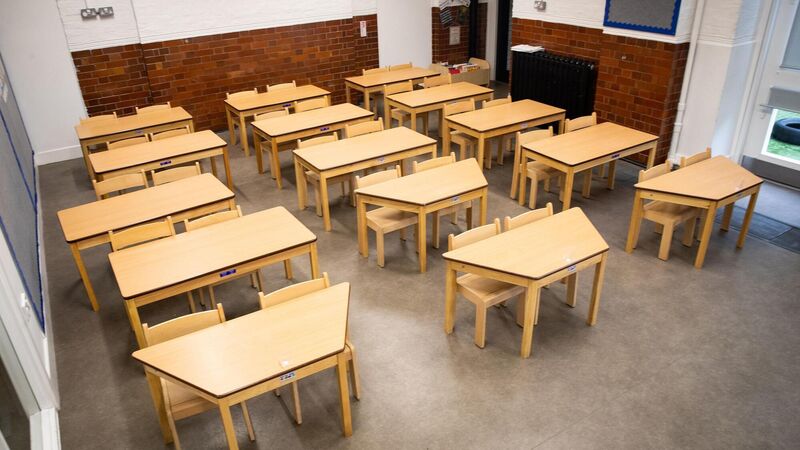
By the time you read this article, I’ll be back in school, but as I write I’m still busy planning my classes for next week. I’ve settled on dystopian fiction for one of my older groups. Let’s face it, the world feels a tad apocalyptic at the moment. We eye each other over masks. We can no longer see each other smile. The gentlest touch can feel like an assault.
Our social fabric appears threadbare, the edges fraying.
Our shared reality is the stuff of science fiction, up there with Huxley’s or McCarthy’s . So, having read these texts in extracts, I plan to invite students to create their own dystopian world. Not explicitly about Covid-19, but for some, the task might be a healthy way to sublimate what they’ve been through — a cathartic exercise we can do together. It’s an indirect way to connect, my biggest responsibility now.
Last night I penned my own dystopian story because modelling is so important in my subject. Let me share my opening with you:
‘Ella MacKenzie woke up at the same time in the same bed every morning — lying between the same two children she’d lived with all her life. In the New Order, children were taken from their homes on their fourth birthdays and released on their 18th. Parenting was done by schools. Politicians had increased their rhetoric around schools for decades, slowly adding more responsibilities to them. It was the easiest way, they said. Parents had to feed the economy. Marriages, indeed families, were rare, impractical, old-fashioned.
Or, like so much science fiction, terribly prescient?
My invented world reflects my darker thoughts today. As a country, we want our children back in school, all children from four to 18, no matter what. But we’ve just finished our first meeting back in secondary and I don’t recognise where my students are going. I’m being asked to stay in one fixed spot at the top of the room. I cannot approach students to help or guide them. There will be no group or pair work. If a child shows symptoms they will be covered in PPE and isolated. How terrifying for them! For a child with special needs even more so.
Why are we sending secondary schools back in these exceptional circumstances? Maybe because there’s no other option. Basic parenting has been sub-contracted to schools for a while now. Parents are busy and life is tough. It’s nobody’s fault but even teenagers cannot stay at home to keep everyone safer. It doesn’t work. It’s no longer an option. This deserves our greatest attention.
Zoe Williams, in , says her children lost their reason to get up in the morning for the last six months.
Like Britain, as a country we will do anything, absolutely anything, to see all students at their desks. Micheál Martin tells us: “Reopening our schools is important to the health of children, to the health of our society.” He calls schools 'exceptional'. He’s right. They have become essential to the health of our society, but should we be happy about it? You see, I don’t disagree with him. I know that thousands of children and teenagers rely on schools for their wellbeing, their mental health, their knowledge of how to eat healthily, how to keep themselves safe and well. Schools are so exceptional that we will take the risk of re-opening all of them. Otherwise, we can’t be certain that young people are safe.
I’m not sure how we got here. I’m not sure where we’re going.
We simply don’t know enough and already, according to , studies in Italy show that 15%-20% of those treated in one hospital’s intensive care for Covid-19 have scarring three months later. Already, they predict a huge burden on health services down the line.
Nothing is definite at this point — other than the fact that all students are returning to school.
Is it possible that politicians are giving in to public pressure against the interest of teenagers? Am I being cowardly to hope for different solutions? I’m certainly anxious. And I’d like clear guidance on when enough will be considered enough if things go badly. What does it take to close a school? The minister seems reluctant to tell us.
I wish we’d spent the last six months updating our online provision on a national level to give us fairer choices for every student now.
Fundamentally, I hope my dystopian imaginings of Ellie McKenzie are nonsense, that we haven’t forgotten our ultimate responsibility — to keep each other safe, rather than to make our lives easier or more straight-forward.
CONNECT WITH US TODAY



Be the first to know the latest news and updates