Darina Allen: My recipes for a traditional Easter Sunday lunch — including roast lamb
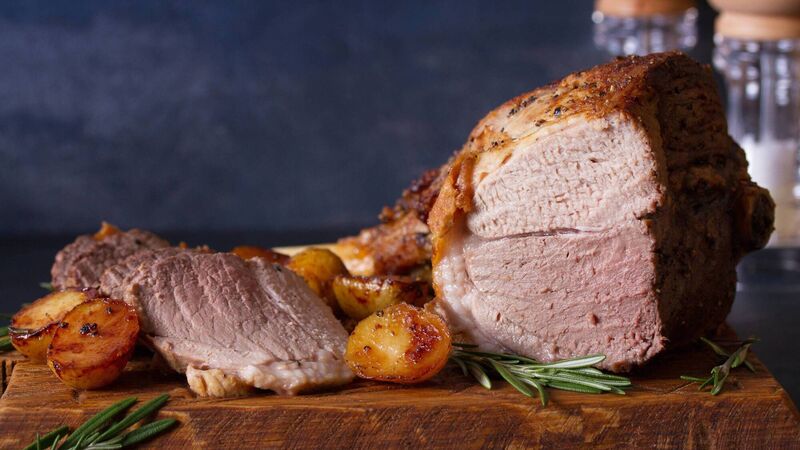
Forget perfect slices, cook to melting tenderness and just lift little chunks off the bone with tongs. The wild garlic aioli makes a tempting change from mint sauce.

Just as I was about to start my Easter column, I spotted this written by Myrtle Allen in the 1970s. ‘A late Easter, with warm, damp weather, upset the man who made our Easter eggs, as the chocolate was slow to set in the moulds. An early Easter made my butcher angry. The churches really ought to get together and do something about it, he stormed. This was the proper purpose of ecumenism. He was never known to kill a lamb before Easter, no matter how late it was. If the lamb is ready before my mint bed, it upsets me. It is essential to have one small secret patch in a sheltered place, unknown to friends, relations and kitchen staff.’
This is from Myrtle Allen’s The Ballymaloe Cookbook, published in 1977 and still in print 49 years later. The butcher referred to was the legendary Michael Cuddigan from Cloyne who supplied Ballymaloe House with exceptional meat for decades. If perchance you have the first edition of the Ballymaloe Cookbook, treasure it, it’s even more valuable now as a collector’s item.
Well, Happy Easter to each and every one and in the midst of all the jollity, choccie bunnies, fluffy chicks, and Easter egg hunts, it’s worth remembering the religious significance and what we are celebrating. Easter is all about rebirth and fresh hope for the future, something we desperately need in the midst of these extraordinary times. Time to give thanks for so many blessings and to get together with family and friends for an Easter Sunday lunch.
Some of you will know that our clever hens lay eggs with the grandchildren’s names on them for Easter Sunday and John makes sure we’ve got a batch of chicks hatched out in time for the celebration. All fun and wonderful but the elephant in the room this year is the price of chocolate, which has skyrocketed during the past year. So, in order to keep prices relatively low, most chocolate companies have opted to dumb down the quality. The increase in prices was driven by weather events in West Africa that resulted in cocoa shortages. The crops are hopefully now recovering, but this won’t be reflected in prices on the supermarket shelves any time soon.
So, if you still haven’t purchased your Easter egg, seek out a chocolate egg from one of the artisan Irish chocolatiers who are committed to keeping quality. It’s infinitely more expensive than the supermarkets deal but maybe decide to share and eat it slowly. Better still, if you can make time, plan a fun Easter egg session. Buy a stack of really good Callebaut or Valrhona chocolate and a few moulds, melt gently, and have an egg making session with the kids and their friends. Be prepared for a mess but they will always remember the fun of Easter 2026!
We love Easter Sunday lunch. It has to be lamb. This year, my fresh mint patch is slow to recover after the winter weather, but wild garlic is leaping out of the ground so I’m going to serve my roast shoulder of spring lamb with wild garlic mayo, or I might just chop some wild garlic into the gravy instead.
As far as vegetables are concerned, we are still in the midst of the Hungry Gap, stranded between the end of the winter and the first of the summer vegetables, but we’ve got sea kale that I love to serve on toast with hollandaise sauce as a starter.
We’ve still got some winter kale, spinach, Swiss chard, but they are now beginning to sprout greens as they start to flower. The greens are tender and delicious — use every scrap. Purple sprouting broccoli is a brilliant super-delicious ‘hungry gap’ crop worth planting every year.
The leeks, too, are coming to an end, but I’ve been enjoying mixing them with other vegetables to make a side dish. Try this version where I add peas to the leeks, it’s got a delicious fresh spring-like vibe, everyone loves it and it will also be delicious with the first of the young leeks and fresh peas in summer.
For dessert, it has to be a garden rhubarb tart, made with freshly picked garden rhubarb, or it could even be a rhubarb crumble, but rhubarb it has to be… the perennial that more than any other ‘fruit’, keeps on giving and signifies rebirth every year.
Happy Easter, once again.
Slow Roast Shoulder of Spring Lamb with Wild Garlic Aioli
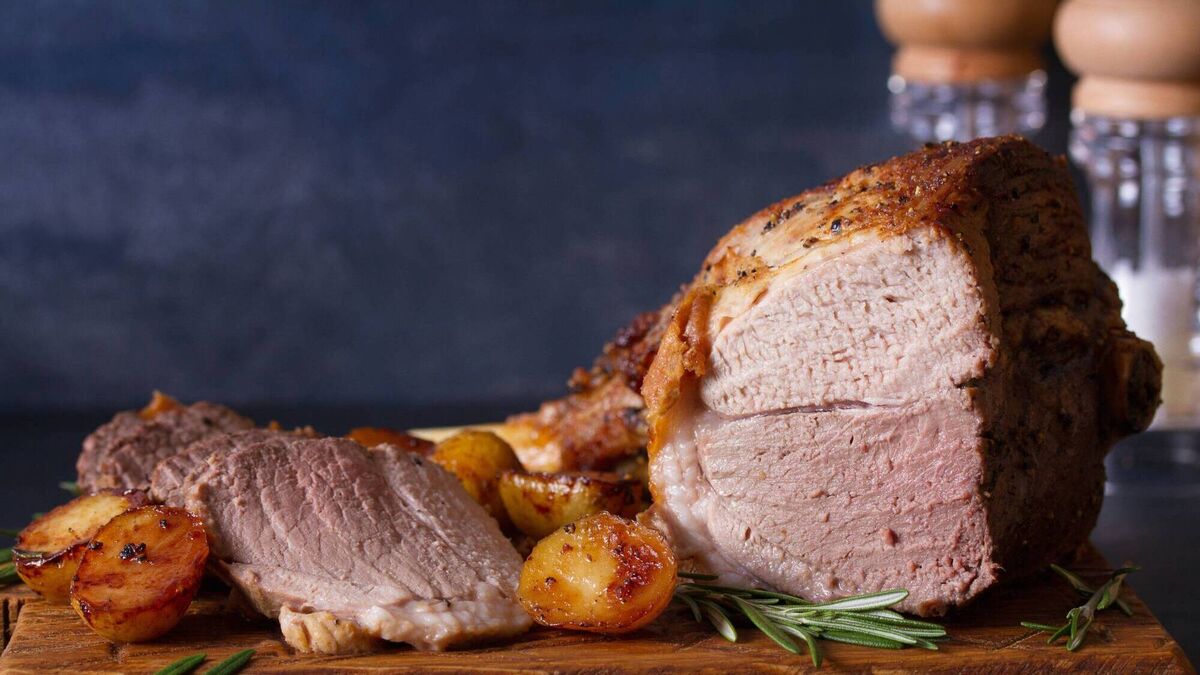
Forget perfect slices, cook to melting tenderness and just lift little chunks off the bone with tongs. The wild garlic aioli makes a tempting change from mint sauce.
Servings
8Preparation Time
20 minsCooking Time
3 hours 0 minsTotal Time
3 hours 20 minsCourse
MainIngredients
1 whole shoulder of spring lamb on the bone, weighing about 3.6kg
Maldon sea salt and freshly ground pepper
For the wild garlic aioli
2 egg yolks, preferably free range
¼ tsp salt
Pinch of English mustard
1 tsp white wine vinegar
225ml oil: We use 175ml sunflower oil and 50ml olive oil, alternatively use 7/1
1-2 large cloves of garlic
2 tsp chopped parsley
2 tsp chopped wild garlic leaves (Allium ursinum)
4-6 tbsp lamb cooking juices
Method
Preheat the oven to 180°C/Gas Mark 4. Place the lamb shoulder in a wide roasting tin or oven tray with the skin side up. Score the skin to encourage the fat to run out during the cooking and to crisp up the skin. Season with sea salt and freshly cracked pepper. Place in a roasting tin, transfer to the oven and roast for 30 minutes before turning the temperature down to 160°C/Gas Mark 3 for a further 2 ½ to 3 hours or until the meat is soft and succulent and will lift off the bones.
Meanwhile, make the aioli.
Note: The crushed garlic may be mixed into the mayonnaise for the aioli, but this sauce cannot be finished until we have the juices from the cooked lamb.
Put the egg yolks into a bowl with the crushed garlic, mustard, salt and the white wine vinegar (keep the whites to make meringues). Put the oil into a measure.
Take a whisk in one hand and the oil in the other and drip the oil onto the egg yolks, drop by drop whisking at the same time. Within a minute you will notice that the mixture is beginning to thicken. When this happens, you can add the oil a little faster, but don’t get too cheeky or it will suddenly curdle because the egg yolks can only absorb the oil at a certain pace. Taste and add a little more seasoning and a touch more vinegar if necessary.
To test if the lamb is cooked to a melting tenderness, pull the shank bone and some of the meat should come away easily from the bone.
When the lamb is cooked, remove from the oven. There will be plenty of fatty cooking juices. Strain these through a sieve into a bowl. Keep the lamb warm in the oven with the temperature reduced to 100°C/Gas Mark ¼.
When the fat has risen to the surface of the lamb cooking juices, skim carefully and thoroughly with a spoon. Bring the remaining juices to a simmer and taste and correct seasoning.
Thin out the garlic mayonnaise with 4-6 tablespoons of the degreased juice to achieve a consistency similar to softly whipped cream or in other words the mayonnaise should now just lightly coat the back of a spoon. Taste and correct the seasoning.
To serve the lamb, a tongs or serving fork and spoon are the best implements to remove the meat from the bones.
Prise largish pieces off the bones and serve on hot plates with some of the hot cooking juices, wild garlic aioli and lots of crusty roast potatoes.
Easter Garden Rhubarb Pie
This gem of a recipe was passed on to me by my mother who was famous for her pies – it’s a real keeper. The pastry is made by the creaming method so people who are convinced that they suffer from ‘hot hands’ don’t have to worry about rubbing in the butter
Servings
8Preparation Time
2 hours 0 minsCooking Time
45 minsTotal Time
2 hours 45 minsCourse
DessertIngredients
225g soft butter
50g caster sugar
2 eggs, preferably free range
350g white flour, preferably unbleached
For the filling
900g sliced red garden rhubarb (about 1cm thick) (not forced)
370g sugar
Egg wash, made with a little beaten egg,
a dash of milk and a pinch of salt
Caster sugar, for sprinkling
To serve
Softly whipped cream
Soft brown sugar
1 x 18cm x 30.5cm x 2.5cm deep rectangular tin OR 1 x 23cm x 4cm deep round tin
Method
Preheat the oven to 180°C/Gas Mark 4.
First make the pastry.
Cream the butter and sugar together by hand or in a food mixer (no need to over cream).
Add the eggs, one by one, and beat for several minutes.
Reduce speed to minimum and mix in the flour slowly.
Turn out onto a piece of floured greaseproof paper, flatten into a round wrap and pop into the fridge. This pastry needs to be chilled for at least 2 hours otherwise it is difficult to handle.
To make the tart, roll out the pastry 3mm thick approx. and use about two-thirds of it to line a suitable tin.
Place the sliced rhubarb into the tart, sprinkle with sugar.
Cover with a lid of pastry, seal edges, decorate with pastry leaves, egg wash and bake in the preheated oven until the rhubarb is tender, approx. 45minutes to 1 hour.
When cooked, cut into squares or slices, sprinkle lightly with caster sugar.
Serve with softly whipped cream and soft dark brown sugar. Divine!
Melted Leeks with Peas
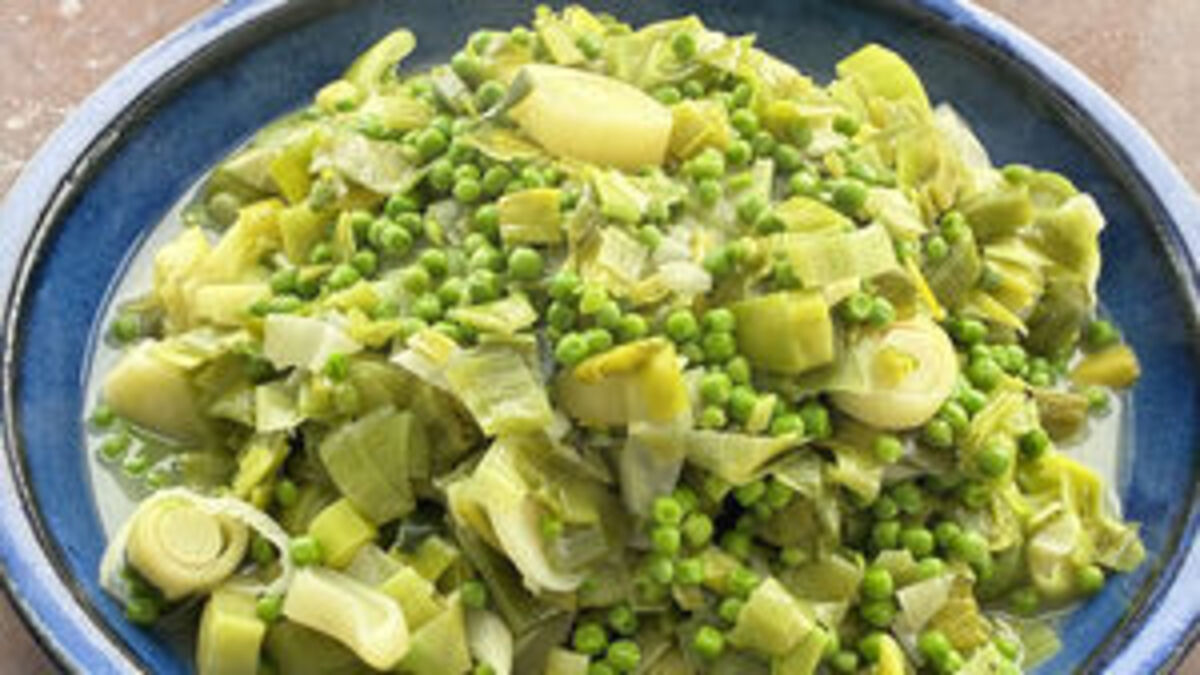
Two vegetables in one, fresh tasting and delicious – my garden peas are months off being ready to harvest so I use frozen peas here with delicious results.
Servings
8Preparation Time
45 minsCooking Time
20 minsTotal Time
1 hours 5 minsCourse
SideIngredients
900g leeks (once prepared)
50g butter
2 tbsp water, if necessary
salt and freshly ground pepper
300g frozen peas
Method
Cut off the dark green leaves from the top of the leeks (keep for soup).
Slit the leeks about halfway down the centre and wash well under cold running water.
Slice into roughly 10mm rounds. Season with salt and freshly ground pepper.
Melt the butter in a heavy casserole; when it foams, add the sliced leeks and toss gently to coat.
Cover with a paper lid and a close-fitting lid. Reduce the heat and cook very gently for 8-14 minutes approx., or until tender (it will depend on how old the leeks are). Check and stir every now and then.
Add the frozen peas and continue to cook for 1-2minutes.
Turn off the heat and allow to continue to cook in the heat for a couple of minutes until the peas are tender.
Serve in a warm dish – it should be juicy.
Note: The pot of leeks may be cooked in the oven at 160°C/Gas Mark 3 if that is more convenient.
Still one of the hottest food trends and a great way to eat. An appetiser can be a starter, a trio of little plates can make up a meal and provide the opportunity to try lots of dishes on the menu, something new and tempting, or even something scary that one may not have ordered before. Small plates are also perfect for those who may have a concern about the price point without the potential of a wallet-busting experience.
It’s also a brilliant stress-free way to entertain, show off your new skills and have lots of fun.
The restaurant at Ballymaloe House has been welcoming guests from all over the world since Myrtle Allen opened the doors of her family dining room to the public in 1964. Her philosophy of serving fresh, seasonal food from the surrounding farm, walled garden and local area was the start of the farm-to-fork revolution in Irish food, which continues to this day.
Although the menu has evolved throughout the years, there are many classic dishes that continue to be favourites and that guests come back year after year to enjoy.
We have chosen a selection of iconic, signature dishes from 60 years of Ballymaloe House menus for this demonstration and for you to enjoy cooking at home. Recipes and tastings included.
Winter’s over! Wild garlic, one of the first harbingers of spring, is leaping from the ground in woodlands and along the roadside verges.
So, how about a bit of foraging in the open air this weekend . There are two varieties, Allium ursinum or ramps, a broad-leaved bulbous plant which grows in moist woodland and Allium triquetrum, with a triangular stem also known as three-cornered leeks. The la t ter has a flower that resembles ‘white’ blue bells, and pointy narrow leaves. They are often first to appear and are best for champ. If you can find some of the pretty white flowers, scatter them over the top.
We use the wide leaved Allium ursinum for wild garlic pesto and aioli.
Read More