Séamas O'Reilly: Trump and Musk's malfeasance hits America like an asteroid
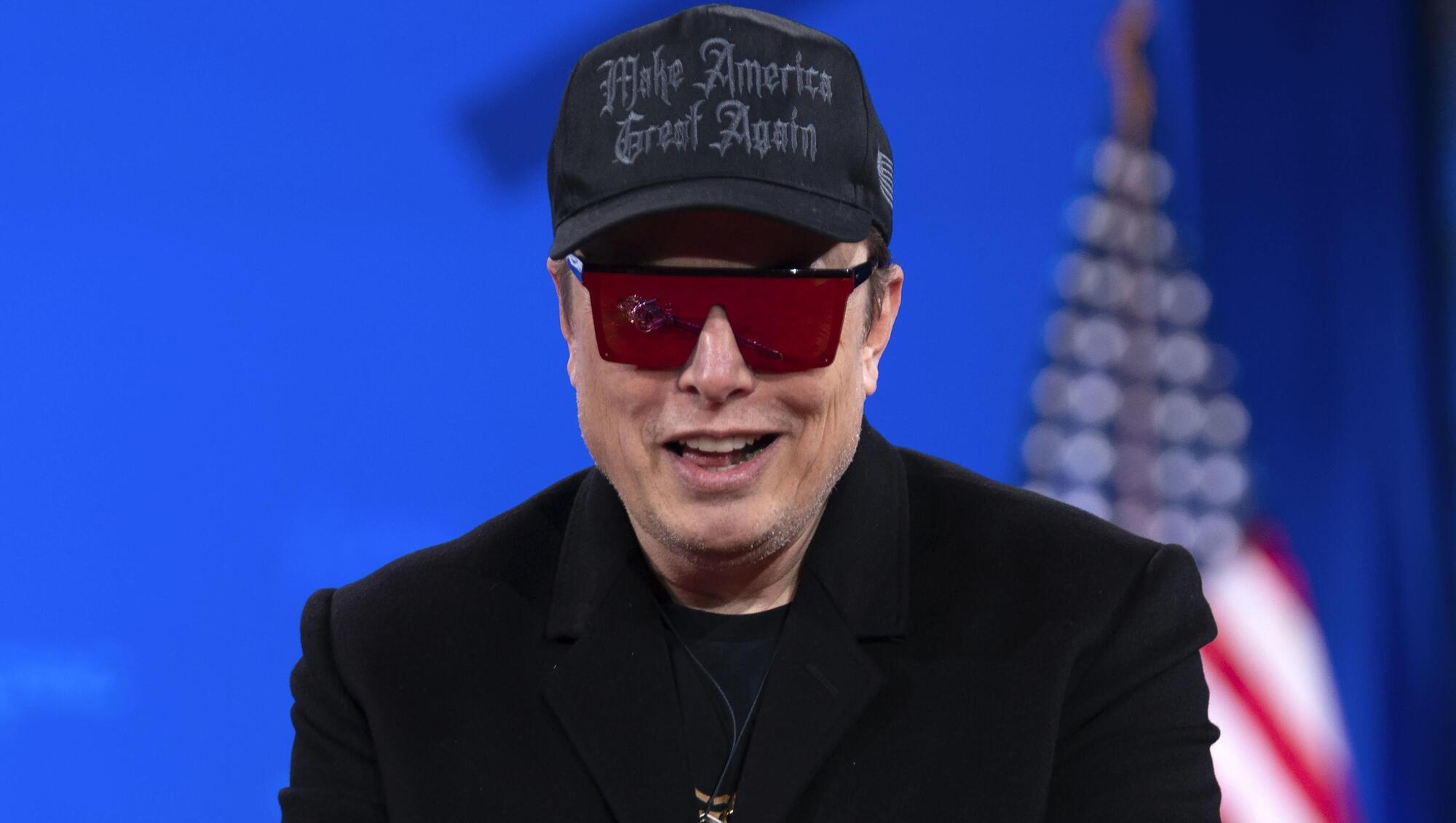
speaks at the Conservative Political Action Conference, , at the & Convention Center, Thursday, Feb. 20, 2025, in , Md. ( Photo/)

In December, astronomers noticed an asteroid hurtling toward Earth.
Catchily named 2024 YR4, it’s 40-90m wide and due to hit somewhere very near us around December 22, 2032.
An object that size is on the city-killer scale, and if it were to make contact with Earth — which experts originally gave it a 1-in-43 chance of doing — it would likely explode in mid-air with a force 500 times more powerful than the Hiroshima bomb.
This week, those odds were revised to 1-in-38, which is not yet terrible news, but certainly not great news either.
I spent yesterday learning as much as I could about this plucky little rock, and what it might feel like from the ground if it hit me, personally, head on.
I envisioned a tense, drawn-out period in which it slowly grew in the sky over days or months, but this does not appear to be on the cards.
“You would not sense it as something approaching you” wrote Kim Aaron, chief engineer of Nasa’s Jet Propulsion Lab, in response to this very hypothetical last September.
“It would just look like a really bright light in the sky... This would last a few seconds. Then you’d be dead… You wouldn’t feel anything.
"The actual obliteration of your body would be much faster than the speed of signals getting to your brain by nerves, so you would not perceive any of that.”
The fact that a city-killing asteroid would go from “huh, what’s that little light in the sky?” to “my body is now a gas” in seconds, is not exactly a cheery one. Luckily, we don’t have to rely on the naked eye.
This seven-year head start gives us ample time to formulate a response if those odds dip further into panic territory, and we have many smart and capable experts on the job. Right?
Well, you might be surprised to learn that, in the time since 2024 YR was detected, Nasa has sacked 10% of its staff, with tens of thousands more offered voluntary redundancies, while the Jet Propulsion Lab alone has cut over 300 workers.
You likely haven’t heard about this because these are mere grains of space-dust compared to the impacts landing elsewhere.

Since Trump’s inauguration, Elon Musk has headed the Department of Government Efficiency, an agency he named specifically so that its acronym, Doge, would be that of a cryptocoin he’d previously boosted which was — because this is Elon Musk — based on a dog meme from 2013.
He’s used this all-powerful entity to access every nook and cranny of the US budget, effectively freezing all international aid provided by the US, ceasing any government programs he deems “woke”, briefly pausing all Medicaid payments to senior citizens, and offering redundancies to federal workers in emails so cack-handed that their promises are likely to have mammoth legal implications.
Some 200,000 probationary employees are being targeted with dismissal and at least 10,000 government workers have already been fired.
Some were dispatched with such haste that moral or legal qualms about their treatment were rendered secondary — as with the staff of the National Nuclear Safety Administration, or the Department of Agriculture’s bird flu researchers.
In both cases, the dismissals were discovered to be disastrously unsafe — prompting Doge to attempt to rehire needlessly terminated experts with thousands of years of experience between them.
For the most visible sign of Doge’s malfeasance, however, we must once again turn our gaze toward the skies.
With Musk by his side, Trump’s administration has had a peculiarly specific beef with the Federal Aviation Authority (FAA), the body responsible for regulating the 16.4m flights that take off in America each year.
On day one of his administration, Trump pressured the head of the FAA to resign, and over the following two days announced a freeze of air traffic control hires and disbanded the Aviation Safety Advisory Committee.
A week later, there followed a mass emailing of hundreds of FAA staff offering them redundancy.
The next day, America witnessed its first mid-air collision in 16 years, resulting in 67 fatalities.
In the four weeks since, there have been a further nine crashes, bringing the air flight death toll since Trump’s inauguration to at least 87 people.
Planes literally falling from the sky is a heavy-handed metaphor for all that’s been going on but it is, unfortunately, what we’re left with.
In its most obvious reading, it forms a parable about the interconnectedness of complex systems, and the perils of someone like Musk pursuing “efficiency” in areas in which he has little competence.
Staggeringly, that diagnosis gives Musk too much credit.
The fact is, he originally called for director to be fired after Whitaker had demanded an investigation into a SpaceX launch which scattered debris across aircraft flightpaths, prompting his resignation the following day.
This Tuesday, hours after the eighth air crash in four weeks, Musk announced he was bringing SpaceX staff in to work at the , finally capturing the very agency whose ire he’s fought for the past decade — with the near bottomless capacity for conflict of interest and personal enrichment that entails.
That is who Musk is.
Not just a thundering charlatan, but one animated by venal personal gain, entrenched bigotry, and personal grudges.
He has retooled an entire nation’s civic structure with the “move fast and break stuff” approach that’s turned Twitter into an arid wasteland, tanked the stock of the world’s most valuable car brand, and rendered only the second least popular billionaire in his own administration.
Musk is an incompetent fraud, but that quality makes him more dangerous, not less.
Some impacts are hard to detect, but others happen in full view, and in slow motion.
Knowing that won’t help us unless we stare the latter in the face.