Séamas O'Reilly: How did Trump win the US election — and how did Harris lose?
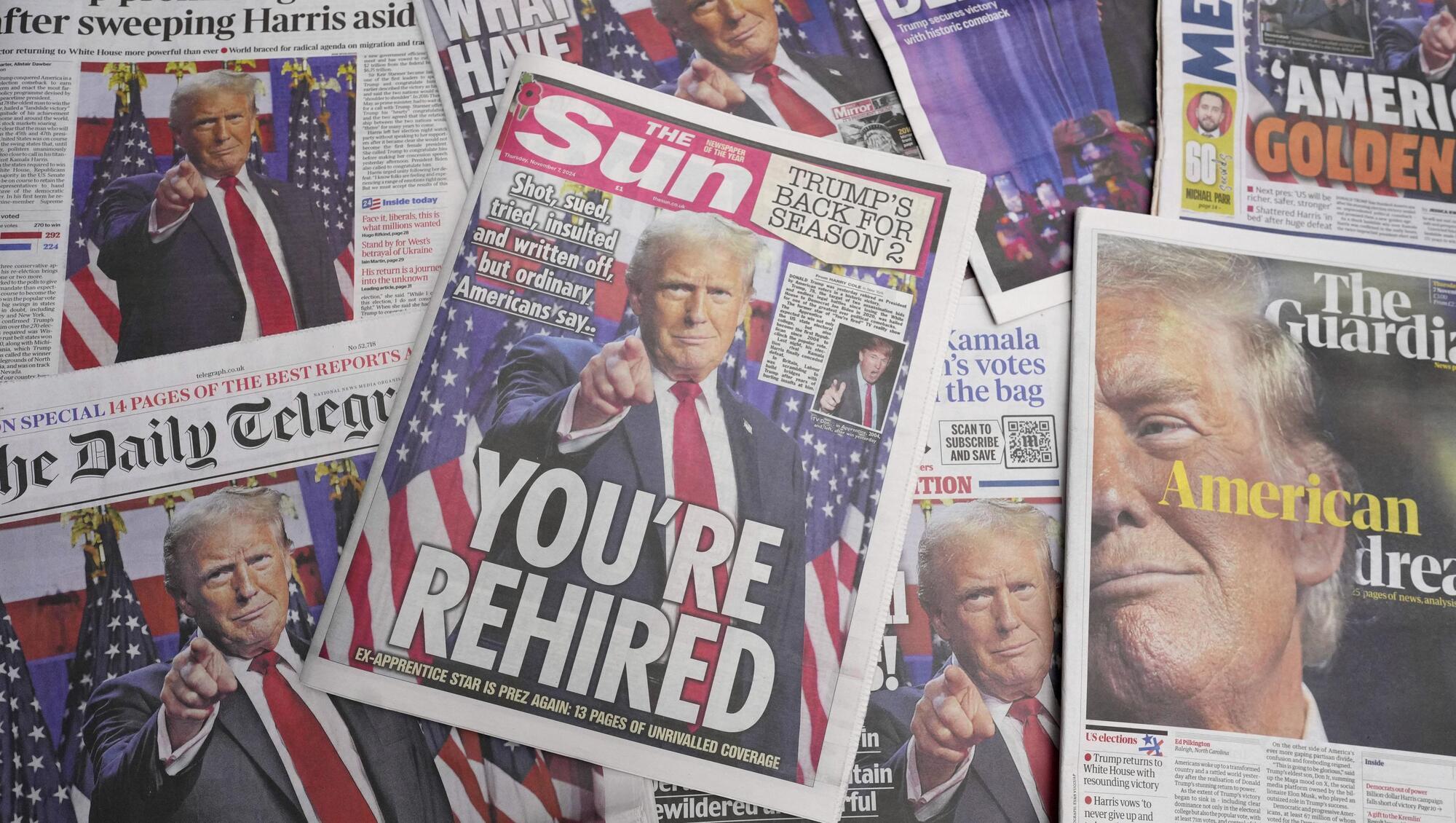
Britain's newspapers’ front pages reporting on U.S. President-elect Donald Trump in the U.S. presidential election, are seen in London, Thursday, Nov. 7, 2024.

I was surprised by this week’s election in America, and I want to get that out of the way before I say anything else.
This is not a case of ‘I told you so’, and I don’t wish to paint myself as that most loathsome genre of political writer: the prophet of the past.
Last week, I thought the favourable rumblings from polls and the momentum Harris had in the last few days of her campaign would make a difference.
Or hoped that, for all the inanity and frustrations of her campaign, America would look at what Trump represents — what he says, does, and promises — and reject him for the second time in four years, if only by a slim margin.
This did not happen. Trump won every swing state, as well as the popular vote, and made gains in states he lost.
There is a temptation to say Americans voted for him because they are more backward, racist, crude, and crass than cosmopolitan elites predicted.
I am not in the business of rehabilitating the image of Trump voters — the combined ranks of the American media have spent nearly 10 years doing enough of that already — but this is too simple an explanation for what appears to have happened.
It’s true that, in purely ethical terms, I don’t consider there to be much of a difference between a voter who actively wants a president with policies like Trump’s, and one who’s simply willing to let such policies slide.
But if that is what has happened, in huge numbers, then it behoves us to examine why, especially since the very same voters who rejected Harris, also backed progressive measures she championed in huge numbers.
To pick just one fulcrum of Harris’ campaign, there is abortion.
Trump has been correctly associated with both the unravelling of Roe v Wade — put into place by Supreme Court justices he picked — and with Project 2025, the draconian manifesto of action for his presidency, which includes swingeing cuts to abortion access, IVF, and a host of other ultra-conservative policy goals.
Trump’s VP, JD Vance has been even more outspoken, going so far as to say he wants women crossing state lines to procure abortions to be arrested, and police granted access to their medical records to do so.
It is hard to think of a more cut-and-dry case of association than that of the Trump-Vance campaign and abortion rights, or a stronger point in favour of Harris for those who care about this issue.
And yet, everywhere that keeping abortion legal was on the ballot, its popularity outpaced Harris in large numbers.
Less than 35% of voters in Montana opted for Harris, yet 54.5% of them voted to keep abortion legal.
This pattern was not merely prevalent, but ubiquitous. It was, in fact, repeated in every single one of the 10 states that had abortion on the ballot.
In each, hundreds of thousands — even millions — of people voted for Trump to become president and in favour of legal access to abortion.
We’re left with the inescapable conclusion that a very significant proportion of the US electorate were dead set against Trump on one of the most important issues of this election cycle, but still disliked Harris more as a candidate.
The reasons for that can obviously be disputed.
To some, the fact that Harris was a woman of colour is front and centre.
I don’t wish to dispute that, given all we know about the racism and sexism that exists in every stratum of American society, and which Trump himself has helped to normalise and amplify in the past decade.
But it is also worth addressing Harris’ weakness as a candidate more generally.
Some of those were built-in, and hardly her own fault.
She was shackled, permanently, to Joe Biden, the least popular president in modern memory.
While her takeover from his candidacy was a massive boost compared to his own flailing campaign, she failed to put significant daylight between herself and the incumbent.
In many senses, this was an impossible task.
But it didn’t help that almost no attempt was made to do so.
In a very real sense, Kamala’s campaign wasn’t entirely her own. It continued to be staffed and run by Team Biden, even keeping its headquarters in his home state of Delaware.
This might account for some of the more absurd choices made by said campaign once Harris joined, from refusing to shore up the Democrat’s progressive base by splitting from Biden’s disastrous and criminal support for Israel’s war on Gaza, to spending the last month of the campaign touting the endorsements of neocons like Dick and Liz Cheney — figures reviled not just by ardent progressives but by voters across every tier of the American electorate.
When repeated polling, and consistent Republican attacks, emphasised the economy as a major issue, senior Dems touted inflation graphs and stock charts that showed the economy was booming.
All of which is of little relevance to the people still reeling from the economic shocks that have come from this administration, and who are bombarded 24/7 with tall tales from its opponent, the world’s most famous businessman, about how he’s going to make prices go down.
I can be appalled by the alternate route they’ve taken. Terrified, even, for what it now means for the rights of women, migrants, the LGBT community, and so many others.
I guess I’m just kicking myself for being so surprised.