Séamas O'Reilly: Ireland's solidarity with Palestine is rooted in history — and common cause
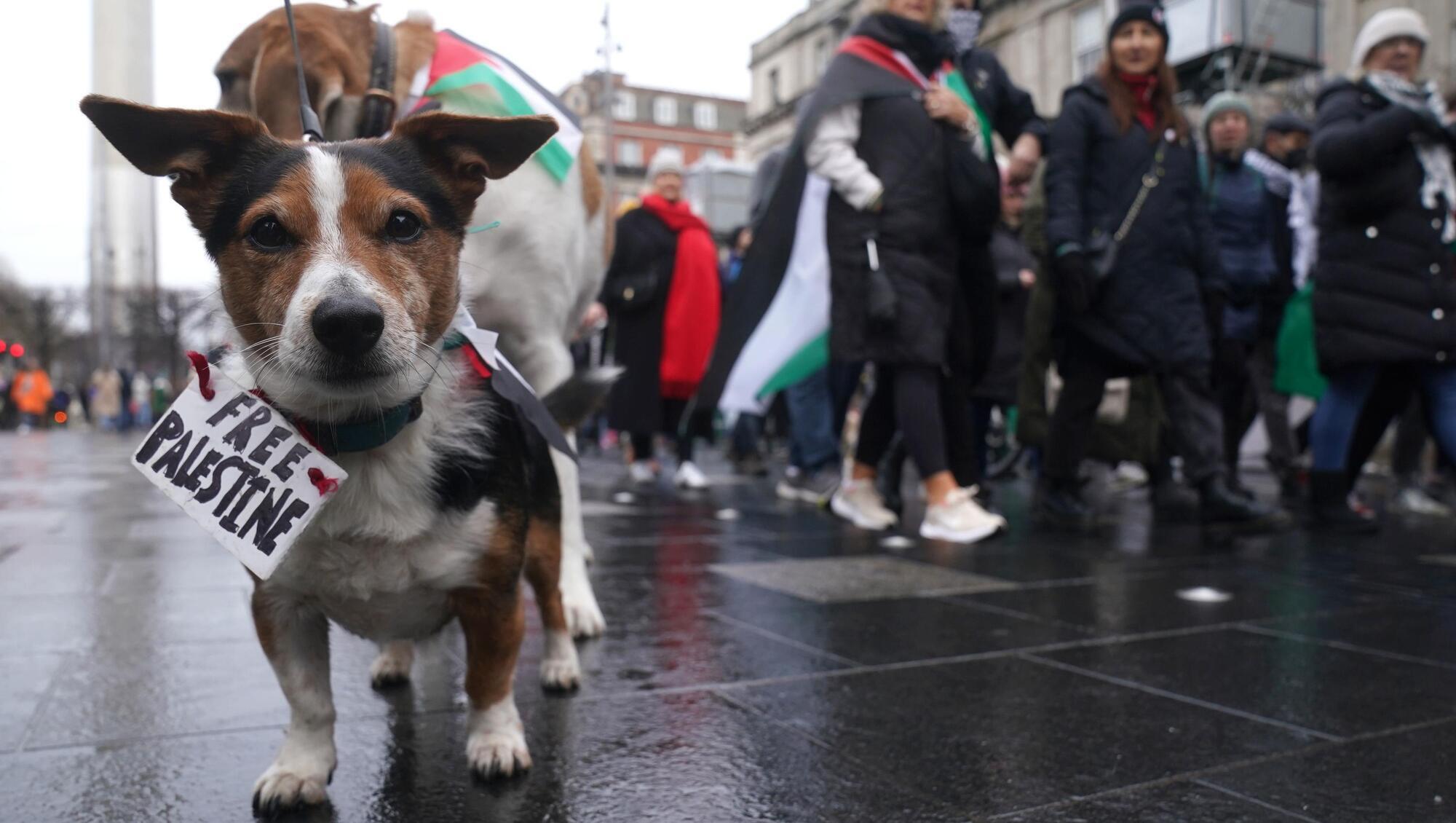
A dog called Buster joins protesters from the Ireland-Palestine Solidarity Campaign during a march in O'Connell Street, Dublin. Picture date: Saturday January 13, 2024.

Sometimes I’m asked why Ireland has been more outspoken about Israel’s actions over the past year than so many other rich, Western countries.
While I’m wary of casting ourselves as some sort of unique moral force in the world, I say it’s very likely that social memory of our own oppression forms a significant part of Irish solidarity toward those suffering oppression elsewhere.
For Northern Irish people, like myself, this effect is undoubtedly multiplied.
Sometimes, this leads to a mistaken conception that the Irish view every conflict through their own lens, or that people who share my Derry background are guilty of thinking we know just what it’s like for people in a completely unrelated conflict thousands of miles away.
My response to that charge would be to say that lived experience of militarisation, State violence and massacres, does provide you with a moral vocabulary that’s missing from those who did not.
As the Shona people of Zimbabwe have it, “the axe forgets, the tree remembers” and many of our partners in the west would sooner forget the oppression in their past, since they were not usually on its receiving end.
The issue has flared up again this week in the standoff currently playing out between the Israel Defence Forces (IDF) and Irish forces in Lebanon.
Since 1978, Ireland has kept station on the Israel-Lebanon border, as part of the United Nations Interim Force in Lebanon (Unifil).
Some 370 Irish troops are stationed there, and have seen several full-scale invasions, numerous raids and incursions, and the killing of 47 Irish personnel in the 45 years of its existence.
Ireland has, in fact, been in Lebanon long enough that some of the local staff who’ve worked closely with them have developed strongly-accented English, as displayed in an old RTÉ news segment that went viral this week, featuring one such local, praising his Irish brethren in an accent more Ballyhaunis than Beirut.
The current standoff stems from Israeli forces telling the Irish to evacuate their posts, the better for Israel to pursue their military objectives.
This the UN peacekeepers refused, resulting in the bizarre escalation of the IDF driving a tank up to the Irish position, with its barrel squarely facing the soldiers inside.
If this sounds bad, rest assured it is nothing less than a violation of international law, although at this point who’s keeping score?
Although restricting any numbers to the last few weeks is itself misleading, since Israel has been launching missiles into Lebanon for the past year, razing whole towns to the ground in the process.
In light of Israel’s ongoing decimation of Gaza and the West Bank, much of its activity in Lebanon has gone under-reported, but the self-same playbook of targeting homes, schools, hospitals, mosques and life-saving civilian infrastructure — each a war crime — has been deployed to Lebanese targets in this period.
When the Irish detachment stood their ground, some of the reaction online sought to attack Ireland for doing little more than obeying their orders, and the articles of international law they are ordered to defend.
“Israel should carpet bomb the Irish area and then drop napalm over it” wrote one poster, Matthew RJ Brodsky.
This was no mere online stooge, however, but a consultant for Minnesota Republican congressional candidate Dalia al-Aqidi.
It was also not his first entre into commentary on Irish-Palestine solidarity. In May, when Ireland joined two other European nations in recognising Palestinian statehood, he tweeted “I think the mass rape of Ireland, Spain and Norway would clarify things for them and their populace”.
At time of writing, Brodsky’s employer has only responded to her campaign manager’s invitation to napalm Irish soldiers by saying “I want to clarify that the statement below does not reflect my campaign, policies, or personal beliefs. I stand firmly against all forms of violence”, but Brodsky has not been sanctioned orremoved from his position.
We’re now a year into this conflict and, sadly, such comically evil language is par for the course among Israel’s most fervent supporters, who have translated the blank check the state has been given to decimate civilian populations, into a blank check to post whatever they want without fear of censure.
Those urging for a ceasefire, on the other hand, are treated as bloodthirsty ghouls, and nations and organisations which speak out in favour of international law are cast as terrorist sympathisers.
When Ireland recognised the Palestinian state in May, I noted the perversity of the fact that there had been so many massacres in Gaza that it was necessary to distinguish them by individual names.
Just five months later, this issue has compounded, since any invocation of, say, “tent massacre”, “flour massacre” or “Jabalia massacre” merely prompts the question: Which one?
Which brings me back to the whys of Irish solidarity. I can’t speak for everyone in Derry, much less Ireland, but I know that the shadow of one massacre loomed large over my childhood in Derry.
Bloody Sunday took place 13 years before I was born, and seismically affected every person in my hometown. It is no exaggeration to say that half a century on, everyone I grew up with still knows someone grieving the murder of a father, brother, uncle or friend. Everyone else was affected in other ways.
Horror, grief and anger change you, the cruelty of state violence, and the cover-ups of same, remove from you the luxury of ignorance.
My empathy for Israel’s victims in Lebanon and Palestine is not due to a sense that my own distant experience of events like Bloody Sunday means “I know just how they feel”.
On the contrary. I empathise with them because their horror and trauma is in a language I recognise, but at such a scale and proportion, that I have spent an entire year incapable of imagining how they feel at all.