Séamas O'Reilly: Is it Doomsday for the comic-book film genre?
Some strange sense of living death now reigns in a conglomerate that once felt like an irresistible, unstoppable force
Séamas O'Reilly: Is it Doomsday for the comic-book film genre?

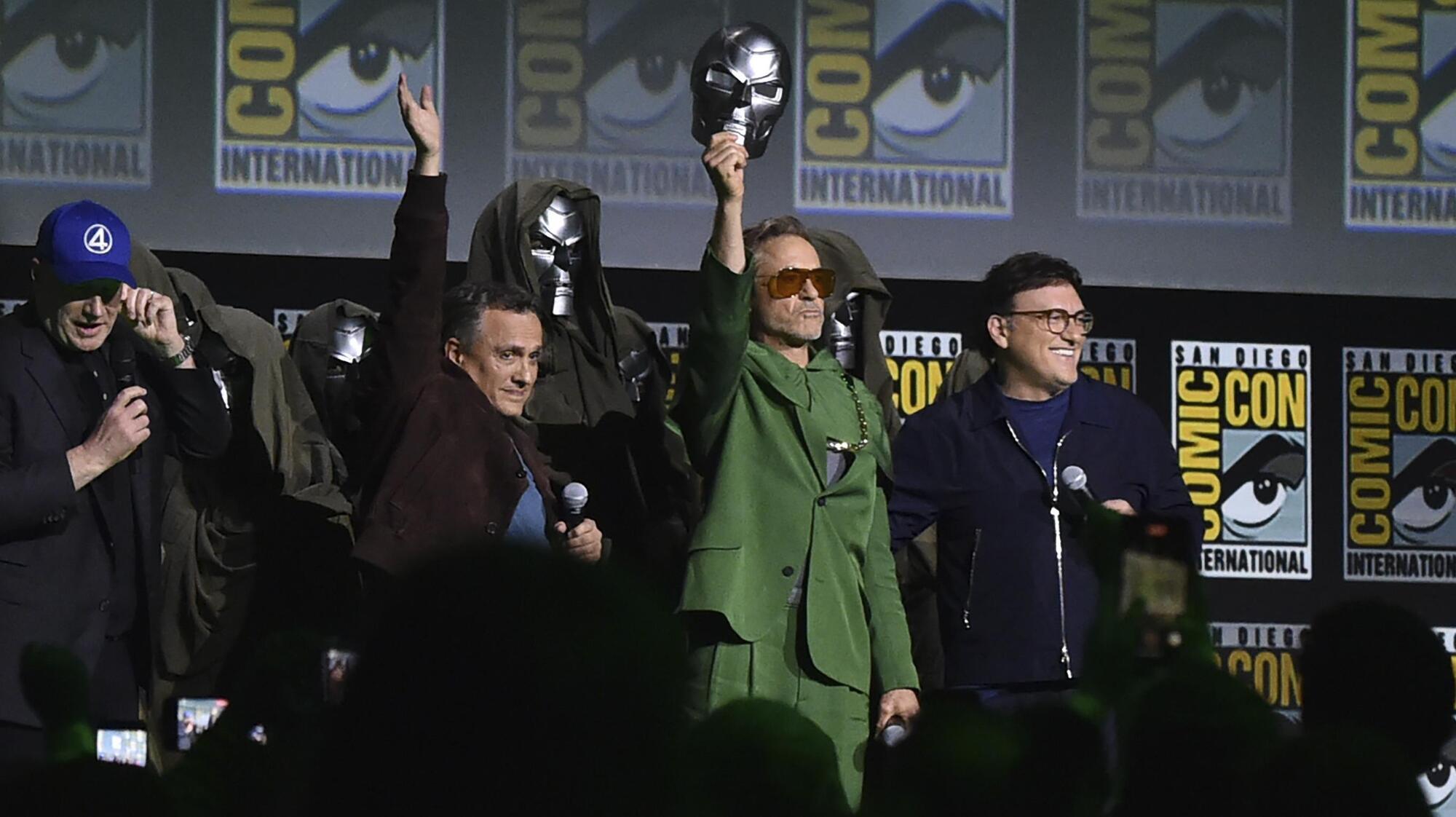
Kevin Feige, from left, Joe Russo, Robert Downey Jr., and Anthony Russo attend a panel for "Marvel Studios" during Comic-Con International on Saturday, July 27, 2024, in San Diego. (Photo by Richard Shotwell/Invision/AP)

Last weekend, a masked man strode on stage at San Diego Comic Con to be announced as the latest iconic villain in the Marvel Cinematic Universe (MCU), Dr Victor Von Doom. 

Dr Doom — as his name is near-ubiquitously abridged — is the primary antagonist of Marvel’s original superhero team, The Fantastic Four, a metal-masked megalomaniac and ruler of the conveniently vague Eastern European state of Latveria. 

Like the heroes he sets himself against, he’s not yet been incorporated into the mainstream MCU, due to a genuinely quite interesting separation of film rights for the comic behemoth’s core properties, which is sadly too complex for me to go into here.

Suffice to say, a lot of true Marvel heads were quite invested in seeing who would play Dr Doom in the first ‘Fantastic Four’ film to be integrated into the wider Marvel universe, and were doubly astounded when the man behind the mask was unveiled as none other than Iron Man actor himself, Robert Downey Jr. 

It was a stroke of stunt casting so audacious it would have broken the internet just five years ago. And, in 2024, it couldn’t help registering a whiff of desperation.

A lifetime of loving comics means I know and care more about the lore of Marvel than I let on in polite circles, where it’s taken as moot that superhero movies have been the death knell of cinema since the late noughties. 

Personally, I greatly enjoyed the first few phases of the MCU, but will admit to finding my interest waning of late, a sentiment that appears to be increasingly common among the rest of the filmgoing world over the past few years.

Of course, I say this just as the world has rallied as one to give Deadpool & Wolverine one of the strongest box office showings of the year, and the single highest opening weekend ever for an R-rated movie. 

That it’s done this by leaning into mockery and satire of the self-same bloated conveyor belt of franchise mulch from which it springs — in ways you may find either charming or excruciating, depending on your tolerance for such things — has not been lost on commentators who, like me, feel like some strange sense of living death now reigns in a conglomerate that once felt like an irresistible, unstoppable force.

TOO BIG TO CEASE BEING

We are now three years into Marvel’s post-covid run of, admittedly relative, critical and commercial flops, and it feels increasingly like the canary in the entertainment coalmine, a sign that something within the wider machine has finally broken.

For this is not a phenomenon unique to Marvel, so much as a system-wide problem which now seems pervasive everywhere: things getting too big to be good but, crucially, too big to cease being.

In Marvel’s case, we can draw a complicated map of issues stemming from plot bloat, audience fatigue, and unforeseen issues like lockdown interruptions, strikes, the utter collapse of the attention economy from traditional social media, and the deeply depressing riddle of what to do with your interconnected film series once its purported future star, Jonathan Majors, is credibly accused of domestic abuse.

But we see it everywhere else too. You’ve noticed it, I’m sure. 

That feeling of disconnection from culture that means you only know that, say, Twisters or Furiosa is coming out about 18 seconds before its opening weekend. 

One performs incredibly, one dies a death, with little sense or reason to be gleaned from how or why. 

So much of this flux seems so random that even the successes seem arbitrary. How, for example, would you advise a film to learn from Barbenheimer? 

Make sure your film is a massive blockbuster by a beloved auteur which just so happens to come out on the same day as a separate blockbuster by a different beloved auteur, which is comically opposite in tone? Wait for news of your shared release date to be jumped on — organically — first as a humorous coincidence, then a meme, and then the most singular and freakish example of convergent marketing ever stumbled upon?

NOTHING NEW

On TV, Disney+’s latest tentpole ‘Star Wars’ offering The Acolyte has proven disappointing, although so much of the discourse around that show is couched in bad faith by malignant bigots, it’s hard to know what to gain from points on either side. 

We’ve just begun the eighth month of this year and it feels like only Baby Reindeer and Bridgerton have given Netflix the 2024 watercooler moments which, as by some distance the biggest boy on the streaming block, were recently their bread and butter. 

Since Succession ended, HBO’s biggest conversation-starter has probably been House of the Dragon, which remains excellent in its second series, and yet struggles to attain a fraction of the zeitgeist bandwidth that would have been afforded to a middle-tier offering from a decade ago, let alone the planet-consuming mania of its parent franchise.

On Amazon, only The Boys and Fallout have really broken through, while Apple+ has begun the process of stepping away from its $20bn commitment to streaming television, a five-year experiment that’s generated many genuinely brilliant shows, united in the fact they’ve been watched by almost nobody.

As with cinema, their bloated budgets and questionable labour practices have remade the entire medium in their image, and what might happen if and when they collapse is hard to judge.

As characters, both Deadpool and Doctor Doom share one specific trait; their masks are not like those of Spider-Man or Batman, tools to grant them a secret identity or personal anonymity, but rather a way for them to hide from the world the scars of decay that lie beneath. 

Stunt casting, bloated budgets, and increasing reliance on self-mockery may represent a similar urge; billions of dollars spent on churning out content the world no longer wants as it once did, with nothing yet ready to come in its place.

For years people have warned of what might happen once this particular entertainment bubble bursts. 

This week, I’ve never been more sure that we’re about to find out.

More in this section

Lifestyle

Newsletter

The best food, health, entertainment and lifestyle content from the Irish Examiner, direct to your inbox.

Cookie Policy Privacy Policy Brand Safety FAQ Help Contact Us Terms and Conditions

© Examiner Echo Group Limited