Séamas O'Reilly: England's far-right metastasises nostalgia into anger
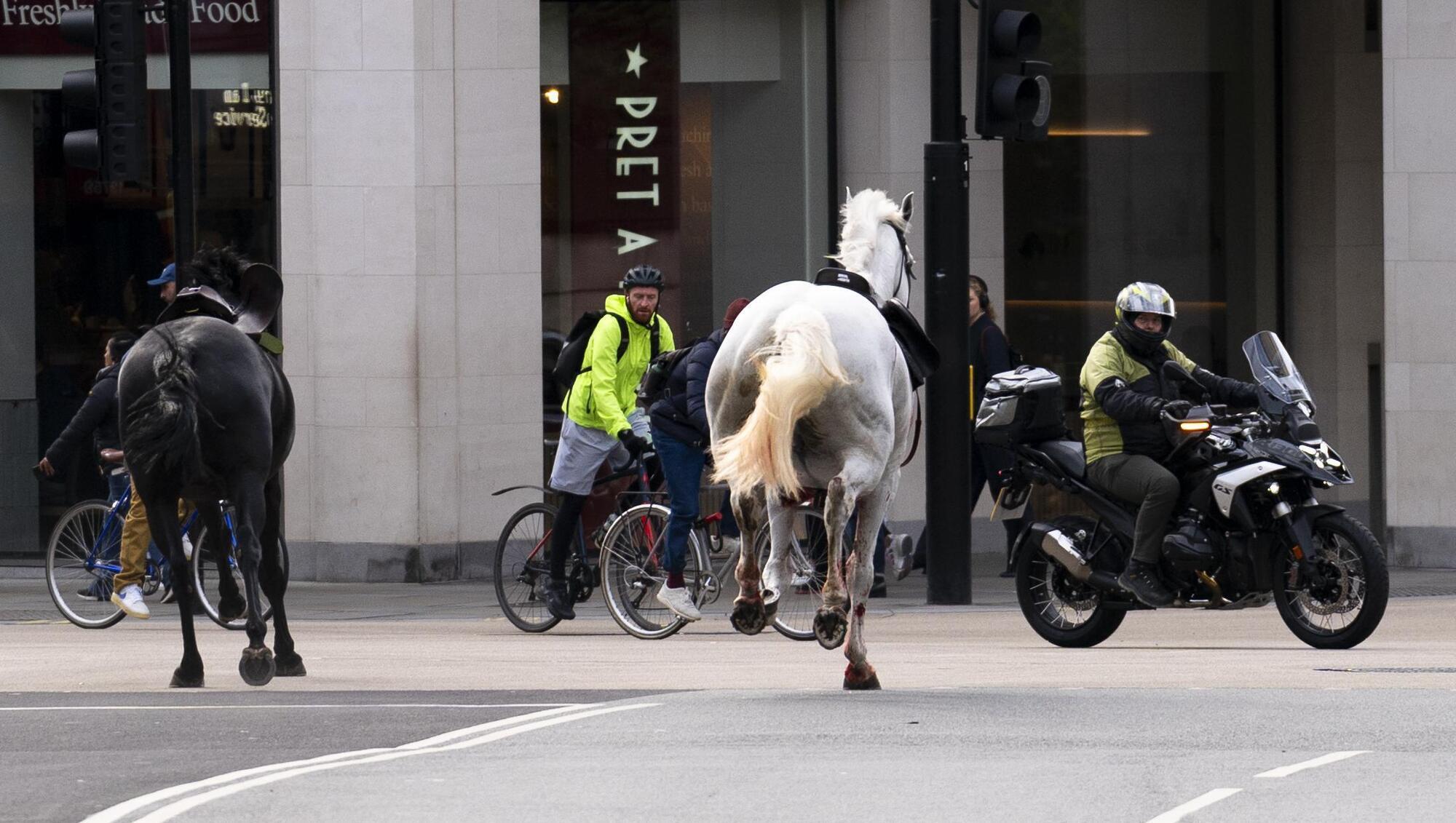
Two horses on the loose bolt through the streets of London. Pic: Jordan Pettit/PA
On Wednesday, Big Ben failed to ring at 10am, with the clockface on the Elizabeth Tower remaining frozen at 9.
At 10:06, eleven bongs rang out, conjuring imagery of someone on staff — hopefully a beefeater in full garb — clumsily attempting to do it themselves.
Then came the spooky sight, captured all over the internet by entranced passers-by, of the world’s most famous clock being wound to the correct position in eerie silence.
Those intent on discerning some greater metaphor from such a calamity were aided in the fact that, at that very moment, five horses were galloping through London, one of them smeared in blood.
They’d been spooked near Horse Guard Parade, during a traffic altercation which threw off at least one soldier who suffered serious injury in the process.
There followed bizarre scenes of these noble beasts, terrified and riderless, racing through traffic, colliding with double-decker buses and taxis, unaware of the chaos they were causing as they weaved a bloody path through England’s capital.
If this was intended as a neat cap to place on a few days’ worth of consternation about English patriotism, it was apt.
But, as with all other developments in recent British political history, it was less a calculated choice than a sad conflagration of strange events, signifying nothing but a nation confused.
For these were not, sadly, the only horses injured in the capital in the previous twenty-four hours. I spent Tuesday, St George’s Day, in central London.
It was there that police had to step in amid clamour of far-right agitators amassing garbed in St George’s flags.
They were described in several news outlets as “protesters” but what, precisely, they were protesting was never clarified.
Their errant howls into the collective void resulted in six arrests. At least one of these was for animal cruelty after a police horse was attacked, proving this was truly a week to forget for the nation’s equine friends.
For as long as I’ve been alive, St George’s Day has been as much a meta-narrative on English patriotism as a demonstration of it, and this trend has only accelerated in the past decade.
‘It’s virtually illegal to be English and proud’ blared a piece by Patrick O’Flynn in Tuesday’s Telegraph which, curiously, failed to detail any laws against said patriotism at all.
Unsurprisingly, for a proud Englishman named Patrick O’Flynn, he contrasted the excitement with which the English celebrate Ireland’s national day in March each year, compared to the relative disinterest they show in their own patron saint.
He blamed this on an amorphous lack of patriotic spirit among his fellow Angles, which rather gives the impression that such displays are not so much illegal as simply unappealing to most of his countrymen.
The deep neurosis with which England approaches its national identity is too complex for me to examine it with the tact and subtlety it deserves, so the following series of broad statements and easy jokes will have to suffice.
THE DOG THAT CAUGHT THE CAR
It is entirely clear to me why St George’s Day is less of an event than its Irish equivalent.
For one thing, St Patrick’s Day in its modern guise is a product, and for many, a very, very good one.
People of Irish heritage make up a disproportionately large, and well-liked, portion of the UK’s population.
St Patrick’s Day has, in its roots, a strong current of genuine Irish pride, borne from defiance and survival in trying times, but it also brings with it specific, and highly marketable, modes of drinking, dancing and music that lend themselves well to the novel experience of us having “a day to ourselves”.
(Read: a day for everyone to drink a certain well-liked Irish stout and dress up a bit.)
The above conditions have placed it in a unique position to capitalise on this novelty and have created the machine-like behemoth of platitudinous Hibernophilia it has now become.
This is simply not replicable for the English majority because no such tradition has ever been needed.
It is nothing but the same silly equivalence you’ll recognise from its more sinister applications elsewhere, among those who decry the lack of Straight Pride parades, or the fact there’s no White History Month.
To paraphrase the famous Mother’s Day response to the child who asks when it will finally be Child’s Day: Darling, every day is child’s day.
On any normal plane of thought, celebrating your nation’s heritage should be fairly uncontroversial.
Certainly, the normal everyday examples I saw this week bear this theory out. My son’s school had flags up and had a jolly time celebrating Englishness in its various forms, and plenty of national institutions took to social media to highlight proud moments in English history.
Ordinary, normal people found, and expressed, their pride in the ordinary, normal ways that people do.
I’d imagine, in greener parts of England’s shores, there were street parties and church fetes, Morris dances, dogging, and so on.
This, unfortunately, is not enough for those who need to feel that some further, secret, sacred, part of their national identity — and their right to express it — is being cruelly curtailed.
For the past decade, a surge in patriotic populism has seized the UK’s government and popular press, weaponising itself against every grievance; Europe, immigrants, the environmental protesters, the environment, unions, LGBT people, and human rights.
These spectres vanquished, they are at a loss.
So, like Big Ben, they rail against the passing of time itself, metastasising nostalgia into anger over a woke English football kit redesign, woke fifteen-minute cities, woke plotlines on Doctor Who.
The problem with their pride, like their anger, is not that it is illegal, but incoherent.
The English patriots smashing up central London, and writing op-eds in the country’s press, have gotten everything they said they wanted, but the pride they thought it bought them has not arrived.
If they stand angry and confused in the face of all these victories, it is because they are the dog that caught the car.
Or, perhaps, the horse that caught the bus.