€600m shortfall threatens most rural rail lines
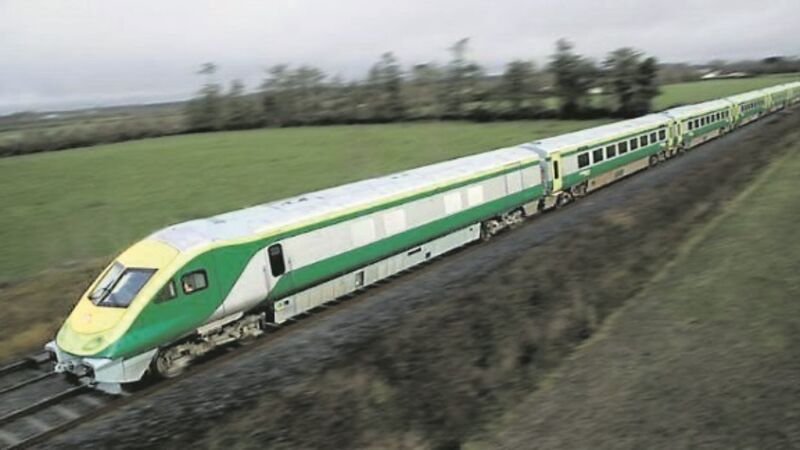
That is the scenario for Irish Rail if there is no extra State bailout to plug the €600m funding gap over the next five years.
A joint National Transport Authority/Irish Rail report has identified the least performing routes, giving the government a fresh headache. Without a decision, passenger lives could be put at risk, Irish Rail chief executive David Franks suggested yesterday.
“Continued under-investment will ultimately impact on safety and on service quality and this is at complete odds with our ambition, which is to improve both,” said Mr Franks as he launched the review.
The 316-page report examines options to address the finance issue. These include increasing funding, closing routes, or a combination of both. One option considered, without state help, would see the shutting of the network in rural areas. The review notes: “Assuming no extra Government funding is provided, the operational funding gap would have to be eliminated through large rail network reductions.”
This would require the closure of the majority of the rail network, leaving only Dart lines, Dublin and Cork commuter services, and intercity services from Dublin, Cork, Belfast, and Limerick, it says. Furthermore, such closures would require a costly redundancy scheme.
A failure to increase State funding would see a “dramatic” jump in fares, warned Mr Franks.
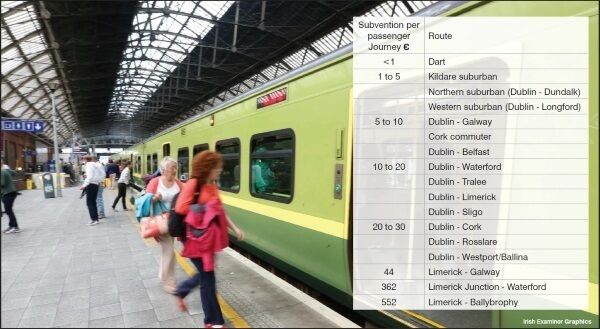
There is a huge variance in the subsidies for routes. Subsidising a Dart passenger journey costs €0.70, compared to €5.10 for a Dublin commuter trip, and €12.20 for a Cork commuter journey. The worst-performing route, Limerick to Ballybrophy, requires a subsidy of €550 per passenger.
The busiest station on the day of a survey was Connolly in Dublin, with 29,755 boardings, while Carrick-on-Suir in Tipperary had just one. Several stations had fewer than 20 users on the day, including Fota, Cloughjordan, Attymon, Foxford, Ardrahan, Cahir, and Roscrea.
The review has prioritised closing four routes, including Limerick-Ballybrophy, Limerick-Waterford, Ennis-Athenry, and Gorey- Rosslare, but this will only save €17m a year.
A rise in subsidies for 800,000 people under the free travel scheme is also needed.
Other options could boost passenger usage, including improving the frequency of services or reducing fares.
Transport Minister Shane Ross is expected to hold off on any decision about Irish Rail’s financing until public consultation on the review is concluded next year.
News: 2
CONNECT WITH US TODAY



Be the first to know the latest news and updates