How to make Ed Smith's delicious skillet eggs with a twist and easy breakfast bap
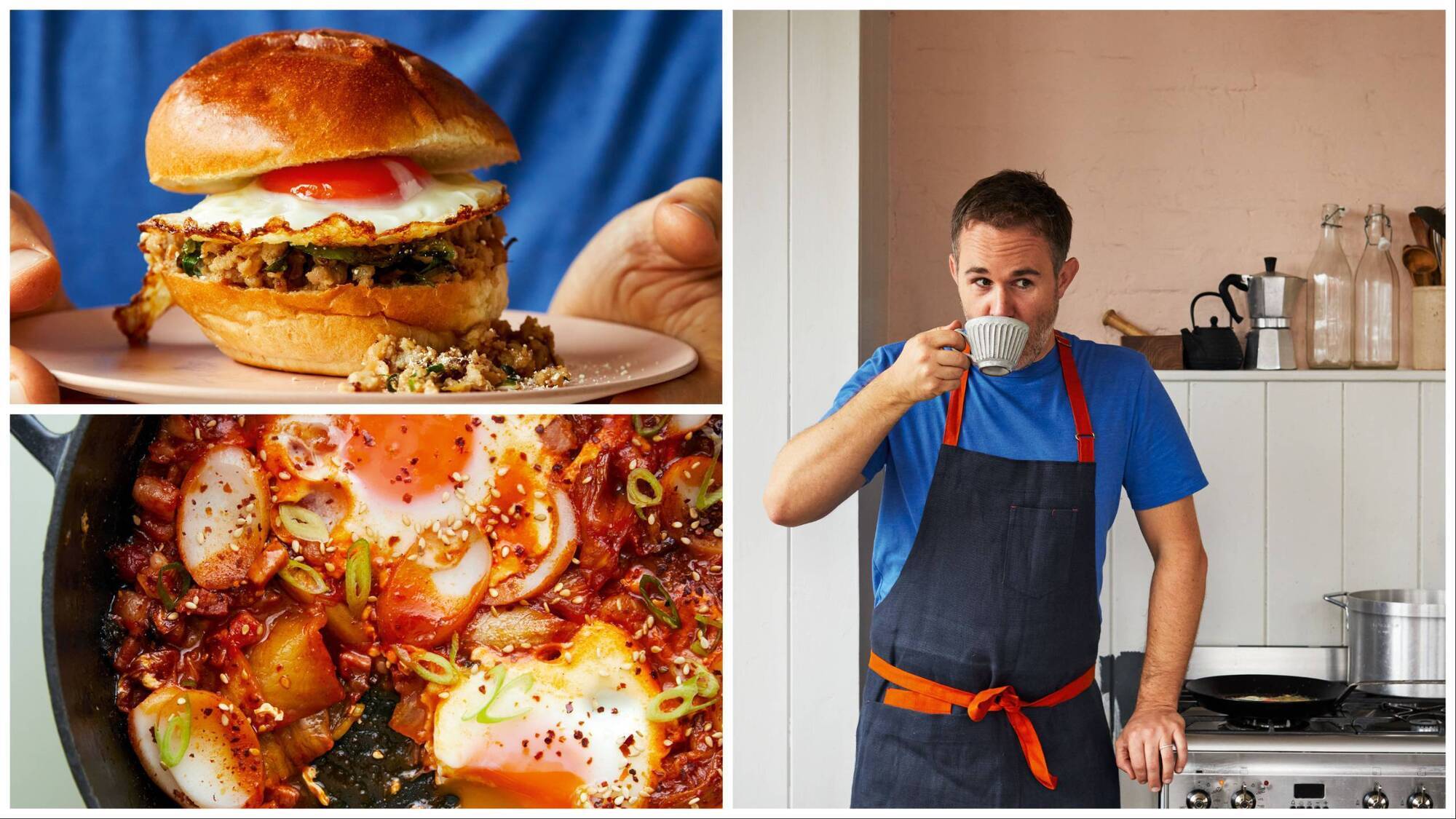
Ed Smith shares some of his egg-cellent recipes.
Eggs have somehow become synonymous with the millennial phenomenon that is brunch. But are scrambled eggs on sourdough really worth the money you’d pay at a cafe, or could you better master the art of egg-making at home?
In defence of restaurants, it’s really hard to make an egg dish that’s worth the money they need to charge to keep an establishment running, says cook, writer and content creator Ed Smith. But eggs are the ultimate “quick and nourishing” ingredient for a home-cooked meal — not to mention cheap.
And if you have forked out cash for an upmarket brunch, the stakes are higher. “You know when you get that poached egg and you cut into it, and the yolk doesn’t move anywhere? That is I think one of the more disappointing things in life,” says the 42-year-old Londoner.
Even with the huge rise in places serving up poached eggs or shakshuka for £12 a pop, Smith says: “There are not many places I’d rather eat an egg than in my own house.”
And with a bit of encouragement, and a few out-of-the-box egg ideas, most people would agree, he reckons.
Smith, who made his name with the blog and social account Rocket and Squash, and left his corporate law job working 60-80 hours a week in 2012 to pursue food, first started experimenting with eggs more when his son was a baby.
“I tended to have what I would call a second breakfast after having been up for a few hours. I’m sitting there trying to occupy my child while I’m letting my wife sleep, and I found myself slightly embellishing eggs.”
Eggs are, after all, usually always in most people’s fridges.
“It’s a great way to clear out the cupboards of all the ingredients that you buy for other other recipes,” he says, and they became a staple of his working lunch during lockdown and the years of working from home since.
It’s only fitting then that Smith’s fourth cookbook is called — including no less than 100 different recipes celebrating the humble ingredient but with some elevation — like kimchi and gochujang skillet eggs, sausage laab and fried egg bun, and za’atar-dusted fudgy-yolked eggs.
“It’s not about eggs as an ingredient, but eggs as a centrepiece,” he says, although none of the recipes, he points out, are rocket science.
“Eggs are personal,” he concedes, but they don’t need to be boring. “If you want to have eggs over easy with an extremely hard yolk then that’s totally fine, but do consider putting chilli oil on and having it with a paratha rather than white bread.”
One of the major mistakes people make when making brunch at home, is attempting eggs for big groups of people, he says.
“I don’t think that you should cook eggs for more than three other people at the same time.
“As soon as you start multiplying it beyond about four people, it becomes chaotic. And on a selfish basis, its worse for the cook. They’re the person that gets the worst egg. If you fry loads of eggs and one splits, you inevitably feel like you have to have it.”
To counteract this, Smith has specific recipes that cater for groups; think group shakshuka or tray-baked frittata baguettes with minted feta salad.
Unless you’re able to be very organised and poach a batch of eggs ahead of time and reheat when needed — as they would do in a restaurant. Smith says when the whites of the egg are set, immediately transfer the egg to a container of iced water and pop them in the fridge until you need them. Then when your guests arrive (or your big family wakes up), reheat them in simmering water for 30-45 seconds.
But save yourself some hassle and serve the eggs with stress-free accompaniments, like his marmite and thyme braised portobello mushrooms.
Smith’s book is peppered with helpful tips and tricks for the cooking process. For perfectly scrambled soft, oozy eggs, Smith suggests cooking them very gently over a low-medium heat.
“Stir constantly, encouraging very small curds to form as the eggs thicken. Remove from the heat before they are ‘done’,” he writes. If you sense they’re about to overcook, or your other elements aren’t ready yet, transfer to a cold bowl.
Boiled eggs must be the most under-appreciated form of cooked egg though. “If you ever see a dippy egg, you know, getting an egg in a cup brings back a kind of visceral childhood joy for a lot of people.”
His no-fuss method is room temperature, medium-sized eggs in a saucepan of just-boiling water — and simmer for four minutes and 30 seconds for eggs so soft that they must be left unpeeled and dipped into in the shell instead, or seven minutes for a jammy consistency (45 seconds longer for ‘fudgy’).
Exactly how fresh an egg is determines how it should best be cooked. “You will never get a good poached egg if that egg is not really fresh. It doesn’t matter how much vinegar you chuck in there or what technique you use, it will be straggly and disappointing,” Smith says.
The best way to determine freshness is to put it in a glass of water. According to Smith, the fresher the egg, the smaller the air pocket and the less it floats.
Super fresh eggs are best for poaching and frying, but become difficult to peel when boiled. Whereas an egg standing upright in the water (but still touching the bottom of the glass) will be slacker, which would be fine for scrambled, and omelette or soft or hard boiled eggs.
But what about the yolks, should you be suspicious of a pale one?
“The colour of the yolk comes from the chicken breed and what they eat,” says Smith, “[it] often involves paprika or something in their feed, which is not a secret.”
Sometimes those eggs also taste better, he reckons. “But that might be a placebo effect, or it might be a close correlation to the fact that the eggs, the farm or the company that has got those bright egg yolks is probably also treating its chickens in a nice way,” Smith says.
Plus, those runny orange yolks do look better on Instagram.
“I think that we eat with our eyes to at least a small degree in every meal. Yolks are kind of emblematic of that as well – it’s such a joy to open a really bright vibrant orange yolk, it’s like sunshine pouring onto the plate.”
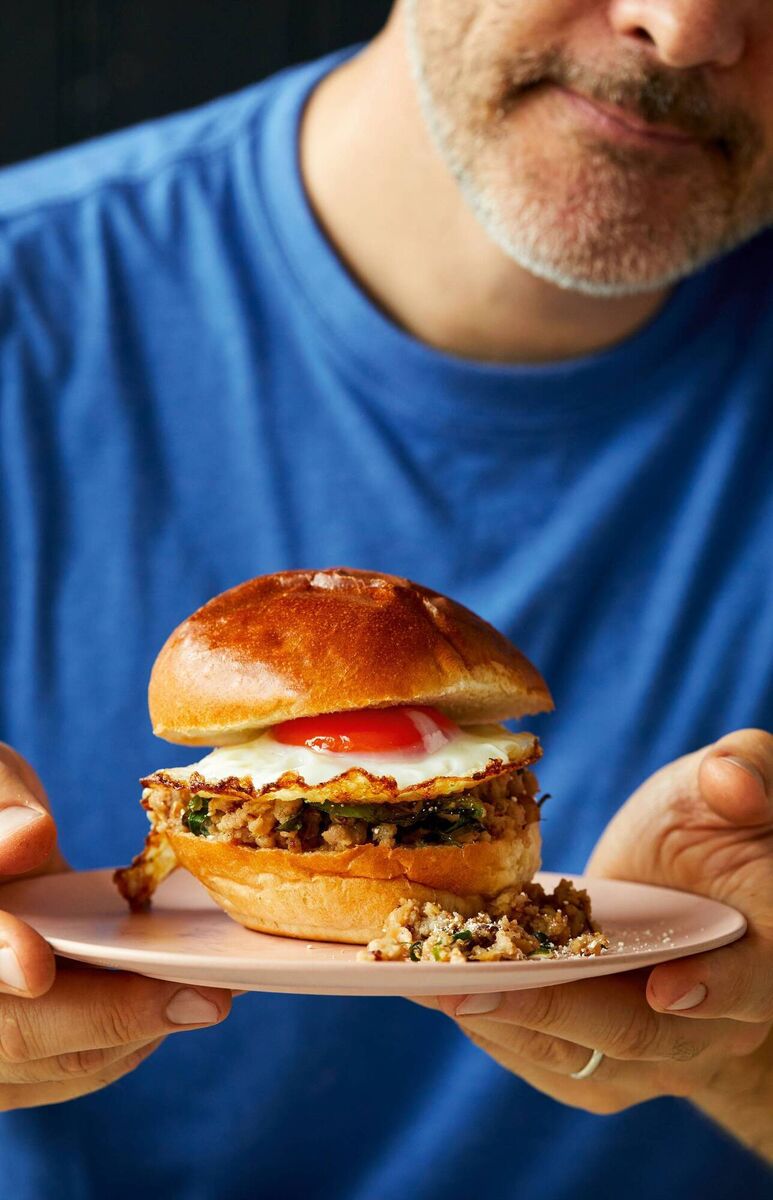
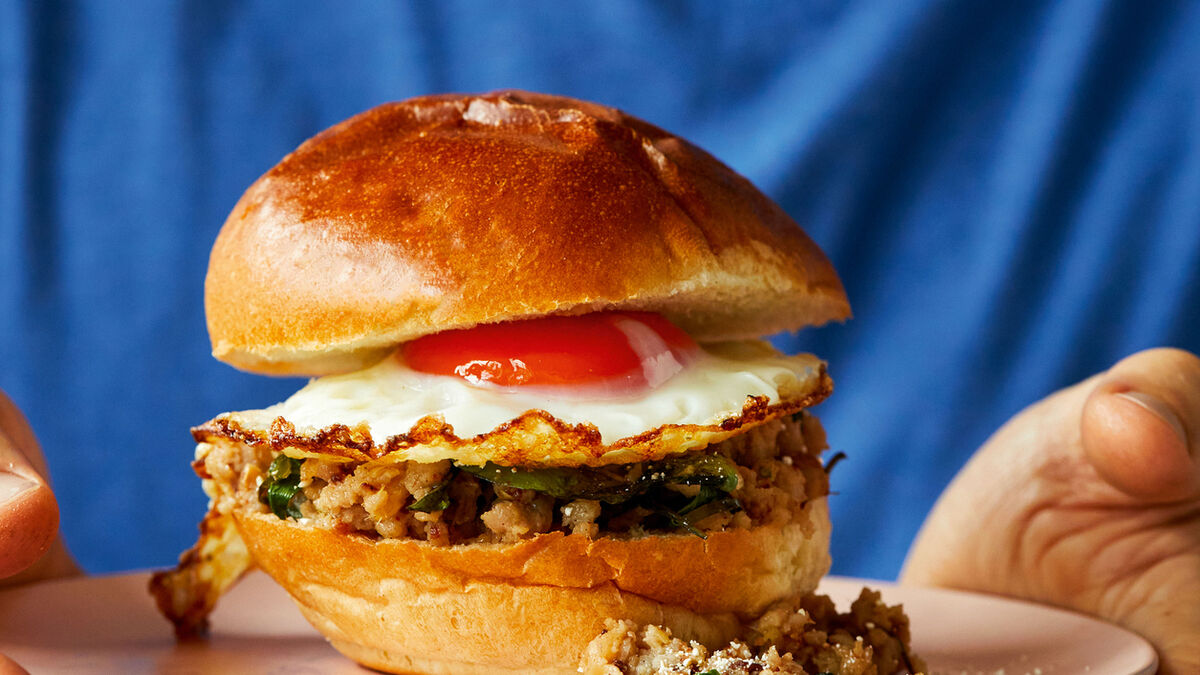
Sausage laab and fried egg bun
The breakfast bap just got tastier.
Servings
2Preparation Time
10 minsCooking Time
6 minsTotal Time
16 minsCourse
MainIngredients
200–220g plain pork sausages
Neutral cooking oil, for frying
2 cloves garlic, minced
20g ginger, peeled and finely grated
1 stick of lemongrass, finely sliced
2 makrut lime leaves, finely sliced
3 bird’s eye chillies, finely sliced
1tsp caster sugar
1⁄2tsp Kashmiri chilli powder
1⁄2tsp Chinese five spice
Juice of 1⁄2 lime
2tbsp fish sauce
A handful of Thai basil leaves (or fresh mint)
2 eggs
2 soft brioche burger buns, halved and lightly toasted
Pinch of rice powder
Method
Toast the rice powder: Toast a pinch of rice in a small, dry pan for two to three minutes until tinged bronze. Grind to a fine grit using a pestle and mortar.
Score the sausages with the tip of a sharp knife. Remove the meat and discard the skins, then ball the meat into a flat patty.
Heat the oil in a wok set over a high heat. Add the sausage meat and squash it down using the back of a spatula. Let this fry for around 45 seconds, so that it begins to colour. Then start to break up the patty, again using a spatula to squash and chop away at it. Keep going until the meat is in a fine, minced meat-like consistency.
Add the garlic, ginger, lemongrass, lime leaves and three quarters of the fresh chilli. Cook the aromatics for 45-60 seconds, continually stirring and shaking the wok.
Then add the sugar and spices and cook for another 45-60 seconds, stirring frequently and adding a tablespoon of water if the meat is sticking.
Squeeze in the lime juice, add the fish sauce and Thai basil, then immediately remove from the heat. Stir and set aside, allowing the basil to wilt a little while you fry two eggs in neutral oil and toast the buns.
To assemble, spoon the fragrant pork over the base of each bun. Sprinkle generously with rice powder, then place an egg on top before closing the bun and tucking in.
Also consider: Using minced beef (a burger mix works well) or chopped chicken livers, instead of the sausage meat. Eating the laab and fried egg with rice or flatbreads, instead of the burger bun.
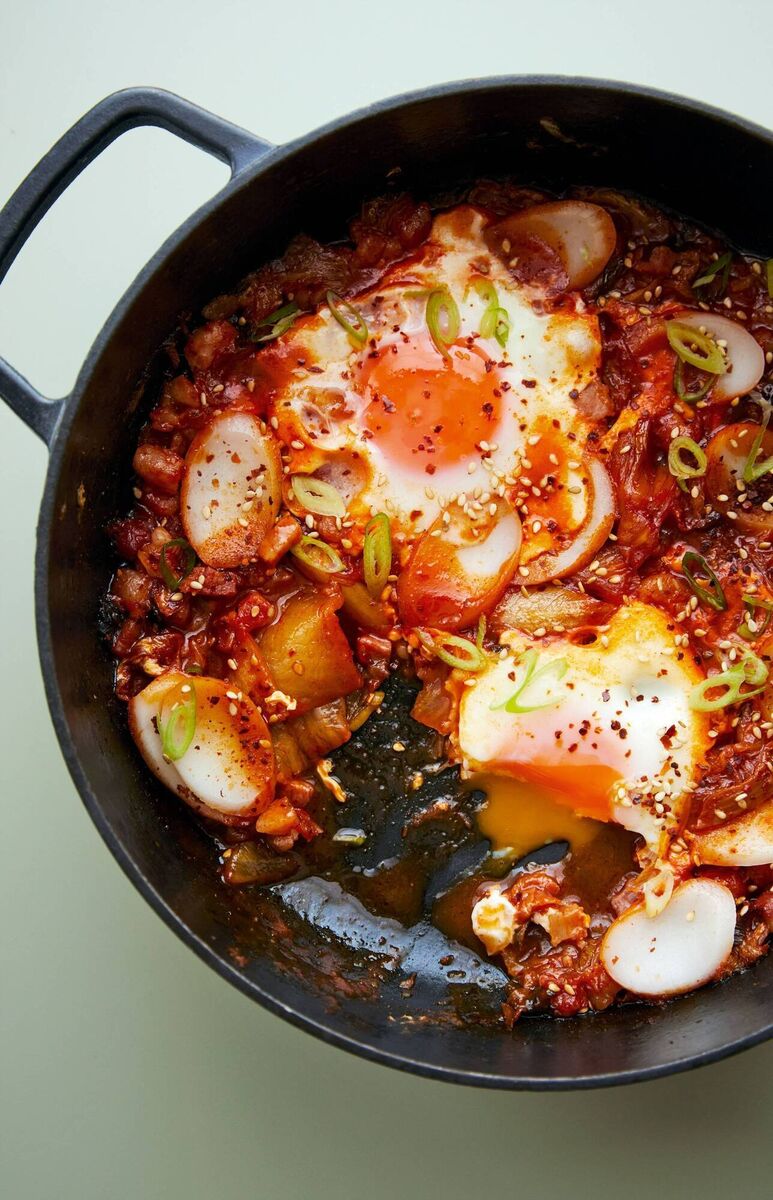
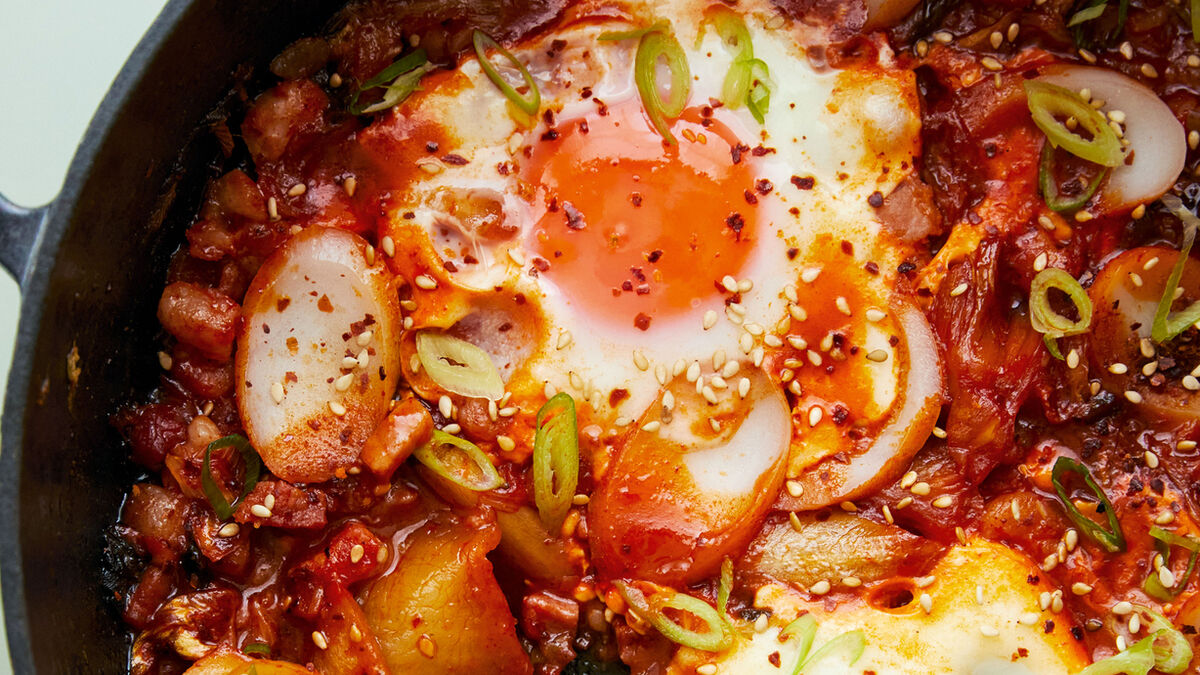
Kimchi and gochujang skillet eggs
Similar to shakshuka, but with a Korean twist.
Servings
1Preparation Time
5 minsCooking Time
15 minsTotal Time
20 minsCourse
MainIngredients
Oil, for frying
50-60g bacon lardons (optional)
1 spring onion, sliced finely on a diagonal, whites and greens kept separate
100g kimchi, larger bits roughly chopped
2-3tbsp kimchi brine
1tbsp gochujang
60g sliced fresh tteok (Korean rice cakes)
2 medium eggs
1⁄3tsp gochugaru pepper flakes (or another chilli flake)
1⁄2tsp toasted sesame seeds
Method
Pour a hint of oil into a 20-22 centimetre frying pan set over a medium-high heat. Before the pan is hot, add the lardons, if using, and let these render and fry for five minutes until they begin to colour and crisp.
Add the white parts of the spring onion, cook for one minute more, stirring, then add the kimchi, kimchi brine, gochujang and 100 millilitres water.
Simmer for five minutes until the liquid in the pan is around one centimetre deep.
Scatter in the rice cakes, then make wells in the mixture between mounds of kimchi and crack the eggs into them. Reduce the heat a little, cover and gently simmer for two and a half to three minutes until the whites are set. Remove from the heat. If the whites aren’t firm by this point, keep the pan off the hob, but return the lid and check again after 30-60 seconds.
Scatter over the gochugaru flakes, sesame seeds and the spring onion greens. I like to eat this with a spoon, straight from the pan.
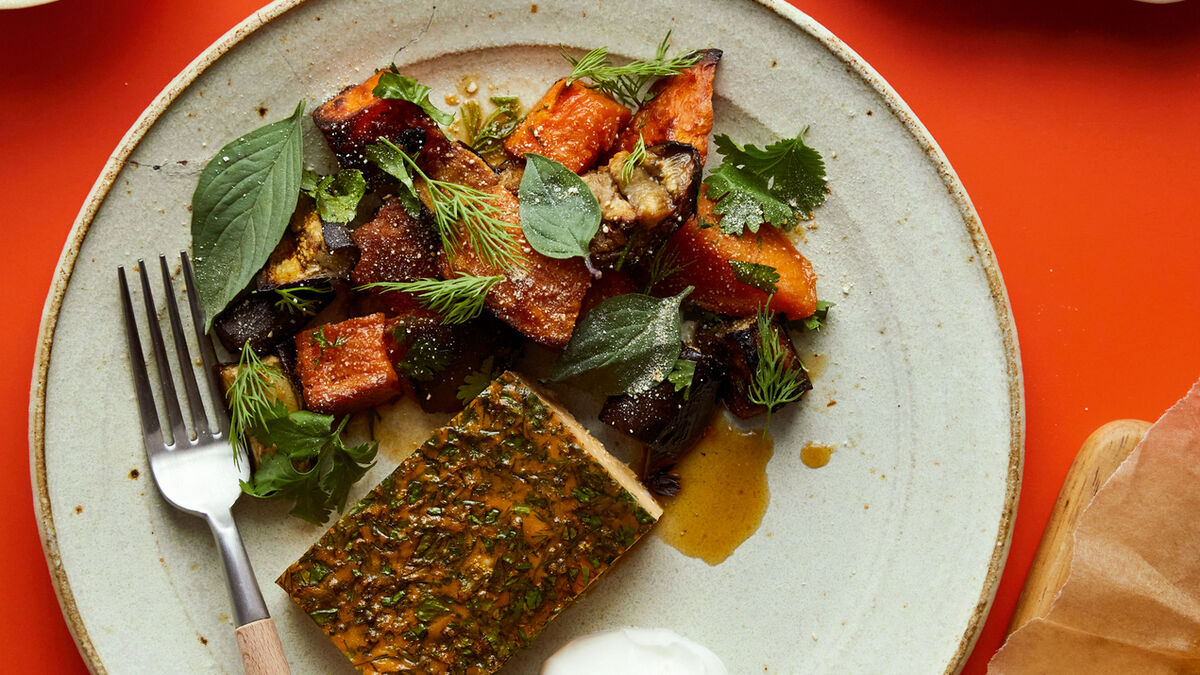
Tray-baked coconut omelette with fragrant salad
Both the omelette and the side salad are fragrant, aromatic and invigorating, according to cook Ed Smith.
Servings
6Preparation Time
15 minsCooking Time
1 hours 10 minsTotal Time
1 hours 25 minsCourse
MainIngredients
3 medium aubergines (about 750g), cut into 2-3cm chunks
3 medium sweet potatoes (about 800g), cut into 3cm chunks
4tbsp olive oil
25g coriander, leaves picked
20g dill, picked
12 large eggs
1⁄2tsp ground turmeric
1⁄2tsp flaky sea salt
1tsp finely grated fresh ginger (about 15g)
200ml coconut milk (70-80% coconut solids)
1tbsp short-grain rice
1tbsp caster sugar
2tbsp fish sauce
Juice of 1 lime
25g Thai basil, leaves picked
Coconut or Greek-style yoghurt, to serve
Method
Heat the oven to 220°C/200°C fan/425°F. Spread the aubergines and sweet potatoes over a baking sheet or roasting tin in which they easily fit in one layer. Drizzle with the olive oil, then shake the tin and roll the vegetables so they’re glossy.
Roast on the top shelf of the oven for 50 minutes until both are soft and slightly charred, shuffling the tin once or twice during that time.
Once the vegetables are in, very, very finely chop two-thirds of the coriander leaves and one-third of the stems, plus two-thirds of the dill. Break the eggs into a mixing bowl, add the turmeric, salt and ginger, then pop the yolks and use a whisk to thoroughly beat them together. Add the coconut milk and chopped herbs and stems, and whisk again until fully combined.
Line a low-sided 20 x 26 centimetre baking tray with greaseproof paper and pour in the egg mixture to a depth of one to two centimetres. Slide onto a shelf underneath the roasting vegetables and cook for around 20 minutes until the middle is set. Remove and set to one side to cool for five minutes or so.
Meanwhile, toast the rice in a dry pan until lightly coloured, then pound to a coarse powder using a pestle and mortar. Separately, in a large mixing bowl thoroughly combine the sugar, fish sauce, lime juice and one tablespoon of water.
Once cooked, tip the roasted vegetables into the bowl. Toss and let the dressing soak in for five minutes before adding the remaining herbs. Transfer to a serving platter and sprinkle generously with rice powder.
Portion the omelette and serve with a pile of the fragrant salad, and big dollops of yoghurt.
Also consider: Serving with flaky, stretchy paratha or roti.
- Good Eggs by Ed Smith is published in hardback by Quadrille. Photography Sam A. Harris. Available now.