Michelle Darmody's foodproof guide to shortcrust pastry
A good shortcrust pastry recipe is very handy to have in your repertoire, particularly if you bake a lot. It can be used to make both sweet and savoury tarts, pies or quiches.
A traditional shortcrust pastry was often made with half lard or shortening and half butter. The butter gave it its richness and the lard added to the texture.
Shortcrust has a crumbly biscuit-like composition compared to the flakiness of puff pastry or the thin brittleness of filo. The addition of sugar to the recipe changes its taste considerably and allows you to use it in more varied ways.
As mentioned butter adds a smooth richness and today most good quality shortcrust is made entirely with butter.
When rubbing it in with your fingertips do so until the mixture resembles breadcrumbs and always use very cold butter diced into small cubes.
Over rubbing at this stage will end in a flaccid pastry that will not crisp up. You want to butter to stay as butter rather than turning to oil. Placing the pastry back in the fridge to cool it after the initial mix will help with this. I often put it back in again after it has been rolled and the tart or pie is assembled.
A hard or tough shortcrust is most likely the result of too much rolling or an indication that too much liquid was added. Do not let these tips scare you off, once you get the flair for it the pastry will not be so daunting; follow the recipe and be light of touch.
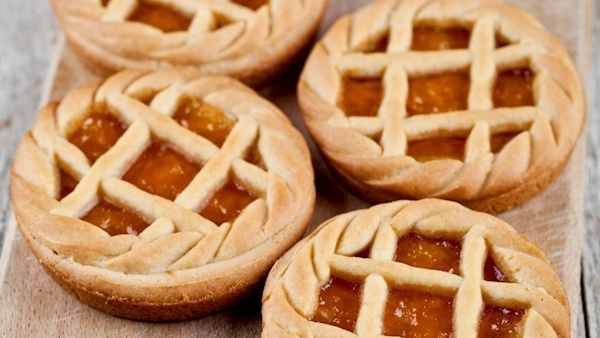
Marmalade and orange blossom tarts
225g flour
1 pinch of ground sea salt
140g cold butter, cubed
55g caster sugar
1 egg, lightly beaten
6 tbs of thin cut marmalade
3 tsp of orange blossom water
3 tsp of orange juice
Mix the flour and salt. Quickly rub in butter until it looks like rough breadcrumbs, do not over mix.
Stir the sugar into the eggs, mix it lightly and add to the flour mixture.
Rest the pastry for at least an hour in the fridge, you can leave it overnight.
Pre heat your oven to 180 and lightly grease your bun tin with a little butter and also sprinkle some flour on to it so that all the butter is covered with a thin layer of flour.
Roll your pastry on a floured surface and cut out 12 circles of about 6 cm across. Cut 12 long strips to make a lattice top.
Mix the marmalade,orange blossom water and orange juice together.
Pop your circles gently into each slot in the bun tin and place about a dessert spoon of marmalade mixture in the center of each one.
Cut your strips so that you have four small ones for each tart. Place the strips across in opposite directions on the top. Turn the edges of the tart in to secure the end of each strip.
Place the tarts in the oven and bake for about 15 minutes until they are turning golden brown.
Carrot and beef turnovers
225g plain flour
1 pinch of salt
150g of cold butter, cubed
1 egg, mixed with cold water until together they measure 25 mls
2 shallots, diced
4 cloves of garlic, finely chopped
1 small potato, diced
3 carrots, diced
180g of minced beef
4 tsp of tabasco sauce
2 tbsp of tomato puree
For egg wash
I egg
½ tbsp of milk
Mix your flour and salt and start to rub in your cubes of butter. You do not want to handle this too much.
Rub the butter quickly until it forms what looks like rough breadcrumbs.
Add your egg and water mix and bring this together with your hand as quickly as you can.
Put the pastry on some baking parchment and wrap it up. Place it in the fridge for at least an hour before using it.
Preheat your oven to 220 degrees and line a flat baking tray with parchment.
While the pastry is resting sauté the shallots until transparent and add the garlic, frying everything for another minute.
Add the diced potato and carrots and stir fry for about five minutes. Add the beef and cook until all the pink is gone.
Add in the tabasco and tomato puree, stir until the beef is cooked through and the potato and carrots have softened. Taste and season. Set aside.
On a lightly floured surface roll your pastry to about three millimetres in thickness. Use a side plate as a template to cut pastry circles.
Beat the egg and milk together lightly. Scoop the mince onto the circles, keeping it all to one side, brush around the edge of each circle with the egg and milk, then fold over and use a fork to seal the edges. Cut two little slits in the top of each turnover. Place onto the flat baking tray and brush the top with the remaining egg and milk.
Bake for about 25 minutes or until golden.
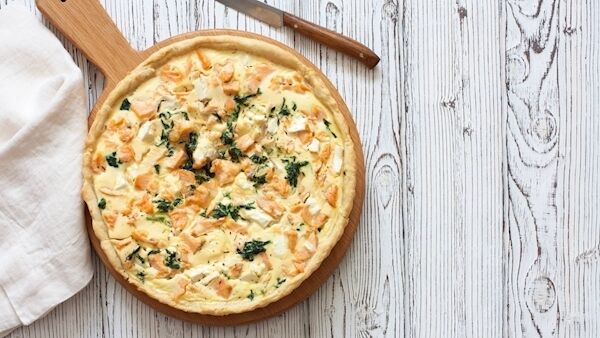
Salmon quiche
225g plain flour
1 pinch of salt
150g of cold butter cubed
1 egg, mixed with cold water until together they measure 25 mls
30g flour
30g butter
210 mls milk
200g of cooked salmon, flaked or you can use tined salmon
Zest of 2 lemons
1 tsp of smooth Dijon mustard
A small handful of baby spinach, chopped
2 eggs, separated
To make the pastry, mix your flour and salt and start to rub in the cubes of butter. You do not want to handle the mixture too much as the resulting pastry will not be as crisp.
Rub the butter quickly until it forms what looks like rough breadcrumbs.
Add your egg and water mix and bring this together with your hand as quickly as you can. Put the pastry on a sheet of baking parchment and wrap it up. Place it in the fridge for at least an hour before using it.
Grease and flour a size loose base tart case, of about 9 inches.
On a lightly floured surface, roll your pastry so that there is a circle bigger than the tart case. Press it slightly with your hand into the case, but do not force it. Bake your case blind, remove it from the oven and allow it to cool slightly in the tin. Trim the edges if needed.
Make a white sauce by melting the butter in a saucepan and adding the flour.
Stir until the mixture forms a smooth paste, cook while stirring continually for about two minutes, start adding the milk slowly, beating vigorously until all of the milk is added and a smooth paste is formed.
Flake the fish and add it into the sauce with the lemon zest, mustard, egg yolks and spinach and mix them all well.
Whisk your egg whites until very stiff and fold them into the sauce.
Pour your mixture into your waiting pastry case and bake in the oven for 15 to 20 minutes, until the filling has risen and is a golden colour on top.