Darina Allen's Weekend Food: The importance of school lunch and some recipes for the weekend

A special day – one more of our little dotes had her hair brushed (no mean feat), donned her school uniform, wore shiny new shoes and a school bag for the very first time. It’s always a bitter sweet moment and an anxious one. She’s really excited now but how will she take to school?
Her big sister and brother will take special care of her so she will hopefully settle in a couple of days…
In the UK and US children are provided with a school lunch, a subject of much controversy. Jamie Oliver did much to highlight the poor quality of the school food in the UK. A few schools do a brilliant job and where extra effort is made, the teachers find a tangible difference in the children’s behaviour and concentration levels in the classrooms.
Some are convinced that this results in happier kids who miss less school days through colds and flus.
One way or another, school lunch is vitally important for children’s health and wellbeing yet it seems to be very low on many governments’ list of priorities. In the US, Alice Waters original Edible School Yard Project in Berkley in California has been an inspiration for many more initiatives across the country and indeed the world.
Each school has a school garden where the children learn how to grow some of their own food, then cook it and sit down at the table with their friends to enjoy the fruits of their labour.
They love the experience, learn lots of skills and get credits for eating school lunch - what’s not to love about that model.
Stephanie Alexander’s Kitchen Garden project is similar and has been rolled out into over 650 schools in Australia and still counting. I have visited both these projects and several others, and have been blown away by the enthusiasm of both children and teachers, as well as the deeply grateful parents.
Most recently at the MAD food Symposium in Copenhagen I attended two sessions on school food given by Dan Giusti who was originally sous chef in Noma (the top restaurant in the world).
After years of feeding 45 or 50 privileged guests a night, he felt the need for a change and yearned to feed more people. So after much thought and consideration, he decided to create a school lunch project called Brigade (www.chefsbrigaid.com), based in a small town in Connecticut called New London where 1 in 4 children are below the poverty line.
Many are certified homeless so the food they eat on Friday at school is most probably the last meal they will eat until the following Monday.
The challenge for Dan and his team on the Brigaid project is not easy. There are 85 pages of government nutritional guidelines, allergies, ethnic preferences and logistics. Plus the budget for each child’s food is $3.31, which must include a glass of milk and cover other expenses so $1.25 in real terms.
In that case one has to let go of deeply held preferences for local sustainable produce and do one’s very best within the restrictions. Dan has gradually changed the system to do ‘from scratch’ cooking and uses plates as opposed to disposable moulded plastic containers.
The kids have become much more engaged and now it will be rolled out in some schools in the South Bronx in New York City, where a million kids get a free school lunch every day. I asked Dan what was the kids’ favourite lunch – he told me barbequed bone-in chicken with warm corn bread and potato salad.
So back to the reality in Ireland – where like everywhere else much depends on the quality of our children’s school lunch. It’s a constant concern and hassle for parents, it needs to be nutritious, delicious and not too nerdy. It’s quite a tight rope to navigate.
If it is too different from the norm, we run the risk of our kids being teased or ridiculed by their friends which may be ‘water off a ducks back’ to parents but can devastate a child and may well result in them skipping lunch altogether. It’s fun to involve older children in making their own packed lunches, many are now becoming very adventurous, hummus, wraps, dips, chunky soups, yoghurts, rice bowls and salad jars are becoming the norm but ham sandwiches are still the favourite so the quality of bread is super important, ditch the processed ham for a piece of thinly sliced home-cooked bacon and a piece of good cheddar. A mixture of nuts or spiced seeds make a delicious nibble, chunks of melon with berries tossed in honey, lemon juice and a shred of mint – delicious.
A little rainbow salad in a jar or hummus pots are easy to transport and eat. A grated carrot and apple salad is another winner and if your child likes avocado, it’s a brilliant option or you might like to try a guacamole dip.
Alternatively, sticks of raw vegetables and a little pot of aioli (garlic mayo) may make an irresistible nibble. A hard-boiled egg is full of protein, a super easy option and also great with a dollop of mayo. When the weather gets a little colder, think how your child would enjoy a warm glass of soup and a little buttered brown scone. One dad who takes his kids foraging on a regular basis, told me how they love to have wild sorrel and sprigs of purslane and pennywort in their salad – how wild and cool is that and super nutritious.
Fortunately their school friends are curious rather than dismissive. Dan Giusti made another observation, when they sliced the apples particularly for younger children, they ate the slices rather than throwing away the apple after taking a bite or two.
Rachel’s Drop Scones
- 110g (4ozs) self-raising flour
- 1 teaspoon baking powder
- 25g (1oz/1/8 cup) caster sugar
- pinch of salt
- 1 egg
- 110ml (4fl ozs/) milk
- drop of sunflower oil, for greasing
Sift the flour and baking powder into a bowl, add the sugar and salt and stir to mix. Make a well in the centre, crack in the egg and whisk, gradually drawing in the flour from the edge. Add the milk gradually, whisking all the time, to form a smooth batter.
Lightly grease a frying pan and warm it over a moderate heat. Drop 3 tablespoons (3 American tablespoons + 3 teaspoons) of the batter into the pan, keeping well apart so they don’t stick together. Cook for about 2 minutes or until bubbles appear on the surface and begin to burst and the drop scones are golden underneath, then flip them over and cook on the other side for a minute or until golden on this side as well.
Remove from the pan and serve warm with butter and jam, apple jelly, lemon curd or if you are like my children, chocolate spread! (If you wish, wrap the drop scones in a clean tea towel to keep warm while you make the rest.)
See-in-the-Dark Soup Carrot and Sweet Potato Soup
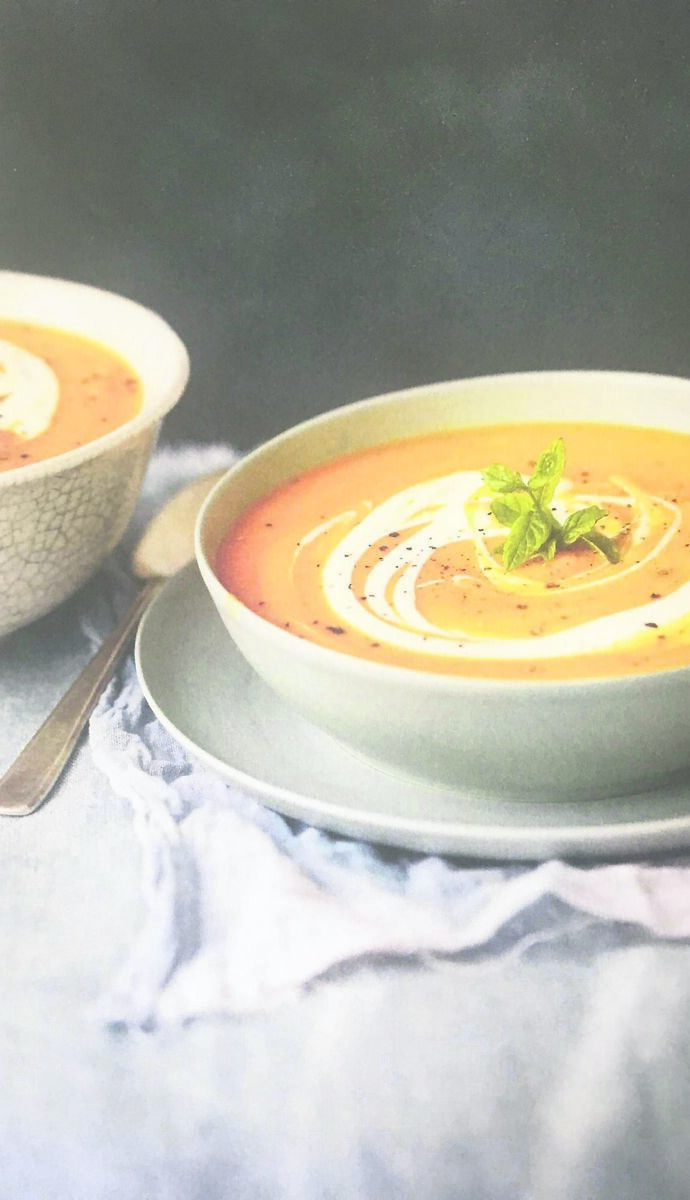
This soup may be served either hot or cold, don’t hesitate to put in a good pinch of sugar, it brings up the flavour.
- 450g (1lb) carrots, preferably organic, chopped
- 45g (1½oz) butter
- 110g (4oz) onion, chopped
- 140g (5oz) potatoes, chopped
- 140g (5oz) sweet potatoes, chopped salt, freshly ground pepper and sugar sprig of spearmint
- 1.1Litre (2 pints) home-made light chicken or vegetable stock
- 62ml (2½fl oz) creamy milk, (optional)
- 3 teaspoons freshly chopped spearmint
- Garnish a little lightly whipped cream or crème fraiche
- Sprigs of spearmint
Melt the butter and when it foams add the chopped vegetables, season with salt and freshly ground pepper and sugar. Add a sprig of mint, cover with a butter paper (to retain the steam) and a tight fitting lid. Leave to sweat gently on a low heat for about 10 minutes approx. Remove the lid, add the stock and boil until the vegetables are soft. Pour the soup into the liquidiser. Add 3 teaspoons of freshly chopped mint, puree until smooth. Add a little creamy milk if necessary. Taste and adjust seasoning
Garnish with a swirl of lightly whipped cream or crème fraiche and a sprig of fresh mint.
Tip: Buy unwashed local carrots whenever possible, they have immeasurably better flavour and keep longer. Heirloom seeds are said to have more vitality and food value than F1 hybrids.
A Little Brown Soda Bread Loaf
The buttermilk in the shops is low fat but if you have access to rich, thick buttermilk, there is no need to add butter or extra cream. This little loaf of brown soda bread is mixed in minutes and then just poured into a tin. A few seeds can be sprinkled over the top or added to the dough for extra nourishment. Why not weigh up x 5 times the amount of flour and salt (but not bread soda). Mix well and each time just scoop out 450g (16oz), add bread soda and buttermilk – mix and pour into the tin.
- 225g (8oz) brown wholemeal flour (preferably stone-ground)
- 225g (8oz) plain white flour
- 1 teaspoon salt
- 1 level teaspoon bread soda (Bicarbonate of Soda/Baking Soda), sieve
- 450ml (16fl oz) buttermilk plus 2 tablespoons cream
- A selection of sesame, pumpkin, sunflower and poppy seeds (optional)
- 1 loaf tin 13x20cm (5x8inch) approx. brushed with sunflower oil
- First preheat the oven to 200°C/400°F/Gas Mark 6
Mix all the dry ingredients together in a large wide bowl, (if using cream, add to the buttermilk). Make a well in the centre and pour all of the buttermilk. Using one hand, stir in a full circle starting in the centre of the bowl working towards the outside of the bowl until all the flour is incorporated. The dough should be soft. When it all comes together, a matter of seconds, turn it into the oiled tin – slide a knife down the centre of the loaf. Sprinkle with a mixture of sesame, sunflower, pumpkin and poppy seeds.
Bake in the preheated oven for 60 minutes approximately.
(In some ovens it is necessary to turn the bread upside down on the baking sheet for 5-10 minutes before the end of baking.) It will sound hollow when tapped. Cool on a wire rack, wrapped in a clean tea-towel while hot if you prefer a softer crust.
One could add 12g (1/2oz) fine oatmeal, 1 egg, and rub in 25g (1oz) butter to the above to make a richer soda bread dough.
Bread should always be cooked in a fully pre-heated oven, but ovens vary enormously so it is necessary to adjust the temperature accordingly.
Flapjacks
These nutritious oatmeal biscuits keep very well in a tin. Children love to munch them with a banana. Don’t compromise — make them with butter, because the flavour is immeasurably better.
This is the recipe that I use when I want to prove to people who swear they can’t boil water that they can cook. We often drizzle them with melted chocolate as an extra treat.
- 350g (12oz) butter
- 1 tablespoon golden syrup
- 1 teaspoon pure vanilla extract
- 225g (8oz) caster sugar
- 450g (1lb) rolled oatmeal (porridge oats)
- Swiss roll tin 25 x 38cm (10 x 15in)
- Preheat the oven to 180°C/350°F/gas mark 4.
Melt the butter, add the golden syrup and vanilla extract, stir in the sugar and oatmeal and mix well. Spread evenly into the Swiss roll tin.
Bake until golden and slightly caramelised, about 30 minutes. Cut into squares while still warm – they will crisp up as they cool.
Variation: Oatmeal and coconut flapjacks
Substitute 50g (2oz) desiccated coconut for 50g (2oz) oatmeal in the above recipe.
Hot tips
- Riot Rye Bakery, Cloughjordan will host the Real Bread Ireland Gathering on Saturday September 22.
Check out www.riotrye.ie for details of courses through the year.
- Also Féile na nÚll Apple Festival, The Sustainable Community Fair, takes place on Saturday September 22. Contact Cloughjordan Ecovillage for more details – see www.thevillage.ie.
It’s a day of talks and discussions, amphitheatre performance, apple pressing, apple pie contest, Ecovillage guided tour, The Little Food Fair and so much more.
A Date for your diary….
We are super excited to welcome Rebecca Sullivan of Granny Skills (www.rebeccasullivan.com.au) who will be speaking at Slow Food East Cork Grandmothers Day at Ballymaloe Cookery School on Sunday September 30.